
Affordable Marketing Strategies for SMBs on a Budget

Budget-Friendly Digital Marketing Strategies for SMBs: Grow More with a Small Budget
Small businesses often juggle tight marketing budgets while expected to deliver measurable growth. The solution is a focused set of low-cost, repeatable tactics that reliably generate leads. This guide lays out AI-enabled, budget-friendly digital marketing approaches that drive traffic, produce qualified leads, and improve return on ad spend without large retainers. We outline high-impact channels and clear workflows, then walk through step-by-step tactics for local SEO, paid media, social content, trust-building content, and KPI-driven budget optimization—calling out South Florida relevance where it helps. Harmony Technologies is a South Florida digital marketing partner that combines real-time AI optimization, predictive modeling, and hyper-local targeting to implement these strategies cost-effectively. Read on for quick-start checklists, low-cost tool playbooks, easy ROI formulas, and actions you can try this quarter.
What Are the Most Affordable Digital Marketing Strategies for Small Businesses?

Affordable digital marketing favors channels that scale with effort, not just spend—owned assets and high-intent local discovery are the priority. In practice, organic search and direct outreach (email, Google Business Profile) compound over time and usually deliver a lower cost-per-lead than broad paid campaigns when optimized. This section lists the highest-priority strategies for SMBs, explains why each fits tight budgets, and gives a quick-start checklist for allocating limited time and a small monthly spend. Following that, we cover SEO moves that turn unmanaged traffic into leads and compare free and low-cost tools you can deploy right away.
Here are six high-ROI, low-cost strategies SMBs should prioritize:
- Local search optimization—focus on Google Business Profile and neighborhood keywords to capture intent-driven traffic.
- Email marketing with automated welcome and nurture sequences to convert site visitors into customers.
- Content repurposing—turn one blog post into social clips, FAQs, and email sequences to extend effort.
- Organic social with short-form video and user-generated content to build trust without large ad budgets.
- Performance-focused micro-paid campaigns (geo-targeted) using AI-assisted bidding to control costs.
- Analytics-driven budget reallocation using a few simple KPIs to double down on the most efficient channels.
These channels work together: local visibility feeds low-cost leads, email nurtures prospects into customers, and small paid tests scale what already performs. The next section covers practical SEO quick wins that convert traffic into measurable leads.
How Can SEO Drive Cost-Effective Traffic and Leads for SMBs?
SEO produces cost-effective traffic by matching content to buyer intent and capturing long-tail and local queries competitors often miss. On-page tweaks—title and meta updates, local business schema, and focused landing pages—help convert searchers into leads with minimal recurring cost. A practical quick-win plan is to:
- Identify 10 high-intent local keywords
- Optimize 2–3 landing pages with clear calls to action
- Add structured FAQ content to capture featured snippets and voice queries
These steps increase qualified traffic and lower cost per lead because organic clicks replace paid acquisition for repeat intent searches.
Start with a short technical audit to fix crawl and mobile issues, then track conversions with a simple form or call-tracking number to measure lift. The next subsection provides a compact tool list of free and low-cost options to execute this SEO roadmap efficiently.
Which Free and Low-Cost Digital Marketing Tools Can SMBs Use?
Below is a compact comparison of free and low-cost tools across SEO, content, social, and analytics so small teams can assemble a practical toolchain without large subscriptions. The table shows each tool’s core features and the best use case for a small marketing team or solo owner. After the table, we outline example workflows that combine these tools into efficient processes and show how to scale from free tiers to paid plans as results justify spend.
This toolset lets an SMB run recurring campaigns for minimal monthly fees by pairing free audits, an AI assistant for content drafts, inexpensive scheduling, and basic email CRM. Next, we explain how to apply AI specifically to local SEO for South Florida businesses.
How Can AI-Powered Local SEO Boost Visibility for South Florida SMBs on a Budget?

AI-powered local SEO uses automation and pattern recognition to find micro-geographic intent, tidy up your Google Business Profile, and scale citation consistency—tasks that otherwise take a lot of manual work. The process is straightforward: AI analyzes query patterns and competitor signals to recommend neighborhood keyword targets, suggested GBP content, and the highest-impact citation fixes first. You get faster local ranking improvements, draft responses for reviews, and more accurate service-area targeting without ballooning hourly costs. The following sections detail the GBP tasks AI can handle and show how to pull neighborhood-level keywords affordably.
What Are the Best Practices for Google Business Profile Optimization Using AI?
Optimizing Google Business Profile with AI combines structured-data hygiene and content automation to boost local visibility and conversions. AI can draft concise, keyword-rich business descriptions, suggest the best service categories, and create GBP posts that match trending local queries so your profile answers searcher intent. Practical steps include verifying categories, uploading geo-tagged photos with AI-assisted captions, and automating suggested review responses to keep engagement timely.
Measure success by tracking GBP views, search queries, calls, and direction requests to confirm optimizations drive offline actions.
Using AI for routine GBP tasks lowers recurring labor while preserving local relevance, letting you reallocate time to customer service and in-person experience. The next section explains how AI finds hyper-local keywords and automates citation management across directories.
How Does AI Help with Hyper-Local Keyword Research and Citation Building?
AI surfaces neighborhood-level queries by analyzing local search patterns, nearby points of interest, and long-tail phrases that signal purchase intent at the street or neighborhood level. Typically you feed location seeds into an AI prompt or tool to generate micro-keyword lists (for example: service + neighborhood). Citation work uses automated discovery to find relevant local directories, then standardizes NAP data across listings to avoid duplicates and inconsistent entries. Automating these steps reduces manual submission time and prevents ranking drops from citation errors.
A simple workflow is:
- Run AI-based keyword extraction
- Prioritize terms by purchase intent
- Update local landing pages
- Use an automated citation manager to push consistent NAP data
This sequence preserves local relevance with lower recurring cost and faster execution.
How Can SMBs Maximize ROI with AI-Driven Paid Media on a Limited Budget?
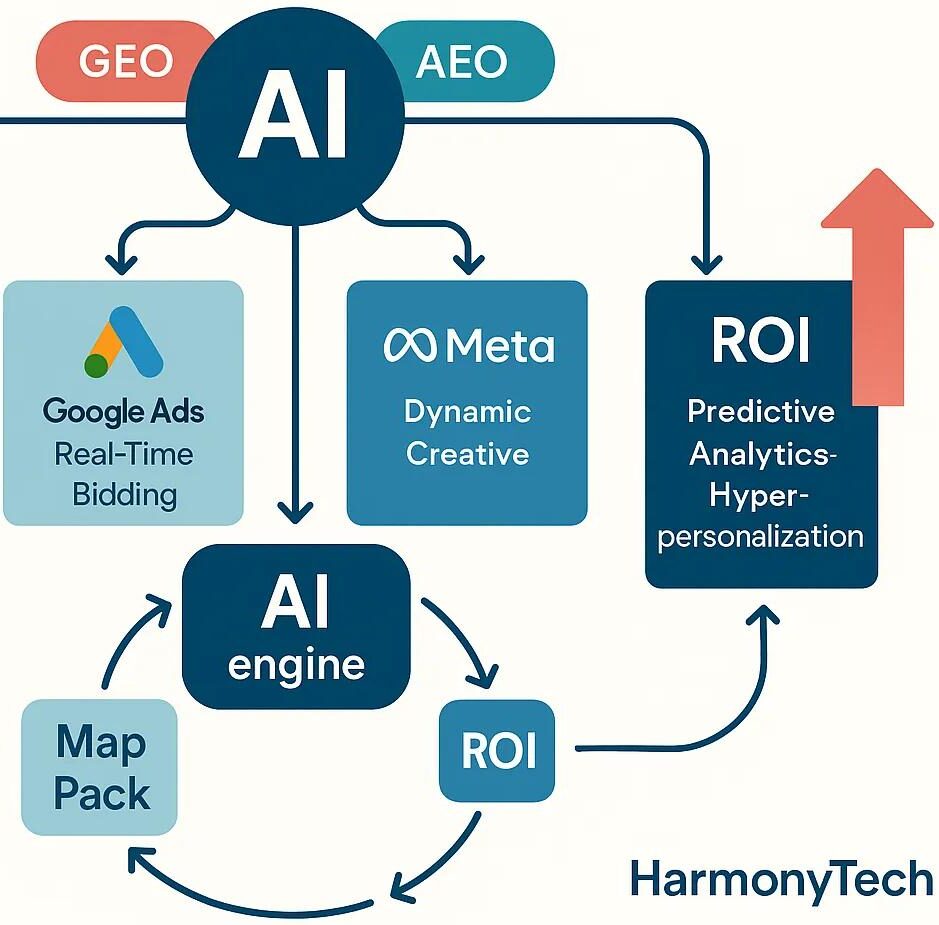
AI improves paid media efficiency by automating audience segmentation, creative testing, and bid management—reducing wasted spend and getting more from small budgets. Predictive models shift budget toward the audiences, times, and creative variants most likely to convert. For SMBs, the playbook emphasizes micro-targeted campaigns, tight conversion windows, and automated creative rotation to squeeze maximum value from modest daily budgets. Below are tactical recommendations and a comparison table of AI-driven paid-media tactics with expected cost/effort and ROI impact.
Start with small geo-targeted tests, measure CPA precisely, and only scale budgets on proven segments; AI flags winners and pauses losers automatically. The following sections cover concrete strategies for Google and social ads, then detail real-time bid optimization rules.
This comparison helps SMBs match tactics to budget: prioritize geo-targeted search ads and smart bidding first, then add AI creative testing as volume grows. The next subsection provides setup steps and budget thresholds for common platforms.
What Are Cost-Effective AI Strategies for Google Ads and Social Media Ads?
Cost-effective AI strategies for Google and social combine narrow audience targeting, responsive ad formats, and automated creative rotation to reduce testing costs. Practical setup steps: create responsive search and dynamic social formats, enable smart bidding focused on conversions, and start with small daily budgets aimed at South Florida micro-areas.
On social, seed lookalike audiences from your best customers and reuse top organic posts as ad creative to cut production expense. The expected result is faster signal accumulation for AI and a lower cost per conversion once the system finds winning variants.
Begin with a test budget that’s 5–10% of your total marketing spend, measure CPA, and let AI models optimize; this limits risk while giving models enough data to learn. The next section covers real-time bid management specifics and an example rule set to save ad dollars.
How Does AI Optimize Real-Time Bid Management to Save Advertising Dollars?
AI bid management adjusts bids in real time using signals like device, location, time, and behavior to avoid overspending on low-value impressions. Predictive models lower bids when conversion probability drops and raise bids for high-probability segments; pacing algorithms stop budgets from exhausting early in the day.
Example rules: cut bids during low-conversion hours, shift budget to top-performing ad groups automatically, and pause segments with persistently high CPA. These optimizations typically lower CPA and improve ROAS when models are trained on accurate conversion data.
A practical safeguard is incremental reallocations—move 10–20% of budget at a time on AI recommendations to validate changes before larger shifts. Below is a short example of how a South Florida SMB might apply AI-driven reallocations in practice, followed by how an AI-first provider implements the tactics.
Harmony Technologies applies real-time AI optimization and predictive reallocation to limit wasted ad spend and scale winning segments, focusing on hyper-local audiences and creative variants that generate measurable leads. Our approach emphasizes precise conversion tracking and automated rule sets that reallocate budget quickly when ROI improves, helping small advertisers get more leads from modest monthly spend.
What Are Cost-Effective AI Social Media Marketing Strategies for Small Businesses?
AI social strategies cut content production costs and increase posting velocity through automated idea generation, caption drafts, and short video scripting. The workflow uses prompt-based content creation, template captions, and batch generation followed by scheduled publication. Benefits include a steady social presence, more content variants to test, and lower per-post cost. This section covers how to generate engaging social content cheaply and which scheduling and engagement tools to prioritize for small teams.
Below are best-practice principles for low-cost, AI-assisted social programs that keep engagement high on limited resources.
- Batch-generate captions and creative briefs to reduce per-post time.
- Repurpose one long-form asset into multiple short clips, images, and captions.
- Use light editing tools and scheduling to maintain a steady publishing cadence.
These steps create a repeatable loop: generate, schedule, measure, and reuse top performers. The next section gives prompt frameworks and a short sample video script.
How Can AI Generate Engaging Social Media Content on a Budget?
AI can create captions, image concepts, and 30–60 second video scripts from a few bullets, letting SMBs batch-produce a month of content in hours instead of days. A simple prompt asks for brand voice, target audience, objective, and format—AI returns caption variants and short scripts ready for human polish.
Example prompts request three caption tones, two short video hooks, and one CTA variant per post. Savings come from less creative time and reduced reliance on outside producers, enabling frequent testing that reveals high-engagement formats fast.
Batch-generation plus a human edit preserves brand authenticity while keeping costs low. The next subsection lists scheduling and engagement tools that automate publishing and streamline community response.

What Are the Best AI Tools for Scheduling and Maximizing Social Media Engagement?
Tool choice depends on needed automation and budget—prioritize platforms with queueing, basic analytics, and engagement triggers on low-cost plans. A compact comparison helps you decide which tools to start with, balancing automation and affordability for small teams.
Recommended workflows: schedule a month of posts, set alerts for brand mentions, and link high-performing posts back to lead-capture landing pages. Connect social analytics to a simple dashboard so your team knows which formats to boost with minimal spend.
Use automation sparingly: schedule and monitor, but keep human responses for higher-value interactions to protect authenticity and trust.
How Can SMBs Build Trust and Brand Authority with AI-Enhanced Content Marketing?
AI speeds ideation, drafting, and SEO optimization so SMBs can publish useful content without large teams. The process: AI identifies topic clusters from search intent, creates optimized outlines, and suggests on-page improvements while humans validate accuracy and voice. High-value trust content includes local case snapshots, practical how-tos, and FAQs that answer buyer questions and remove friction. This section explains workflows from idea to distribution and how AI-informed content multiplies through repurposing.
Next, we cover practical steps for using AI to generate blog ideas and measure performance so you can iterate on the content that builds authority most effectively.
How Does AI Help Generate Blog Ideas and Optimize Content Performance?
AI speeds topic discovery by spotting keyword gaps, analyzing competitor content, and identifying local intent signals to produce prioritized topic lists with suggested headings and meta descriptions. The workflow: keyword discovery, outline generation, draft creation, on-page SEO, and performance monitoring—each step accelerated by tools.
A/B test headlines and lead magnets, then track traffic, time on page, and conversions to decide which pieces to repurpose into social clips or email sequences. Iteration based on performance ensures content investment compounds over time instead of producing one-off posts that don’t convert.
Editorial oversight keeps content trustworthy and on-brand while AI handles scale and optimization tasks.
What Types of Budget-Friendly Content Build Leads and Customer Loyalty?
Low-cost content that consistently generates leads includes:
- Email sequences
- Downloadable checklists
- Local guides
- Short how-to videos
- Compact case studies that highlight outcomes
These formats solve customer problems directly, shorten the decision process, and are easy to repurpose. Production workflows often pair a short recording session with AI transcription and editing to create multiple assets from one input. Prioritize lead magnets tied to high-intent queries and follow up with automated nurture emails to turn interest into bookings.
This content mix delivers both immediate lead flow and long-term authority, helping SMBs capture and convert local demand efficiently.
How Can SMBs Measure Success and Optimize Their Marketing Budget Using AI Analytics?
AI analytics helps SMBs measure performance and reallocate budgets by forecasting outcomes, attributing conversions, and suggesting small reallocations that raise overall ROI. The core approach is model-driven forecasting combined with straightforward attribution rules tailored for small datasets. Track KPIs such as traffic, leads, CPA, conversion rate, and customer lifetime value, using simple formulas and benchmarks to guide decisions. The section below presents a KPI table with definitions and targets, then explains how predictive allocation works in practice with safe reallocation rules.
What Key Performance Indicators Should SMBs Track for Digital Marketing ROI?
Focus on a concise KPI set that links marketing activity to business results: traffic sources, qualified leads, cost per acquisition (CPA), conversion rate, and lifetime value (LTV). Simple formulas: CPA = total ad spend ÷ acquisitions, Conversion Rate = conversions ÷ sessions, LTV = average purchase value × purchase frequency × customer lifespan. Benchmarks vary by industry and channel, so track relative month-over-month improvements and compare paid vs organic CPA to guide allocation. Report weekly for paid campaigns and monthly for organic initiatives to balance speed with stability.
This KPI set is the minimum reporting backbone for reallocating budget intelligently; the next section covers predictive allocation workflows.
How Does AI Predict and Allocate Marketing Spend for Maximum Efficiency?
Predictive allocation uses recent performance and short-term trend signals to recommend reallocations that maximize expected return while keeping experiments controlled.
The workflow is:
- Collect recent channel performance
- Run a simple predictive model to estimate marginal ROI per dollar
- Reallocate a small test amount (e.g., 10–20%) from low-return channels to high-return channels
- Measure the actual lift before making broader changes
Choose an attribution model (last-click, data-driven) that reflects your business and test for consistency. Safeguards include caps on reallocation and A/B testing of new mixes to avoid large swings from noisy signals.
Small, iterative reallocations based on AI recommendations reduce risk and accelerate learning for SMBs with limited budgets while improving long-term efficiency. For hands-on help, a local AI-first partner can run an initial audit and pilot reallocations.
Harmony Technologies provides budget-friendly AI audits and implementation plans that focus on lowering CPA and increasing leads through predictive allocation, automated reporting, and targeted local campaigns. We pair AI analytics with practical safeguards so small businesses can test recommended shifts in modest increments and scale what produces measurable ROI.
Frequently Asked Questions
What are the key benefits of using AI in digital marketing for SMBs?
AI automates repetitive tasks, improves ad spend efficiency, and surfaces data-driven insights—so small teams can do more with less. It helps with audience segmentation, predictive analytics, and real-time bid management, and it speeds content production and scheduling. For SMBs on tight budgets, AI reduces manual work and lets you focus on customer-facing priorities.
How can SMBs effectively measure the success of their digital marketing strategies?
Measure success with a concise KPI set: traffic sources, conversion rate, CPA, and LTV. Regular tracking—weekly for paid, monthly for organic—lets you spot trends and reallocate budget where it performs best. Use tools like Google Analytics for behavior insights and a CRM to tie leads to outcomes so marketing decisions map to real revenue.
What role does content marketing play in building customer loyalty for SMBs?
Content builds loyalty by answering customer questions and solving problems. Practical formats—how-tos, local guides, short case studies—position your business as a helpful authority. Good content shortens the decision process and encourages repeat visits, which supports longer-term customer relationships.
How can SMBs utilize social media to enhance their digital marketing efforts?
Use social to engage your audience, share useful content, and showcase real customers. Prioritize short, native formats and repost user-generated content. With scheduling and analytics, you can test formats quickly; with thoughtful responses, you keep authenticity high and build trust.
What are some common pitfalls SMBs should avoid in digital marketing?
Avoid skipping data analysis, running unfocused campaigns, and underinvesting in SEO. Without clear goals and measurement, you risk wasting resources on tactics that don’t move the business. Prioritize tracking, define measurable objectives, and keep SEO on the roadmap to maintain visibility.
How can SMBs ensure their digital marketing strategies remain cost-effective?
Stay cost-effective by focusing on high-ROI tactics: local SEO, email nurture, and content repurposing. Use free or low-cost tools to prove concepts, review performance regularly, and reallocate budget to what works. Leverage AI for automation and optimization—but keep human oversight to protect brand voice and customer experience.
Conclusion
Budget-friendly digital marketing is practical and effective when you combine focused tactics, simple measurement, and modest AI support. By optimizing local SEO, leveraging email and repurposed content, and using AI to stretch ad dollars, small businesses can win measurable growth without overspending. If you’d like help applying these steps locally, our team at Harmony Technologies can build a small-step plan to improve leads and lower CPA this quarter.
No Responses