
Expert AI Digital Marketing Services in Palm Beach County

AI Digital Marketing Services in Palm Beach County, Florida: How HarmonyTech Helps Local Businesses Grow
AI digital marketing combines machine learning, predictive analytics, and generative tools to automate targeting, personalize messaging, and produce clearer, measurable results for local businesses. These systems use first‑party data, location signals, and competitive context to predict which prospects are most likely to convert and to surface nearby businesses inside AI‑powered search and generative platforms. For Palm Beach County owners, AI‑informed local SEO, paid media, and social strategies translate to stronger Google Business Profile presence, higher‑quality leads, and more efficient ad spend—making AI a practical lever for growth. This guide shows what AI digital marketing looks like in practice, how it improves paid, earned, and social channels, and why Generative Engine Optimization (GEO) and Answer Engine Optimization (AEO) matter for South Florida visibility. After practical steps and examples, we explain how HarmonyTech—a Palm Beach County information hub and lead‑generation partner—applies these tactics locally and how to reach us for tailored AI marketing solutions by email or phone. Later sections dive into channel‑specific AI mechanics, GEO tactics for generative search, paid media automation, social optimization, local case examples, and common owner questions about putting AI to work.
What Are AI Digital Marketing Services and Why Do Palm Beach Businesses Need Them?
AI digital marketing services are systems that combine machine learning, natural language models, and automation to tighten audience targeting, tailor creative, and improve forecasting. Using predictive analytics and automated creative, AI reduces wasted ad spend and surfaces locally relevant content to nearby customers—a real advantage in Palm Beach County, where hyper‑local intent often drives foot traffic and bookings. Unlike one‑time campaigns, AI systems learn from outcomes, adjust bids and messaging in real time, and optimize for generative platforms that synthesize answers instead of only ranking pages. Below we outline channel upgrades and the measurable benefits local businesses can expect when they move to an AI‑first approach.
How Does AI Improve Paid, Earned, and Social Media Marketing?

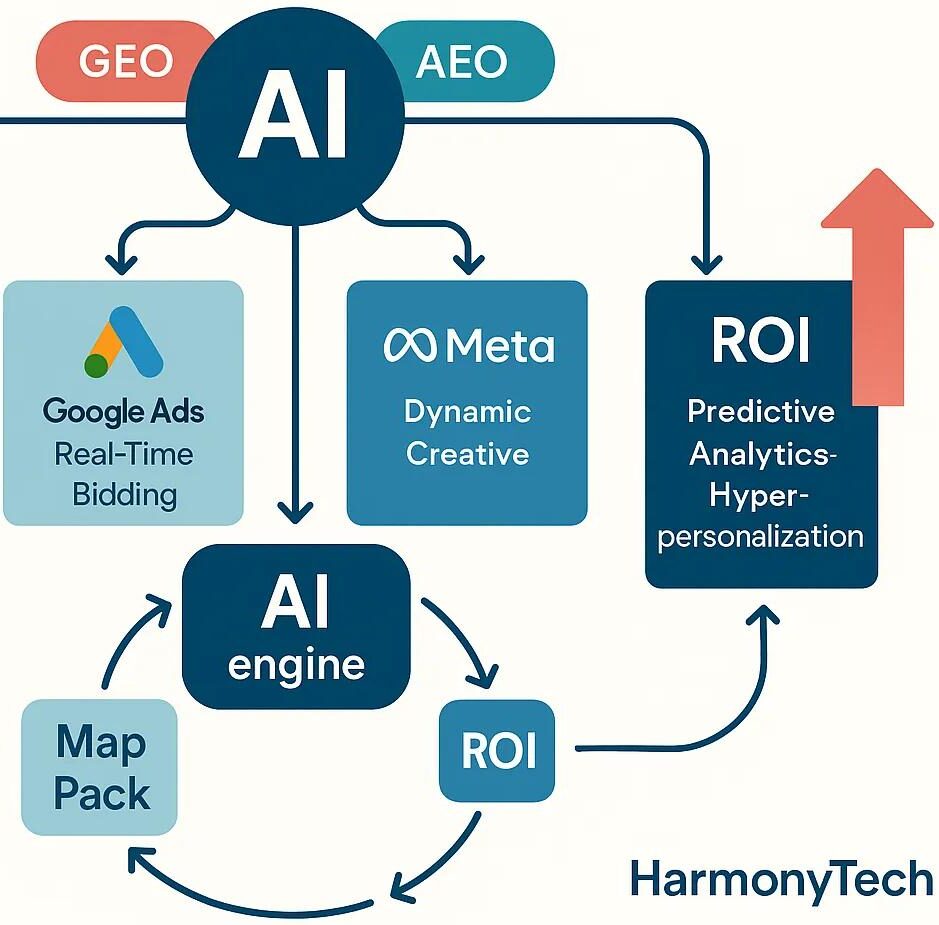
AI enhances paid, earned, and social strategies by applying tailored algorithms to each channel’s needs, improving conversion chances and clarifying ROI. In paid media, predictive bidding estimates conversion likelihood and shifts budget toward higher‑value impressions, lowering CPA while retaining scale. For earned media and PR, AI helps score outreach opportunities and select influencers or placements with topical authority. On social platforms, trend detection and sentiment analysis enable timely, locally relevant creative that resonates with Palm Beach County audiences and increases engagement.
- Paid Media: Predictive bidding, automated budget allocation, and dynamic creative personalization.
- Earned Media: Automated outreach scoring, content optimization for topical authority, and media monitoring.
- Social: Trend detection, sentiment‑informed messaging, and micro‑targeted content delivery.
These improvements feed each other—paid signals inform earned outreach, social amplifies what’s working—and the next section explains the direct benefits local businesses should expect.
What Benefits Can Local Businesses Expect from AI-Driven Marketing?
AI‑driven marketing delivers measurable improvements in lead quality, cost efficiency, and local visibility through targeted optimization and automation. Predictive models prioritize high‑intent prospects, increasing conversion rates and lowering cost per acquisition; personalization deepens engagement and repeat visits for businesses that rely on local traffic. Optimizing Google Business Profile content and creating prompt‑ready, geo‑specific snippets boosts visibility in answer engines and conversational search, helping Palm Beach County businesses get found more often. The table below summarizes typical impacts of AI across Paid, Earned, and Social.
Common outcomes include lead growth, reduced ad waste, and stronger search visibility—each driven by ongoing model refinement and local signals.
These channel effects often compound. For example, paid campaigns can surface creative that becomes the basis for earned placements and social amplification, strengthening local brand signals and producing compound returns.
How Does HarmonyTech Implement AI-Driven Local SEO in Palm Beach County?
We take an AI‑first approach to local SEO, concentrating on Google Business Profile optimization, geo‑targeted content, and technical schema to improve local pack rankings and visibility in generative answer engines. Implementation begins with an AI‑assisted audit to reveal gaps in GBP signals, citation consistency, and content that matches local intent. From there we produce structured, generative‑ready content and set up ongoing monitoring. By combining strong entity signals with concise snippets and FAQ markup, we help Palm Beach businesses appear in conversational results and searches that drive nearby traffic. Below is a concise process overview followed by a practical comparison of core SEO tactics, tools, and outcomes.
Our local SEO workflow pairs automated keyword clustering with human editorial review to preserve accuracy and local nuance—supporting long‑term AEO and GEO performance across South Florida businesses.
What Is Google Business Profile Optimization with AI?
Google Business Profile optimization with AI pairs automated content generation, sentiment analysis, and posting cadence guidance to strengthen local signals and boost local pack visibility. AI uncovers common review themes and competitor GBP attributes, prioritizes the most impactful fields, and crafts short, factual posts that align with searcher intent; reply templates are ranked by likely impact and personalized to stay authentic. We also add structured Q&A and FAQ schema so both traditional search and generative platforms can cite the business as an authority. These steps create a consistent local presence that supports GEO and AEO strategies described below.
This GBP work naturally leads into deeper local keyword research and geo‑targeted content that reflect neighborhood search behavior.
How Does AI Enhance Local Keyword Research and Geo-Targeting?
AI improves local keyword research by clustering queries by intent, geography, and conversion likelihood, helping teams prioritize pages for specific neighborhoods, shopping districts, and service areas in Palm Beach County. Models analyze search patterns and competitor SERP cues to surface geo‑modified long‑tail terms that attract qualified traffic, then recommend content mapping so each local landing page targets a clear intent cluster. Geo‑targeting extends to ad location bid adjustments and GBP keyword alignment, keeping messaging consistent across paid and organic touchpoints. That reduces keyword cannibalization and boosts the localized relevance that AEO and GEO systems reward in generative responses.
Those keyword clusters feed generative‑ready content—brief, factual snippets and schema—that make it easy for AI assistants to cite your business in local queries.
What Is Generative Engine Optimization and How Does It Boost AI Search Visibility in Florida?
Generative Engine Optimization (GEO) is about structuring content, prompts, and knowledge signals so generative AI platforms and chat‑based search tools can reliably surface your business. GEO differs from classic SEO by favoring concise, factual snippets, clear Q&A, and strong entity signals rather than relying solely on long‑form ranking factors. The goal is sourceable, prompt‑ready content—snippets, schema, and clean entity data—that generative models can ingest and cite when answering questions about services, hours, or local recommendations. For Florida businesses, GEO improves the chances of appearing in the conversational interfaces customers increasingly use to plan visits or find local options.
Here are tactical steps to make content prompt‑ready and favorable for generative engines.
- Create concise, factual snippets: 1–2 sentence answers to common local questions.
- Use structured data and Q&A blocks: Make content machine‑readable for sourcing.
- Maintain consistent entity signals: GBP fields, NAP consistency, and schema help models verify locality.
How Does GEO Optimize Content for AI Chatbots and Generative Platforms?
GEO optimizes content by producing short, authoritative answers to likely prompts, adding schema and FAQ markup, and making entity signals (business name, location cues, services) explicit and consistent. Chatbot‑friendly content favors clarity and sourceability: brief, verifiable statements a model can quote. For Palm Beach County searches, embedding neighborhood names and service specifics in these snippets increases the chance a generative engine will select your content. Pairing snippets with GBP updates and structured data creates corroborating signals across platforms.
Optimizing for GEO requires iterative prompt testing to see which snippets generative engines actually surface—an effort that leads naturally into prompt engineering.
What Role Does AI Prompt Engineering Play in GEO?
Prompt engineering shapes how models interpret and rank your content by designing queries that mirror user intent and testing which content fragments the model treats as authoritative. Prompt engineers collaborate with content teams to build question‑answer pairs and refine phrasing, length, and factual emphasis so generative engines favor specific business snippets. Testing simulates common local queries and iterates until the model consistently cites the business’s statements. This loop keeps content resilient across model updates and supports AEO by aligning human phrasing with machine retrieval behavior.
Prompt engineering feeds back into content and GBP updates, creating a continuous refinement cycle for snippets and schema across local pages.
How Can AI-Powered Paid Media Management Maximize ROI for Palm Beach Businesses?
AI‑powered paid media management blends predictive modeling, automated bidding, and dynamic creative to direct budget toward audiences and placements with the highest projected conversion probability. The system forecasts conversion likelihood from signals such as user behavior, location, time of day, and first‑party CRM data, tuning bids and budgets in real time to reduce CPA while maintaining reach. For Palm Beach businesses, this means more efficient local targeting—focusing spend on nearby prospects or high‑intent search contexts—so ad dollars produce measurable foot traffic and inquiries. Below we summarize key strategies and show typical inputs and impacts.
Deploying predictive bidding and dynamic creative requires the right data integrations and a testing framework, which we outline in the sections that follow.
What Are Predictive Bidding Strategies in AI Advertising?
Predictive bidding uses models to estimate an impression’s conversion probability and set bids based on expected value rather than fixed CPC targets. Inputs include first‑party conversion history, device and contextual signals, proximity to service areas, and time‑of‑day patterns; models then reallocate budget to auctions with the highest expected return. Results typically include lower average CPA, steadier budget pacing, and easier campaign scaling without constant manual tweaks. Predictive bidding performs best when fed reliable local data and monitored against clear KPIs.
Those bidding gains also create room for dynamic creative to improve relevance, which we cover next.
How Does AI Dynamically Generate Personalized Ad Copy?
AI produces personalized ad copy by combining templates with live audience signals—recent search queries, location, past interactions, and segmentation attributes. The system generates multiple variants with localized offers, neighborhood references, and benefit‑focused hooks, then tests them automatically to surface top performers. Continuous A/B testing and model‑driven prioritization give higher delivery to strong variants while retiring weaker ones. For Palm Beach campaigns, dynamic copy can reference nearby landmarks or seasonal events to create urgency and relevance.
Dynamic creative and predictive bidding operate as a feedback loop that learns which local messages convert, making paid spend more accountable and aligned with business goals.
How Does AI Enhance Social Media Marketing for South Florida Businesses?
AI strengthens social media marketing by optimizing post timing, analyzing sentiment to shape messaging, and identifying local influencers who drive authentic engagement across Palm Beach County communities. Predicting peak engagement windows and matching content formats increases reach, while sentiment analysis helps teams lean into positive moments or address reputational issues quickly. Influencer‑scoring models prioritize creators with real local relevance, helping brands form partnerships that resonate with neighborhood audiences. These capabilities turn social interactions into measurable visits, bookings, and leads.
Below are specific AI‑driven tactics social teams can use to build local traction and engagement.
- Automated scheduling: Predict peak local engagement windows and post accordingly.
- Sentiment-driven messaging: Use sentiment trends to refine tone and responses.
- Influencer scoring: Prioritize micro‑influencers with strong local resonance.
What Is AI Content Scheduling and Sentiment Analysis?
AI content scheduling uses historical engagement and audience behavior to recommend optimal post times and formats, while sentiment analysis classifies audience reactions to guide tone and escalation rules. Tools predict when local followers are most active and which creative types—video, reels, or carousels—will likely perform best. Sentiment tracking flags shifts in perception so teams can pivot messaging, pre‑approve responses, or engage directly with concerned users. Together, scheduling and sentiment insights keep content timely and aligned with community expectations.
These insights also sharpen influencer outreach and selection, improving the signal‑to‑noise ratio when choosing partners.
How Does AI Identify Influencers and Boost Engagement?
AI finds influencers by scoring relevance, engagement authenticity, and local audience overlap, producing ranked creator lists for campaigns focused on Palm Beach neighborhoods and verticals. Models assess follower demographics, topical alignment, and past campaign performance so marketers can select micro‑influencers who deliver higher local engagement at lower cost. AI also measures post‑level lift and conversion signals, linking influencer activity to outcomes like website visits or bookings. This data‑driven approach improves ROI and deepens community ties through authentic endorsements.
Influencer partnerships often become a steady source of earned visibility that complements paid and organic GEO efforts.
What Success Stories Demonstrate the Impact of AI Marketing in Palm Beach County?
Local success stories typically follow a Problem → AI Solution → Results structure and show clear uplifts in leads, conversion rate, and efficiency when AI is implemented correctly. Service businesses often see more qualified calls from predictive bidding and GBP work, while retail clients report stronger foot traffic from GEO‑optimized snippets and targeted social pushes. HarmonyTech aggregates outcome ranges from client work and can share permissioned case studies on request. These stories give business owners a practical sense of what to expect when AI ties together paid, earned, and social channels.
How Have Local Businesses Increased Leads and ROI with HarmonyTech’s AI Solutions?
Across Palm Beach County engagements, our mix of GBP optimization, GEO‑aware content, and predictive paid media has driven higher‑quality leads and more efficient ad spend. Typical outcomes include more qualified inquiries, lower CPA, and better alignment between organic visibility and paid campaigns—achieved through iterative model training and local signal integration. We position these services as a local lead‑generation and information‑hub partnership for South Florida businesses and invite owners to contact us by phone or email to discuss tailored results and view permissioned case studies. This partnership approach delivers measurable growth while keeping explanations about the underlying AI straightforward and transparent.
Those client improvements lead naturally into industry‑specific applications that clarify which tactics work best by sector.
What Industry-Specific Examples Showcase AI Marketing Benefits?
Different industries see different wins from AI: retailers benefit from GEO and personalized ads for neighborhood promotions, service providers gain efficiency from predictive bidding and lead scoring, and hospitality brands combine local SEO with social offers to lift bookings. Retailers use dynamic creative to promote nearby deals, service firms deploy chatbots and automation to capture qualified leads quickly, and hospitality focuses on reputation signals and localized content to manage seasonal demand. Each example ties specific AI tools to KPIs like conversion lift or booking rate improvement.
These patterns help owners decide which AI capabilities to adopt first based on immediate objectives and internal capacity.
What Are the Most Common Questions About AI Digital Marketing Services in Palm Beach?
Owners frequently ask how AI improves segmentation, where ad spend is saved, and which tools are best for local use. AI sharpens segmentation by using behavioral and demographic signals to build micro‑audiences that receive tailored messages, reducing wasted impressions and improving conversions. Predictive analytics forecast campaign outcomes and enable automated budget shifts for measurable efficiency. When choosing tools, prioritize platforms that integrate with Google Business Profile, protect first‑party data, and support GEO/AEO workflows. The list below outlines practical first steps and the tool categories to prioritize.
- Audit local signals: Start with GBP, citations, and local landing page health.
- Prioritize data integration: Ensure CRM and conversion data feed predictive models.
- Test incrementally: Run predictive bidding and dynamic creative in controlled campaigns.
These steps provide a measured path to adopting AI while keeping control and measurement intact.
How Does AI Improve Marketing Strategies for Florida Businesses?
AI improves Florida marketing by enabling hyper‑local personalization, predicting seasonal and event‑driven demand, and automating routine optimizations so teams can focus on strategy instead of manual tuning. Models combine local search trends, weather and event calendars, and first‑party conversion histories to surface the most promising audiences and message variants. That leads to higher engagement, better conversion rates, and smarter allocation of marketing budgets—especially useful in a market shaped by tourism cycles and local events. Aligned with clear business goals, AI delivers incremental improvements that compound over time.
Deciding which AI capabilities to deploy first depends on business goals and available data; the next section helps prioritize those choices.
What AI Marketing Tools Are Best for Local Businesses in Palm Beach County?
Local businesses should evaluate tool categories—paid media automation, GEO/AEO content tools, social analytics, and CRM integrations—against criteria like data privacy, GBP compatibility, and cost‑to‑value. Paid media automation enables predictive bidding and dynamic creative; GEO/AEO tools produce prompt‑ready snippets and structured data for generative visibility; social analytics reveal sentiment and influencers; CRM integrations feed first‑party conversions back into models for better bidding and personalization. For guidance on selecting and implementing these tools locally, HarmonyTech offers consultative services and can be reached by phone or email for tailored recommendations.
Choosing the right toolset depends on campaign scale, first‑party data quality, and desired speed of results. We recommend a phased approach to validate impact.
- Paid media automation: For predictive bidding and dynamic creative.
- GEO/AEO content tools: For schema, snippets, and prompt testing.
- Social analytics: For sentiment and influencer discovery.
- CRM / Measurement platforms: For feeding first‑party conversions back into models.
Each category supports a different part of the AI marketing stack; together they form a coherent system for sustainable local growth.
Frequently Asked Questions
1. How can small businesses in Palm Beach County get started with AI digital marketing?
Begin with a focused audit of your online presence—Google Business Profile, local landing pages, and citations. Then connect your CRM so first‑party conversion data can feed AI tools. Run small, controlled campaigns using predictive bidding and dynamic creative to test results, and scale based on what the data shows.
2. What types of businesses benefit most from AI-driven marketing strategies?
Businesses that rely on local traffic—retail stores, service providers, and hospitality—see the quickest wins. Retailers benefit from geo‑targeted promotions, service providers from predictive bidding and chat automation, and hospitality from local SEO and targeted social offers. Each sector can tune AI tools to match its goals.
3. How does AI impact customer engagement on social media platforms?
AI improves engagement by optimizing post timing and analyzing sentiment to refine messaging. Posting when local audiences are most active and responding in the right tone increases interactions and strengthens community connections.
4. What are the potential challenges of implementing AI in digital marketing?
Common challenges include data privacy, the need for clean first‑party data, and integrating AI tools with existing systems. There’s also a learning curve. To reduce risk, invest in training, choose user‑friendly platforms, and start with pilot projects that let you learn and adapt.
5. How does AI help in measuring the effectiveness of marketing campaigns?
AI provides real‑time analytics and predictive insights that help you measure and forecast campaign performance. Models track KPIs like conversion rates, engagement, and ROAS, enabling data‑driven adjustments that improve results over time.
6. Can AI marketing tools be customized for specific industries?
Yes. Tools can be configured for industry needs—geo‑targeted promotions for retail, lead scoring and automation for services, and reputation and seasonal demand tools for hospitality. Customization ties tools to business priorities and KPIs.
7. What role does customer feedback play in AI-driven marketing strategies?
Customer feedback is essential. AI can analyze reviews and comments to surface trends and sentiment, helping you refine messaging and offerings. Regularly collecting and reviewing feedback keeps marketing relevant and improves conversion and loyalty over time.
Conclusion
AI digital marketing helps Palm Beach County businesses increase local visibility, optimize ad spend, and attract higher‑quality leads through data‑driven strategies. Techniques like Generative Engine Optimization and predictive analytics deliver measurable growth and keep businesses competitive as the market evolves. If you’d like to explore how HarmonyTech can tailor these solutions to your needs, contact us for a consultation. Embrace practical AI strategies and unlock your business’s local potential.
Learn More! It will only take a minute.
Explore The Abundant Business Opportunities A.I. Digital Marketing Offers For You Today!