
Maximize ROI with AI-Driven Paid Media Optimization

AI-Driven Paid Media Optimization for Maximum ROI: Practical Strategies for South Florida Businesses
AI-driven paid media optimization applies machine learning and automation to continually tune bids, budgets, targeting, and creative so every ad dollar works harder. This paid search article guide walks marketers and business owners through how real-time bidding, predictive audience scoring, and dynamic creative optimization (DCO) combine to lower cost per acquisition (CPA) and raise ROAS across Google Ads, Meta, and LinkedIn. South Florida small and mid-sized businesses face intense local competition, seasonal tourism swings, and mobile-first behavior; practical AI solutions reallocate budget toward high-propensity customers and adapt messaging for micro-audiences. You’ll get clear explanations of how AI paid media functions, platform capabilities, the benefits of predictive analytics and DCO, and why a local AI strategy matters for Miami, Fort Lauderdale, and Margate. We also outline Harmony Technologies’ real-time optimization approach, compare platform features, and summarize anonymized South Florida case results so you can judge readiness for ai paid media and ad spend optimization ai tactics.
Boost ROI with AI-Powered Paid Media Optimization in South Florida
AI-driven paid search optimization automates the use of machine learning and rules-based logic to manage ad spend, targeting, and creative in real time with the goal of maximizing return on ad spend. Systems ingest cross-channel data, predict conversion probability for each impression, and shift bids and creative toward the highest-value opportunities—reducing wasted impressions and accelerating conversions. The most immediate gains are lower CPA and faster conversion velocity as budgets follow the segments most likely to convert. These processes form a continuous learning loop: models update from new outcomes, bids recalibrate, and top-performing creative spreads across channels. Below we unpack the main model types, data signals, and system pieces that produce these gains.
The real impact of these tools on digital marketing ROI is supported by recent research.
AI & Predictive Analytics for Digital Marketing ROI
This study examines how artificial intelligence and predictive analytics change digital marketing strategy and ROI. It finds that organizations using these technologies effectively see higher engagement, better conversion rates, and revenue growth, and recommends investment in predictive analytics and AI to stay competitive.
The impact of predictive analytics and AI on digital marketing strategy and ROI, MA Al Khaldy, 2023
AI-driven paid search campaigns optimize several mechanisms at once:
- Real-time bidding: Models adjust bids at each auction to maximize expected value.
- Predictive targeting: Audience scores prioritize users with the highest conversion likelihood.
- Dynamic Creative Optimization: Automated creative assembly personalizes messaging for each segment.
Together, these mechanisms cut wasted spend and improve ROAS by concentrating budget on the moments and audiences most likely to convert. Understanding the underlying model types and system components helps explain why this approach outperforms static rules.
How Artificial Intelligence and Machine Learning Enhance Paid Media Campaigns
Machine learning turns historical and streaming signals into probability estimates that guide paid search bidding and creative decisions. Supervised models learn conversion likelihood from labeled outcomes, while reinforcement learning can optimize sequential bidding under budget constraints. Inputs include behavioral signals, contextual cues, demographic attributes, and first-party conversion events; combining these produces higher-fidelity audience scores. For example, a propensity model might reveal a segment that’s twice as likely to convert, prompting a bid increase during peak hours. That predictive precision improves budget allocation, reduces wasted impressions, and raises effective conversion rates and overall campaign ROI.
The continuous learning loop is essential: models recalibrate as fresh conversion feedback arrives, which improves future predictions and reduces model drift. That adaptability means campaigns grow more efficient over time without constant manual tuning.
Which Key Components Define AI-Powered Ad Spend Optimization?
AI-powered paid search ad spend optimization depends on a set of integrated components that turn data into action and measurable outcomes. Core pieces include a data ingestion layer that consolidates cross-channel signals, a prediction engine that scores conversion probability or lifetime value, a bidding engine that translates scores into real-time bid adjustments, a creative engine that assembles personalized assets, and a reporting and attribution module that closes the learning loop. Each part has a direct business effect: better signal integration tightens targeting, prediction engines raise budget efficiency, and creative engines lift CTR and conversion rate.
Operationally, these components must integrate with platform APIs for low-latency actions and with reporting systems for accurate attribution. When they operate together, advertisers typically see lower CPA, higher ROAS, and faster identification of high-value segments. The next section shows how a real-world optimization workflow ties these components into a continuous process.
How Does Harmony Technologies Leverage AI for Real-Time Paid Media Optimization?

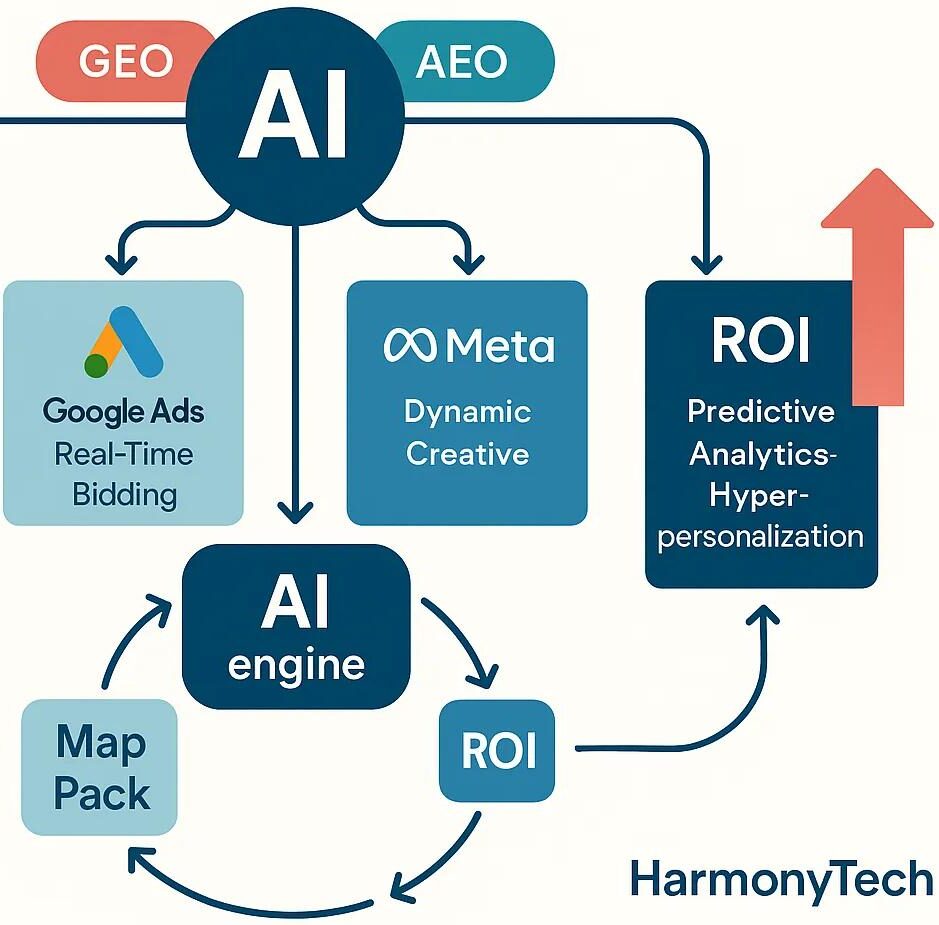
Harmony Technologies runs a real-time paid search optimization workflow that ingests cross-channel signals, applies predictive models, and actuates bids, budgets, and creative adjustments continuously to improve campaign ROI. The flow starts with data collection from ad platforms and first-party events, moves through model scoring and budget allocation, and ends with automated creative swaps plus human-in-the-loop checks to confirm strategy. This design reduces manual effort while preserving strategic oversight, enabling around-the-clock performance gains and faster responses to market shifts that matter for South Florida businesses.
Based in South Florida, Harmony Technologies helps businesses in Miami, Fort Lauderdale, and Margate combine AI-driven techniques across SEO, paid media, earned media, and social channels. Our AI-driven paid search services use machine learning to optimize ad spend in real time across Google Ads, Meta (Facebook and Instagram), and LinkedIn. Core capabilities include predictive analytics, audience behavior forecasting, and dynamic personalized ad copy generation. Harmony’s differentiators are simultaneous optimization across paid, earned, and social; real-time management of bids, budgets, targeting, and creative; predictive identification of high-converting segments; continuous learning with 24/7 improvement; and a local focus tailored to South Florida markets.
The optimization workflow typically follows these steps:
- Data ingestion: Consolidate first- and third-party signals for modeling.
- Model scoring: Predict conversion propensity and LTV for each impression.
- Actuation: Adjust bids, reallocate budget, and swap creatives in real time.
This sequence shifts spend toward high-value opportunities while keeping control via performance alerts and human review. The next subsection covers the direct benefits of real-time bid and budget adjustments.
What Are the Benefits of Real-Time Bid and Budget Adjustments?
Real-time bid and budget adjustments let paid search campaigns capture brief, high-value moments and avoid spending on low-propensity impressions—directly lowering CPA and raising ROAS. By reacting to intra-day signals—like sudden demand spikes, competitor moves, or local events—AI reallocates budget to times and segments with the best expected return. For example, moving spend to a high-converting neighborhood during a local event can increase conversions without raising overall spend. The payoff isn’t just short-term uplift; as models learn which moments reliably convert, efficiency improves sustainably.
These adjustments also reduce manual workload for media teams and speed the scaling of winning tactics across channels. Because the system continuously learns, once a profitable micro-segment is found, future auctions favor that segment automatically, compounding returns. Pairing audience scoring with dynamic messaging is what makes these bid shifts most effective.
How Does AI Enable Advanced Audience Targeting and Dynamic Creative Optimization?
AI enables advanced targeting by producing fine-grained propensity scores that identify users most likely to convert, then expanding reach through lookalike modeling and cross-channel orchestration. Dynamic Creative Optimization (DCO) pairs those scores with modular assets—headlines, images, CTAs—and assembles variations that match audience intent in real time. That personalization boosts relevance and CTR, while automated multivariate testing surfaces winners faster than manual rotations. For instance, swapping in a Miami-specific headline or an image aimed at beachgoers during tourist season can materially improve engagement.
Automated pipelines measure creative performance by segment and feed results back into the creative engine for continuous improvement. When audience targeting and DCO work together, campaigns achieve higher conversion lift and a shorter path to optimal creative combinations, sustaining improved ROAS as programs scale.
Which AI-Powered Paid Media Platforms Drive Maximum ROI for South Florida Businesses?
Each paid search ad platform exposes different AI features that suit distinct objectives and audiences; picking the right mix and orchestrating cross-channel data drives the best ROI. Google Ads offers smart bidding and Performance Max for broad, intent-driven reach; Meta excels at creative permutations and automated placements for consumer engagement; and LinkedIn provides strong professional signals for B2B lead generation. The effect differs by goal: Google delivers direct conversion volume for intent queries, Meta lifts awareness and mid-funnel engagement through creative testing, and LinkedIn produces higher-quality B2B leads at scale for professional services.
Below is a comparison of platform AI features and expected business impact:
This comparison highlights how platform strengths align with common SMB objectives; orchestrating across platforms delivers both scale and precision. The sections that follow detail Google-specific capabilities and Meta/LinkedIn advantages and how to operationalize them.
How Does AI Optimize Google Ads with Smart Bidding and Performance Max?
Google Ads’ Smart Bidding and Performance Max use conversion-value signals and cross-channel data to optimize paid search bids at auction time toward goals like target CPA or ROAS. These systems ingest first-party conversion events, demographic signals, and contextual data to maximize expected value per impression, letting advertisers move from manual bid adjustments to objective-driven strategies. For a local business, Performance Max can consolidate assets and surface them across search, display, YouTube, and discovery feeds—improving reach to high-intent local audiences while optimizing for conversions.
Success depends on solid conversion tracking and a rich asset library—headlines, descriptions, images, and video—so automation has quality inputs to assemble. When configured with accurate goals and enriched signals, Smart Bidding typically reduces manual effort and improves conversion efficiency within weeks, especially when paired with predictive audience scoring.
What Are the Advantages of AI in Facebook, Instagram, and LinkedIn Advertising?
Meta’s AI shines at creative permutation, automated placements, and fast learning from engagement signals to uncover profitable audience pockets for paid search, while LinkedIn’s AI leverages company, role, and industry signals to surface high-value B2B prospects. Meta can test thousands of creative combos and shift spend to top performers, which helps consumer-facing and product-heavy businesses focused on CTR and purchase intent. LinkedIn’s richer professional targeting makes it ideal for lead generation and account-based buy cycles where higher CPMs are offset by stronger lead intent.
Platform choice depends on audience and funnel stage: prioritize Meta for scalable consumer engagement, Google for intent-driven conversions, and LinkedIn for professional services and B2B capture. Cross-platform orchestration amplifies learning—an effective creative from one channel can inform asset groups on another.
How Can Predictive Analytics and Dynamic Creative Optimization Improve Paid Media Results?
Predictive analytics forecasts conversion probability and lifetime value using past conversions and behavioral signals for paid search, while Dynamic Creative Optimization assembles and tests creative variations matched to predicted preferences; together they raise conversion rates and lower acquisition costs. Predictive models help reallocate budget to segments with the best expected returns and can adjust bids by time of day, device, or geography. DCO ensures the ad shown is contextually relevant to the scored user, improving CTR and downstream conversion probability. Used together, advertisers commonly see measurable improvements in CTR and conversion rate while cutting wasted spend on low-propensity audiences.
Below is an EAV-style table that maps capabilities to inputs and outcomes for predictive analytics and DCO:
This mapping shows how inputs become measurable benefits; the next sections look at audience forecasting and creative generation in practice.
What Role Does Audience Behavior Forecasting Play in Campaign Success?
Audience behavior forecasting predicts which users or cohorts are most likely to convert over a set horizon and informs paid search budget, bid, and creative priorities. Forecasts use recency, frequency, intent signals (search queries, site actions), and conversion propensity to rank segments that deserve incremental spend. For example, shifting budget to a high-propensity segment identified by the model during a peak window can deliver immediate conversion lift without increasing total spend. Forecast-driven pacing also prevents overinvestment in low-propensity audiences by throttling bids when predicted ROI falls.
Forecasting improves both efficiency and timing: campaigns reach high-value prospects when they’re most receptive, increasing conversion velocity and lowering acquisition costs. Forecast outputs feed directly into actuation engines for real-time impact.
How Does AI Generate and Test Personalized Ad Creatives for Higher Conversions?
AI generates personalized paid search ad creatives by combining modular templates with audience attributes and contextual signals, then runs automated multivariate tests to find the best combinations. Generation uses templates for headlines, descriptions, images, and CTAs populated based on segment traits—local language, device type, or past purchases—to boost relevance. Testing runs at scale: the system executes many A/B and multivariate experiments concurrently, measures results by segment, and promotes winning variants while retiring weak performers.
The role of AI in creative optimization is well documented.
Creative AI for Online Ad Optimization
Implementing an independent AI-driven creative advertising algorithm combines two advanced AI techniques.
Creative AI: a data-driven design approach for creative online ad optimisation using artificial intelligence and big data, H Phay, 2019
This two-step method—generation followed by automated testing and rollout—shortens optimization cycles and uncovers high-performing combinations that manual testing would likely miss. Faster identification of effective creatives yields measurable CTR and conversion improvements across campaigns.
Why Is Local AI-Driven Paid Media Optimization Essential for South Florida Businesses?
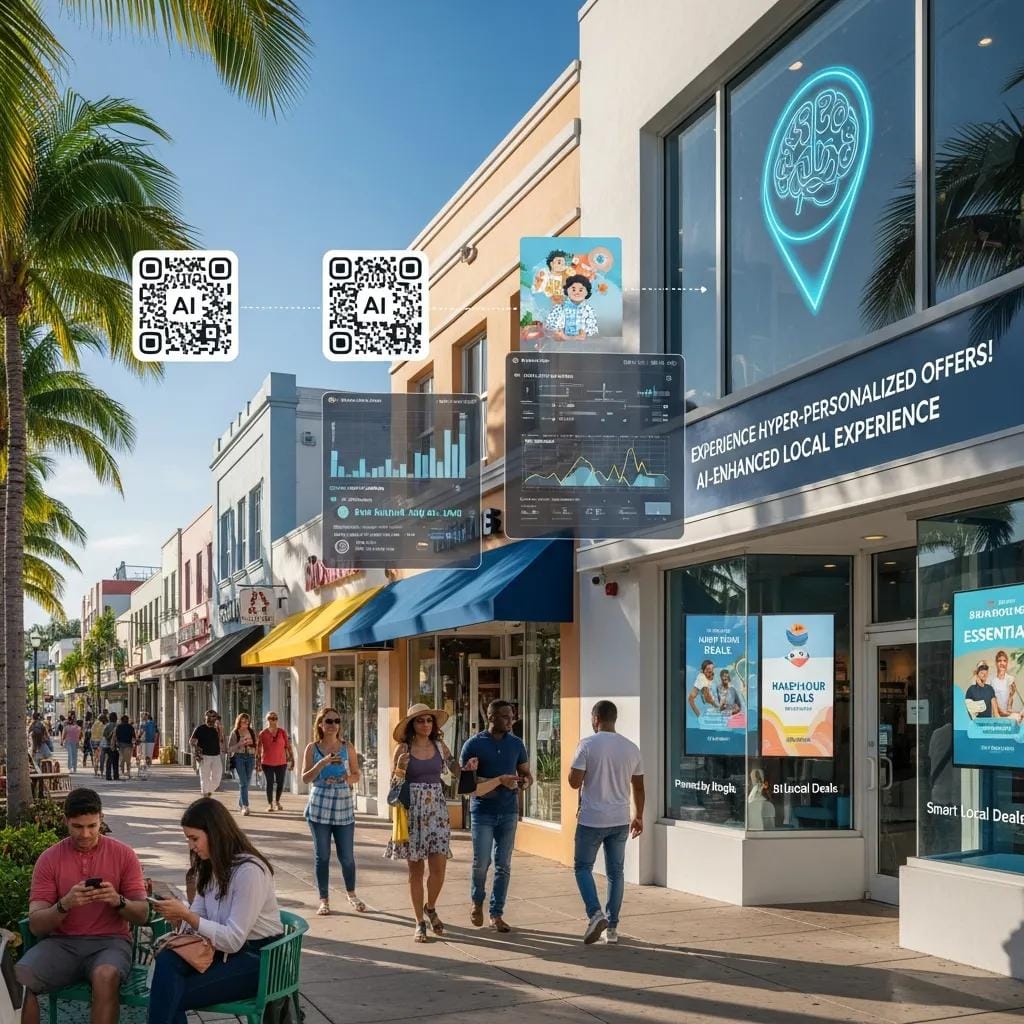
Local AI-driven paid search media is critical in South Florida because the market’s mobile-first consumers, heavy tourism, and tight local competition demand precise timing, geo-specific messaging, and rapid budget shifts. AI systems that use local signals—Google Business Profile interactions, footfall proxies, and event calendars—can prioritize impressions where local intent meets high conversion probability. Hyper-local creative that references neighborhoods, events, or local language improves relevance and CTR, while geo-fencing and schedule-aware bidding cut wasted impressions outside service areas. For South Florida businesses, incorporating local signals separates efficient campaigns from broad, wasteful spend.
Local strategies pair technical tactics with market knowledge to convert nearby intent into visits and leads. The table below summarizes local strategies, AI tactics, and direct local benefits:
Applying these tactics leads to higher CTR, better-qualified leads, and less wasted spend in priority neighborhoods. The next subsections cover GBP integration and hyper-local examples for Miami, Fort Lauderdale, and Margate.
How Does AI Enhance Local SEO and Google Business Profile Optimization?
AI improves local SEO and Google Business Profile (GBP) optimization by automating content suggestions, review monitoring, and localized keyword discovery so organic and paid search signals reinforce each other. Automated tools can create GBP post variations targeted to high-value queries, surface sentiment trends in reviews for fast responses, and identify localized keywords to feed both ad copy and landing pages. That alignment raises perceived relevance in local search and increases the chance paid ads and organic listings work together to drive clicks and conversions.
When paid campaigns reference GBP details—hours, services, promotions—AI can dynamically insert matching information into creatives, creating consistent messaging that reduces friction and builds trust. This combined approach strengthens both organic presence and paid performance in competitive local markets.
What Are the Benefits of Hyper-Local AI Marketing Strategies in Miami, Fort Lauderdale, and Margate?
Hyper-local AI paid search strategies pay off by tailoring creative, timing, and bids to neighborhood behavior, local events, and cultural cues that drive engagement. In Miami, neighborhood- and tourist-aware messaging can lift CTR and visits during peak windows. Fort Lauderdale campaigns that sync with boating and event calendars capture transactional intent, while Margate efforts focused on community promotions improve lead quality for service businesses. These tactics reduce irrelevant impressions and increase conversion density where it matters most.
Measured results typically include higher CTRs, increased footfall, and better lead qualification—results that translate directly into stronger ROAS for local SMBs. Localized approaches bridge national-scale automation and neighborhood-level relevance.
Harmony Technologies pairs AI optimization with South Florida-specific signals and creative strategies to build local trust with SMBs in Miami, Fort Lauderdale, and Margate. By aligning local organic signals and paid search assets, Harmony helps businesses improve discoverability, convert nearby intent, and track footfall-related outcomes. This local focus accelerates iteration on what resonates with nearby audiences while preserving the benefits of predictive optimization and DCO.
What Are Proven Case Studies Demonstrating AI-Driven Paid Media Success in South Florida?
Real-world case studies show AI-driven paid search media can deliver rapid, measurable ROI improvements when paired with good data hygiene and local context. Typical anonymized results include conversion lifts, CPA reductions, and ROAS gains after implementing predictive bidding, DCO, and cross-channel orchestration. Case stories commonly follow a pattern: baseline measurement, AI-driven testing, rapid creative and targeting iteration, and sustained performance as models learn. These examples show how focused data inputs and model governance produce scalable ROI for local advertisers.
Case summaries below highlight anonymized results and next-step recommendations:
- Local retail chain: Baseline conversion rate rose 35% and CPA fell 28% after deploying Performance Max with DCO and predictive audience scoring.
- Regional services firm: Lead quality improved using LinkedIn-targeted LTV scoring, increasing qualified leads by 22% while spend stayed steady.
- Hospitality client: Event-aware bidding and geo-targeted creative boosted booking conversions by 41% during peak windows.
How Have Miami Businesses Increased ROI Using Harmony Technologies’ AI Solutions?
Miami clients working with Harmony Technologies typically see better paid search conversion efficiency without losing brand control or creative standards. Implementations that combine predictive bidding, Performance Max setups, and DCO produced conversion lifts and lower CPAs within defined test periods. The approach layers local signal enrichment, modular creative, and human oversight to validate automated decisions and speed learning. Reported improvements align with the anonymized benchmarks above and were driven by prioritizing high-propensity micro-segments and event-driven windows.
Businesses ready to explore similar results can contact Harmony Technologies for an AI audit and tailored roadmap that fits local market dynamics.
Which Metrics Showcase the Impact of AI on Paid Media Campaign Performance?
Key metrics that reflect AI impact on paid search include CPA (cost per acquisition), ROAS (return on ad spend), conversion rate, CLTV (customer lifetime value), and quality signals like CTR and impression share. AI most often improves CPA and ROAS by reallocating spend to higher-propensity segments and making creative more relevant, while conversion-rate gains show better alignment between message and intent. Secondary metrics—engagement rate, average order value, and attribution-adjusted contribution—help pinpoint whether lift came from targeting, creative, or funnel improvements.
Setting realistic benchmarks depends on historical data and an attribution model that accounts for cross-channel influence; short-term targets commonly range from a 15–40% improvement in conversion efficiency during a test window, with additional long-term gains as models stabilize. Tracking these metrics while keeping human oversight ensures AI-driven campaigns scale transparently and sustainably.
Learn More! It will only take a minute.
Explore The Abundant Business Opportunities A.I. Digital Marketing Offers For You Today!
No Responses