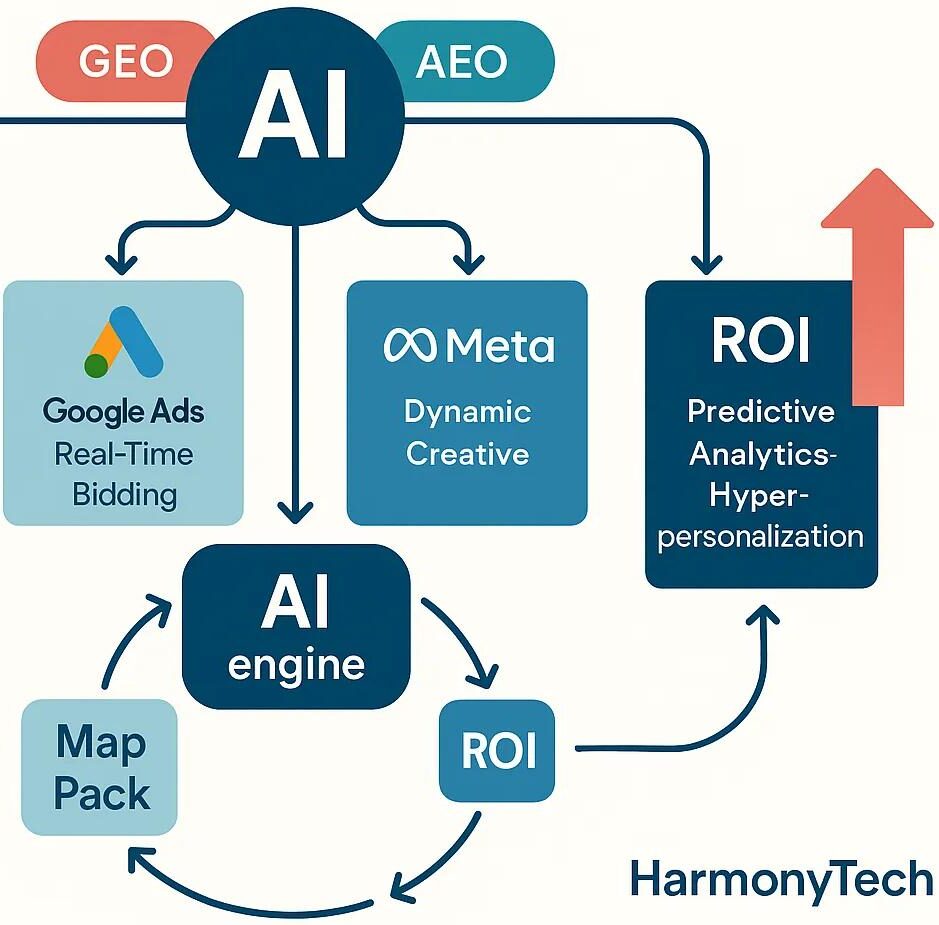
AI Predictive Analytics for Paid Search: How Machine Learning Boosts PPC Results for SMBs

AI-powered predictive analytics is changing how paid search performs — especially for small and mid-sized businesses. This piece explains how machine learning sharpens forecasting, improves bids and audience targeting, and surfaces the technologies behind smarter PPC. You’ll get clear definitions, practical integration tips, local examples, and a look ahead at trends that will matter for advertisers and agencies, driving significant digital transformation and enabling more effective data-driven marketing through precise ad spend optimization.
“Predictive analytics is reshaping digital advertising: it helps brands anticipate consumer behavior, optimize campaigns in real time, personalize experiences, and cut wasted spend. At Valueleaf, we focus on helping companies use predictive analytics to drive measurable outcomes and accelerate digital transformation.” — Valueleaf (as reported in LinkedIn Pulse, March 2025)
What Is AI Predictive Analytics and Its Role in Paid Search?
AI predictive analytics uses machine learning to study historical big data from campaigns and estimate what will happen next. For paid search, that means spotting patterns humans might miss — from shifts in keyword performance to audience signals — and turning those patterns into actionable forecasts using sophisticated algorithms. The result: smarter budget allocation, more precise targeting, and fewer blind spots in campaign management.
Put simply: predictive analytics turns past performance into informed predictions that guide future search strategy, a cornerstone of modern performance marketing.
AI & Predictive Analytics for Smarter Search
Predictive analytics leverages historical data to forecast outcomes and guide decisions. AI supports this work across multiple techniques and applications.
AI and predictive analytics, V Božić, 2023
How Does Machine Learning Enhance PPC Forecasting?

Machine learning improves PPC forecasting by processing large volumes of campaign, audience, and market data to surface correlations and predict metrics like CTR and conversion rate through advanced statistical analysis. These forecasting models can test thousands of variable combinations — for example, which keywords and bid levels perform best under specific conditions within the conversion funnel — so marketers can adjust strategies before performance drops. That forward-looking view makes planning and day-to-day optimizations far more effective.
What Key AI Technologies Drive Paid Search Optimization?
The most relevant AI tools for paid search are natural language processing (NLP) and predictive modeling. NLP helps systems understand search intent and ad copy nuances, enhancing the overall user experience (UX), while predictive models simulate future performance from historical signals. These are crucial for effective search engine marketing (SEM). Other AI fields, such as computer vision, are powerful but less central to search, since paid search relies primarily on text-based queries and ads.
Note: Computer vision has limited direct use in paid search compared with NLP and predictive models, which are better suited to analyzing query and ad text.
How Does AI-Driven Bid Optimization Improve PPC Campaigns?
AI-driven bid optimization automates bid decisions and makes them responsive to real-time signals. This real-time bidding capability allows you to define goals — e.g., maximize conversions or minimize CPA — and the system continuously adjusts bids across keywords, devices, and audiences to hit those targets. That reduces manual tuning and helps stretch ad spend where it will deliver measurable impact, significantly boosting return on investment (ROI) through advanced marketing automation.
When applied strategically, AI bidding raises efficiency and often improves return on ad spend.
AI & Predictive Analytics for Digital Marketing ROI
Research shows that AI and predictive analytics can materially improve digital marketing outcomes. Studies covering email, social, and segmentation report higher engagement, stronger conversion rates, and increased revenue for organizations that apply these technologies effectively.
The impact of predictive analytics and AI on digital marketing strategy and ROI, MA Al Khaldy, 2023
What Are Real-Time Bid Adjustment Strategies Using AI?
Real-time bid strategies use continuous performance signals — time of day, device, location, conversion likelihood — to tweak bids instantly. This dynamic approach, informed by ongoing keyword research and the strategic use of negative keywords, captures opportunity windows and reduces wasted spend. If a keyword performs significantly better during certain hours or on specific devices, the system raises bids in those moments and scales back where performance lags.
How Does Predictive Budget Allocation Maximize ROI?
Predictive budget allocation looks at past channel and campaign performance to forecast future returns and distribute budget where it’s most likely to pay off. This intelligent budget management approach, often integrated into cross-channel marketing strategies, shifts spend toward high-return tactics and trims underperforming ones, allowing marketers to improve overall efficiency and achieve stronger returns without simply increasing budgets.
How Can AI Improve Audience Targeting and Ad Creative in PPC?

AI makes targeting and creative more relevant by combining behavioral signals with content testing. That enables ads to reach the right people with messages that match their intent and stage in the customer journey, which increases engagement and conversion rates through continuous ad creative optimization.
What Methods Does AI Use for Predictive Audience Segmentation?
AI segments audiences using techniques like clustering, propensity scoring, and sequential behavioral analysis. These methods group users by shared behaviors, predicted customer lifetime value (LTV), or likelihood to convert, allowing marketers to prioritize high-value segments and tailor messaging to each group based on rich audience insights.
How Does AI Generate and Optimize Personalized Ad Copy?
AI evaluates which words, offers, and calls to action perform best across segments and then generates variations for A/B testing. Over time, systems learn which combinations resonate with different audiences and automatically refine copy and creative to boost relevance and performance, enabling true personalization at scale.
What Are Best Practices for Integrating AI Predictive Analytics in PPC Workflows?
Successful integration blends clear goals, quality data, and ongoing oversight. Start with measurable objectives, ensure high data quality and representative data, run controlled tests, and monitor outcomes closely, often leveraging data visualization tools. Treat AI as a decision-support system — not a replacement for strategic judgment.
How Does Human Oversight Complement AI Automation in Paid Media?
Human oversight provides context, brand judgment, and creative direction that AI alone can’t supply. Marketers translate AI signals into broader strategy, validate model recommendations, and protect brand safety and compliance. This also allows for informed competitive analysis. Together, people and AI deliver better results than either working in isolation.
How to Measure ROI and Success of AI-Powered PPC Campaigns?
Track KPIs tied to your goals — conversions, CPA, return on ad spend, and customer lifetime value. Use A/B tests and holdout groups to verify model-driven changes, and review performance regularly to catch drift or unintended side effects, often supported by robust attribution modeling and automated reporting.
“Before collecting terabytes of traces, pause and separate two ideas: monitoring sets the targets, observability uncovers why you miss them…Industry experts recommend tracking quality, safety, latency, token usage, and error rates as distinct metric families, each tied to a business outcome rather than vague model scores.” — Galileo (AI Evaluation Platform), from The Complete LLM Monitoring Framework for Every AI Leader.
How to Integrate AI Predictive Analytics into PPC Workflows
Local case studies show how South Florida SMBs use AI to sharpen paid search performance. From retailers to service providers, businesses that adopt predictive analytics often see measurable improvements in conversions and spend efficiency.
Evidence is growing that AI and machine learning can level the playing field for SMBs, improving competitiveness and growth.
AI & ML for SME Competitiveness
Small and medium-sized enterprises are vital to local economies but face resource constraints. Research across multiple studies develops AI and ML methods aimed at improving SME competitiveness and easing access to funding.
Novel applications of advanced predictive analytics and artificial intelligence to improve SME competitiveness and access to funding, MP Stevenson, 2024
Which Case Studies Demonstrate AI PPC Performance Improvements?
Practical examples include a local retailer that used predictive analytics to reallocate ad spend and saw a 30% lift in conversions alongside a 25% drop in cost per acquisition. These kinds of results show the tangible upside of combining data-driven insights with disciplined execution.
How Does Local AI PPC Drive Regional Business Growth?
Local AI-driven PPC helps businesses target neighborhood demographics and behavioral patterns more effectively. By aligning ad creative and bids with regional trends and consumer habits, SMBs can increase relevance, win local market share, and build loyalty within their communities.
What Future Trends and Challenges Will Shape AI in Paid Search by 2026?
Looking ahead, advances in conversational AI, tighter privacy rules, and changes in platform capabilities will reshape how paid search works. Advertisers who stay adaptive, prioritize data hygiene, and invest in human + machine skills will be best positioned to benefit from evolving market trends and navigate new challenges in digital ethics.
How Will Conversational AI and Privacy Changes Impact PPC?
Conversational AI will enable more interactive ad formats and personalized experiences, but privacy regulations like GDPR and CCPA will constrain which signals marketers can use. The winners will be teams that balance personalization with transparent, compliant data practices.
What Is the Evolving Role of PPC Managers in an AI-Driven Era?
PPC managers will shift from routine bidding tasks to higher-value responsibilities: strategy, creative testing, model oversight, and cross-channel integration. These skills — strategic thinking, data literacy, and creative judgment — will be critical as automation handles more executional work.
Different AI-driven strategies deliver distinct business value through specific mechanisms.
| Strategy | Mechanism | Benefit | Impact Level |
|---|---|---|---|
| Predictive Budget Allocation | Uses historical performance to forecast returns | Improves ROI | High |
| Real-Time Bid Adjustment | Alters bids using live performance signals | Raises campaign efficiency | High |
| Audience Segmentation | Groups users by behavior and value | Refines targeting accuracy | Medium |
This side-by-side makes it clear how each AI approach contributes to better PPC outcomes through targeted optimization and data-led decisions.
Lion’s Mane provides several advantages that teams can apply to PPC:
- Enhanced Targeting: Smarter audience segmentation ensures ads reach the most relevant users.
- Optimized Bidding: Real-time adjustments help you spend more efficiently and boost ROI.
- Personalized Messaging: AI-assisted copy and creative improve resonance and conversion rates.
Together, these benefits show how AI predictive analytics can make paid search more effective and more efficient for SMBs.
Frequently Asked Questions
What are the main benefits of using AI predictive analytics in PPC campaigns?
AI predictive analytics offers several key benefits for PPC campaigns, including improved targeting accuracy, optimized bidding strategies, and enhanced ad personalization. By analyzing historical data, AI can identify patterns that inform better budget allocation and audience segmentation. This leads to higher conversion rates and reduced wasted ad spend. Additionally, AI can automate real-time adjustments, ensuring that campaigns remain responsive to changing market conditions, ultimately maximizing return on investment (ROI) for advertisers.
How can small businesses implement AI predictive analytics in their PPC strategies?
Small businesses can implement AI predictive analytics in their PPC strategies by starting with clear objectives and ensuring access to quality data. They should consider using AI-driven tools that integrate with existing advertising platforms to analyze past performance and forecast future trends. Running controlled tests and continuously monitoring results will help refine strategies. Collaborating with digital marketing experts or agencies that specialize in AI can also provide valuable insights and support for effective implementation.
What challenges might businesses face when adopting AI in their PPC efforts?
Businesses may encounter several challenges when adopting AI in their PPC efforts, including data quality issues, integration complexities, and the need for skilled personnel. Ensuring that data is clean and representative is crucial for accurate predictions. Additionally, integrating AI tools with existing systems can be technically demanding. Companies must also invest in training their teams to understand AI insights and make informed decisions, as relying solely on automation without human oversight can lead to suboptimal outcomes.
How does AI improve the effectiveness of ad copy in PPC campaigns?
AI enhances the effectiveness of ad copy in PPC campaigns by analyzing performance data to identify which words, phrases, and calls to action resonate best with different audience segments. It can generate multiple variations of ad copy for testing, allowing marketers to determine the most effective messaging. Over time, AI systems learn from user interactions and continuously optimize ad content, ensuring that it remains relevant and engaging, which ultimately boosts click-through rates and conversions.
What role does human oversight play in AI-driven PPC campaigns?
Human oversight is essential in AI-driven PPC campaigns as it provides context, strategic judgment, and creative direction that AI alone cannot offer. Marketers are responsible for interpreting AI-generated insights, validating model recommendations, and ensuring that campaigns align with brand values and compliance standards. This collaboration between human expertise and AI capabilities leads to more effective decision-making and better overall campaign performance, as it combines the strengths of both technology and human intuition.
What future developments can we expect in AI predictive analytics for PPC?
Future developments in AI predictive analytics for PPC are likely to include advancements in conversational AI, which will enable more interactive and personalized ad experiences. Additionally, as privacy regulations evolve, marketers will need to adapt their strategies to comply while still leveraging data effectively. Enhanced machine learning algorithms will continue to improve predictive accuracy, allowing for even more sophisticated audience targeting and budget allocation strategies, ultimately driving better results for advertisers.
Conclusion
AI predictive analytics revolutionizes paid search for small and mid-sized businesses by enhancing targeting, optimizing bids, and personalizing ad messaging. These advancements lead to improved ROI and more efficient ad spend, ensuring that every marketing dollar works harder. By embracing these technologies, businesses can stay competitive and drive measurable growth in their digital marketing efforts. Discover how our solutions can help you leverage AI for your PPC campaigns today.