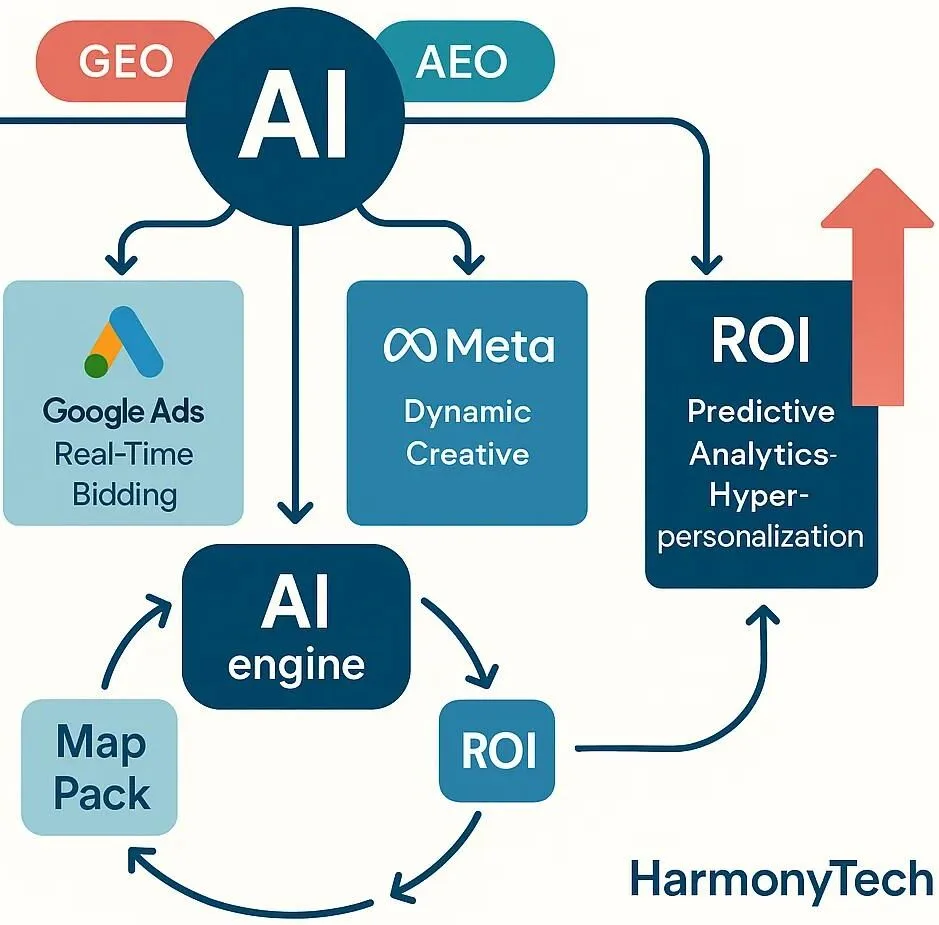
Drive Results: AI Predictive Analytics for Smart Marketing

AI Predictive Analytics for Marketing — Unlock Growth with AI-Powered Digital Strategies
Digital marketing moves fast. AI predictive analytics is the tool that turns guesswork into clear strategy. With more data every day, businesses can’t rely on intuition alone — they need forecasts they can act on. This guide explains what predictive analytics is, how it works, and the real advantages it delivers for marketing. From improving targeting and personalizing customer journeys to lifting ROI, we’ll show practical uses — from paid mediaoptimization and local SEO to social engagement and smarter lead generation — so you can see where AI produces the biggest returns and how it shifts marketing from reactive to proactively informed.
Moving beyond descriptive (what happened) and diagnostic (why it happened) analytics to predictive (what will happen) and prescriptive (what to do) changes how teams plan and act. AI-powered predictive models don’t just summarize past performance — they anticipate trends, customer needs, and market shifts so marketers can act before events unfold. That leads to smarter budget choices, lower risk, and a real competitive edge.
What is AI Predictive Analytics and How Does It Change Digital Marketing?
AI predictive analytics applies modern machine learning to historical data to estimate likely future outcomes. In marketing, that means predicting customer actions, ranking opportunities, and making decisions faster and with more confidence. Well-built models reveal patterns traditional reporting misses, turning vast amounts of data into timely, actionable guidance. The result: marketing that anticipates demand, personalizes experiences, and allocates resources with much greater precision than before.
Defining AI Predictive Analytics in Marketing Contexts
In marketing, predictive analytics looks at many customer signals — purchases, browsing, content engagement, email opens, social interactions, demographics, and more — to forecast preferences, intent, and churn risk. Those forecasts help teams plan offers, manage inventory, and time outreach so customers see the right message at the right moment. It’s about understanding why customers act and predicting what they’ll do next so you can deliver targeted messaging, better recommendations, and timely interventions that actually resonate.
The core idea is building models that learn from past behavior to predict future events. A model can flag which customers will respond to an offer, which leads will convert, or which pieces of content will spark engagement. These are not simple correlations — they’re patterns found by complex algorithms that uncover relationships hidden in large datasets, yielding insights human analysts might miss.
How Machine Learning Forecasts CustomerBehavior and Market Trends
Machine learning processes large, varied datasets to surface correlations and trends that are hard to spot manually. Models combine transactions, on-site behavior, social activity, email engagement, and demographic or contextual signals to predict next actions. The outcome is more relevant experiences and messaging that align with individual intent — which drives engagement and revenue. The process typically follows these steps:
1. Data Collection and Preparation: Pull data from CRM, analytics, social, and ad platforms, then clean and normalize it. Good predictions start with clean data.
2. Feature Engineering: Convert raw inputs into meaningful features the model can learn from. That often means creating new variables or combining existing ones to reveal underlying patterns.
3. Model Selection and Training: Choose algorithms (regression for continuous outcomes, classification for categories like churn, clustering for segmentation) and train them on historical examples so the model learns the link between inputs and outcomes.
4. Model Evaluation and Validation: Test the model on unseen data to ensure accuracy and avoid overfitting. This step proves the model will generalize to real-world scenarios.
5. Deployment and Monitoring: Embed the model into marketing systems to generate real-time predictions and monitor performance. Models need regular checks and retraining as markets and customer behavior evolve.
When applied correctly, machine learning predicts everything from the best send time for an email to the likely success of a new product launch — giving marketers data-driven signals to replace guesswork.
How Can AI Predictive Analytics Optimize Paid MediaCampaigns?

AI predictive analytics makes paid media more efficient by shaping bid strategies, creative choices, and budget allocation in near real time. Instead of broad guesses, you get data-backed actions that stretch ad dollars further and lift return on ad spend (ROAS). Paid platforms are complex and fast — AI can process millions of signals in milliseconds to spot patterns and make adjustments human teams can’t keep up with.
Real-Time Bidding and Budget Allocation with AI
Real-time bidding (RTB) uses models that evaluate signals and set optimal bids for each impression. That means paying for placements with a higher chance of conversion and shifting spend as performance changes — so your budget follows value, not assumptions. AI considers many factors in real time, including:
- User Intent: Interpreting search queries, browsing behavior, and demographics to estimate conversion likelihood.
- Ad Placement Value: Assessing historical performance of specific ad slots across sites and apps.
- Competitive Landscape: Adjusting bids based on competitors’ behavior and current auction dynamics.
- Time of Day/Week: Finding the windows with the best conversion patterns.
- Device Type: Tailoring bids for mobile, desktop, or tablet users based on performance differences.
AI also reallocates budget dynamically across campaigns, ad groups, and channels (e.g., Google Ads vs. social). If one campaign starts converting better, AI can shift spend to capture that value — reducing waste and maximizing overall performance.
Enhancing ROI through AI-Driven Audience Segmentation
AI segmentation groups audiences by behavior and conversion likelihood, not just demographics. That lets you match the right creative to the right people at the right time, boosting conversion while cutting wasted impressions. AI enables micro-segmentation, identifying niche groups with specific needs, such as:
- Propensity Modeling: Predicting who’s most likely to convert, repurchase, or engage with content.
- Lookalike Audiences: Finding new prospects that resemble your highest-value customers.
- Churn Prediction for Retargeting: Locating customers at risk of leaving and targeting retention messages to them.
- Customer Lifetime Value (CLTV) Segmentation: Grouping customers by predicted long-term value for differentiated bids and messaging.
With these granular segments, marketers can craft highly relevant ads and creatives that raise click-through rates, lower cost-per-acquisition, and improve ROI.
AI for Creative Optimization and Dynamic Content
AI influences creative decisions too. Dynamic Creative Optimization (DCO) lets systems automatically generate and test thousands of ad variations — mixing headlines, images, CTAs, and landing pages — to find the best combinations for each audience. AI predicts which elements will perform well for a segment, reducing manual A/B testing and speeding up iteration.
AI also measures sentiment and engagement for different creatives, revealing what resonates. That feedback lets teams refine designs quickly so messages don’t just reach the right people — they motivate action. Personalizing creative at scale is a major advantage for paid media performance.
Multi-Touch Attribution Modeling with AI
Knowing which touchpoints actually drive conversions is crucial. Traditional models (like last-click) oversimplify the customer journey. AI-powered multi-touch attribution maps complex paths and assigns credit to each touchpoint (display, social, search, email) based on real influence. These models use machine learning to reveal each interaction’s contribution, helping marketers to:
- Allocate Budget More Effectively: Invest in channels and campaigns that truly drive conversions.
- Optimize Customer Journeys: Identify weak spots in the funnel and improve them with data-led changes.
- Measure True ROI: Understand the real return on each marketing activity and make smarter decisions.
With AI attribution, businesses get a fuller view of campaign performance and can optimize spend more strategically.
What Are the Benefits of Using AI for Local SEO in South Florida?
For South Florida businesses, AI predictive analytics sharpens local SEO to attract nearby customers. From refining local content to surfacing direct answers, AI helps small and mid-sized businesses raise visibility where it matters most. Local markets have unique search behaviors, events, and competitors — AI sorts through those signals so you can stand out in a crowded local landscape.
Leveraging AI for Geographic SEO and Answer Engine Optimization
Geographic SEO improves ranking in local searches; AI analyzes regional search behavior and intent so you can shape content for local demand. It digs into how people search in your area (e.g., “best pizza near me,” “dentist Miami Beach”) and processes large local datasets to produce:
- Local Keyword Research: Identifying high-value, low-competition phrases and long-tail keywords specific to South Florida.
- Competitor Analysis: Reviewing local competitors’ SEO, GMB profiles, and reviews to find gaps and opportunities.
- GMB Optimization: Recommending changes to Google My Business listings — categories, services, photos, and descriptions — based on local trends.
- Review Analysis: Pulling themes from customer reviews to inform content and service improvements.
Answer Engine Optimization (AEO) prepares your site to appear in featured snippets, “People Also Ask,” and local packs by surfacing concise, useful answers. With voice search and AI assistants on the rise, direct answers matter more than ever. AI helps by:
- Identifying Question-Based Queries: Finding common questions locals ask about your business or industry.
- Structuring Content for Answers: Recommending schema, clear headings, and short, scannable paragraphs so search engines and assistants can extract answers.
- Predicting Featured Snippet Opportunities: Spotting SERP queries where your content has a strong chance to appear as a featured snippet.
Combining Geographic SEO with AEO helps South Florida businesses not only show up in local results but also be the source of the most relevant answers customers see.
Hyper-Personalized Strategies for Small to Medium-Sized Businesses
AI scales personalization for SMBs. By learning individual preferences and neighborhood trends, you can present offers and suggestions that feel local and relevant — improving conversion and repeat visits even against larger competitors. For a local business, that can look like:
- Personalized Local Offers: Identifying customers who showed interest in certain products and sending targeted promotions tied to their location and past behavior.
- Localized Content Recommendations: Suggesting blog posts, events, or services that matter to a customer’s neighborhood or interests within South Florida.
- Dynamic Website Content: Showing different offers or content based on a visitor’s region, time of day, or prior interactions.
- Predicting Local Demand: Forecasting demand by neighborhood so businesses can optimize inventory and staffing.
That level of relevance builds loyalty and makes SMBs feel more connected to their customers — a powerful advantage in a crowded market.
AI for Local Content Strategy and Community Engagement
AI helps local businesses find topics, events, and conversations that matter to their communities. By scanning local news, social chatter, and search data, AI recommends timely content ideas for the South Florida audience, such as:
- Event-Based Content: Creating posts around local festivals, sports, or community gatherings that matter to your customers.
- Neighborhood-Specific Guides: Publishing guides that highlight attractions, services, or unique qualities of different local areas.
- Addressing Local Pain Points: Producing content that answers common questions or solves issues residents frequently face.
AI also monitors local conversations and flags engagement opportunities so businesses can join relevant discussions and grow their local presence organically. This approach strengthens brand visibility and fosters community ties.
Harmony Technologies, a South Florida digital marketing agency, focuses on AI-driven solutions for small and mid-sized businesses. With 20+ years of experience, we use AI to optimize paid, earned, and social channels — delivering speed, scale and smarter decisions.
How Does AI Improve Social Media Engagement and ContentPrediction?
AI predictive analytics clarifies what content performs and when to publish it. By forecasting topical interest and sentiment, teams can produce posts that spark engagement and strengthen relationships over time. Social platforms are rich in signals; AI turns that complexity into clear guidance for better social performance.
Predictive Content Calendars and Sentiment Analysis
Predictive content calendars suggest topics and timing based on past performance and audience signals so your posts land when people are most receptive. AI examines historical engagement (likes, shares, comments, clicks) to identify optimal schedules and can also spot rising topics by monitoring real-time conversations, news, and competitor activity. That allows brands to act on trends early, when they have the most impact.
Sentiment analysis tracks reactions in real time so you can iterate quickly and protect brand perception. Using NLP, AI reads comments, reviews, and mentions to surface emotional tone (positive, negative, neutral). That immediate feedback lets teams respond to issues, amplify successes, and adjust messaging before small problems grow.
Maximizing Customer Interaction with AI-Powered Social Media Tools
AI automates routine replies and highlights high-priority conversations for human follow-up. That keeps response times low while preserving the personal touch that converts followers into customers. Common applications include:
- AI Chatbots: Handling FAQs, providing instant support, and guiding users through basic tasks so agents can focus on complex issues.
- Automated Engagement: Identifying opportunities for automated likes, shares, or comments on relevant posts to boost visibility.
- Influencer Identification: Analyzing engagement and audience overlap to find micro-influencers and brand advocates who align with your goals.
- Personalized Outreach: Crafting one-to-one messages based on past interactions and expressed interests so outreach feels genuine.
Smart automation plus timely human follow-up improves satisfaction, builds community, and drives conversions from social channels.
AI for Audience Insights and Social Listening
AI upgrades social listening by extracting deep insights about demographics, interests, behaviors, and preferences. It can:
- Identify Audience Segments: Find distinct groups within your followers based on shared interests and behaviors.
- Uncover Psychographics: Move beyond demographics to understand attitudes, values, and lifestyles.
- Monitor Competitor Activity: Track competitor content and audience reactions to spot opportunities for differentiation.
- Predict Emerging Trends: Use models to detect early shifts in interest so you can plan ahead.
These insights let marketers create targeted campaigns, craft content that truly connects, and build an engaged community. AI turns social media from a broadcast channel into a listening and learning platform.
What Are Effective Strategies for Lead Generation and Customer Retention Using AI?

Predictive analytics strengthens both acquisition and retention by spotting promising leads early and flagging customers at risk of leaving — so teams can act before value slips away. Because acquiring customers is often pricier than keeping them, AI helps protect revenue while keeping the pipeline healthy.
Identifying High-Value Leads through Predictive Modeling
Predictive models score prospects using attributes and behaviors tied to conversion. Prioritizing high-scoring leads lets sales and marketing focus nurture where it matters, improving close rates and efficiency. This approach goes beyond basic demographics and evaluates complex patterns to reveal true lead quality. Key uses include:
- Lead Scoring: Giving each lead a numerical score based on website behavior, email engagement, demographics, and firmographics so the highest-value leads go straight to sales.
- Ideal Customer Profile (ICP) Identification: Analyzing your best customers to define traits that predict future success, then targeting similar prospects.
- Predicting Conversion Likelihood: Forecasting which leads will convert within a timeframe so outreach is timely and effective.
- Optimizing Lead Nurturing: Recommending the right content, channels, and timing for each lead’s journey.
Focusing on the most promising prospects lowers customer acquisition cost (CAC) and makes your funnel more efficient.
Reducing Customer Churn with AI Insights
AI spots signs that often precede churn — declining engagement, support friction, or reduced product use. Identifying these signals early lets you launch targeted retention campaigns that resolve issues and protect customer lifetime value. Churn models look at:
- Usage Patterns: Falling product use, fewer logins, or lower interaction levels.
- Support Interactions: Rising ticket volume, negative sentiment, or unresolved problems.
- Billing Information: Payment problems, upcoming renewals, or plan changes.
- Engagement Metrics: Drops in email opens, social interaction, or survey responses.
When an at-risk customer is identified, AI can trigger personalized retention plays — targeted offers, proactive service outreach, or educational content — to re-engage them before they leave.
Predicting Customer Lifetime Value (CLTV)
AI can forecast each customer’s Customer Lifetime Value (CLTV) — the total revenue you can expect over a relationship. Predicting CLTV helps businesses:
- Optimize Acquisition Spend: Spend more on customers likely to generate higher lifetime value.
- Personalize Marketing Efforts: Tailor offers and outreach to high-value customers.
- Improve Resource Allocation: Prioritize support and retention for the most valuable accounts.
- Identify Upsell/Cross-sell Opportunities: Recommend products or services that match predicted needs and value.
CLTV insight drives smarter decisions across acquisition, retention, and customer success.
AI for Cross-selling and Upselling
AI finds cross-sell and upsell opportunities by analyzing purchase history, browsing, and demographics. Recommendation engines suggest complementary items (cross-sell) or premium options (upsell) a customer is likely to buy, boosting revenue and improving the customer experience. For example, an ecommerce site might recommend accessories after a purchase or a premium plan to a frequently engaged free-user.
.
A renowned expert in AI and predictive analytics, Andrew Ng (Founder of DeepLearning.AI and a co-founder of Coursera), has provided an insightful perspective on the future of the field. He said “”AI is the new electricity. I think AI will transform many industries… everything from healthcare to education to transportation to entertainment” – Andrew Ng, a pioneer in deep learning and former lead of the Google Brain project. This compelling comparison highlights AI’s broad and lasting impact — especially in data-driven marketing.
Why Choose Harmony Technologies for AI-Driven Digital Marketing Services in South Florida?
Harmony Technologies pairs local market knowledge with a practical, results-first approach to AI in marketing. We blend proven analytics with hands-on strategy so businesses can turn insights into measurable growth. In a fast-changing AI landscape, you need a partner who understands both the technology and your local business context — that’s where our experience pays off.
20+ Years of Expertise in AI and Predictive Analytics
With more than two decades in the field, our team knows how to operationalize AI — from model design to campaign activation — so clients get predictable, scalable outcomes. Our long experience translates into:
- Proven Methodologies: Streamlined processes for data collection, model building, deployment, and continuous optimization.
- Deep Technical Acumen: Expertise across machine learning algorithms, data platforms, and cloud tools to pick the right solution for each challenge.
- Strategic Insight: Advice on integrating AI into your marketing strategy so technology supports business goals.
- Risk Mitigation: Practices to manage data quality, reduce model bias, and address ethical and compliance concerns.
We don’t just implement AI — we partner to build a sustainable, data-driven marketing system that evolves with your business.
Success Stories: Case Studies of Local Businesses Thriving with AI
We’ve helped South Florida businesses increase engagement, generate higher-quality leads, and grow revenue with tailored AI strategies. Our work focuses on measurable wins, not jargon. Examples include:
- Retailer X: Boosting Sales with Personalized Recommendations: A local boutique used our AI recommendation engine to analyze purchases and browsing behavior — resulting in a 25% increase in average order value and a 15% reduction in unsold inventory through better product placement and personalized emails.
- Service Provider Y: Streamlining Lead Generation: A home services firm cut wasted ad spend by adopting our predictive lead scoring. The result: a 30% improvement in lead-to-customer conversion rates and a 20% reduction in customer acquisition cost.
- Restaurant Z: Enhancing Local SEO and Foot Traffic: A restaurant chain optimized GMB profiles and local content with AI-driven SEO and AEO, achieving a 40% increase in local search visibility and noticeable growth in walk-ins.
- Non-Profit A: Maximizing Social Media Engagement: Using AI content prediction and sentiment tools, a non-profit increased donor and volunteer engagement by 50% on social channels, boosting campaign reach and sign-ups.
These case studies show how practical AI applications drive real business outcomes for local organizations.
Our Comprehensive Approach to AI-Driven Marketing
Harmony Technologies offers a full suite of AI-driven marketing services tailored to South Florida businesses:
AI for Local SEO and Geographic Optimization:
We use AI for deep local keyword research, competitor analysis, and Google My Business optimization. Our recommendations include AI-powered content ideas that boost presence in “near me” searches and local map results. We also prioritize Answer Engine Optimization so your site provides concise answers that rank in featured snippets and voice search.
AI for Paid Media (Paid Search & Paid Social):
Our AI models optimize ad spend across Google Ads, Facebook, Instagram, and LinkedIn. We apply real-time bidding, dynamic budget allocation, and refined audience segmentation so your ads reach the right people at the right time. AI also helps us optimize ad creative, boosting engagement and conversion to lift ROAS.
AI for Social Media Engagement and Content Strategy:
We build predictive content calendars, identify trending topics, and pick optimal posting times. Our sentiment tools monitor brand perception in real time so you can respond quickly. We deploy AI chatbots and personalized engagement tactics to deepen customer relationships and grow community.
AI for Lead Generation and Customer Retention:
Harmony Technologies builds predictive lead scoring to prioritize high-value prospects and streamlines sales handoffs. For retention, our churn models identify at-risk customers and trigger targeted retention campaigns. We also forecast CLTV and surface cross-sell and upsell opportunities to maximize lifetime value.
Different AI-driven local SEO strategies drive distinct benefits through specific mechanisms.
Frequently Asked Questions
1. How does AI predictive analytics enhance customer experience?
AI predictive analytics helps teams anticipate customer needs and deliver more relevant interactions. By spotting patterns in past behavior, we personalize offers, timing, and messaging so customers see what matters to them — improving satisfaction and loyalty. The result is a smoother, more helpful experience that builds trust over time.
2. What types of data are most useful for AI predictive analytics in marketing?
Useful inputs include customer demographics, purchase history, site and app behavior, campaign engagement, and social interactions. External signals like market trends, competitor activity, economic indicators, and even weather can add context that sharpens predictions. The broader and cleaner the data, the better the results.
3. Can small businesses benefit from AI predictive analytics?
Yes. Scalable AI tools let small businesses prioritize high-value customers, make the most of limited ad budgets, and improve engagement without needing a large team. Applied sensibly, AI levels the playing field with bigger competitors. Harmony Technologies focuses on making these capabilities practical and cost-effective for SMBs.
4. What challenges do businesses face when implementing AI predictive analytics?
Common issues include data quality and integration, aligning models with clear business goals, and building the internal skills to act on insights. Privacy and compliance (GDPR, CCPA) are also essential — strong governance protects customers and your brand. Having an experienced partner helps navigate these challenges efficiently.
5. How can businesses measure the success of their AI-driven marketing strategies?
Track KPIs tied to objectives: conversion rate, customer acquisition cost (CAC), return on investment (ROI), and customer lifetime value (CLTV). Combine those with engagement metrics — click-through rates, interaction rates, time on site — to assess campaign health. Set benchmarks before you launch and monitor performance continuously to show real impact.
6. What role does data privacy play in AI predictive analytics?
Data privacy is foundational. Compliance with GDPR, CCPA, and similar rules, transparent data use, strong security, clear consent, and anonymization are non-negotiable. Ethical AI practices protect customers and preserve trust.
7. How can AI predictive analytics support content marketing strategies?
AI identifies which topics, formats, and timings work best for your audience so you can prioritize content that drives engagement. It also helps distribute content across channels for maximum reach and impact — from spotting trending keywords to predicting content performance and personalizing recommendations.
8. What is the future outlook for AI in digital marketing?
AI’s role in marketing will keep expanding: more precise personalization, heavier automation of routine tasks, stronger predictive signals for market changes, and deeper integration with AR/VR and other emerging tech. The trend is toward smarter, more human-centered marketing powered by better data and faster insights.
Conclusion
AI predictive analytics converts data into foresight — helping teams target better, spend smarter, and retain customers longer. It’s no longer an abstract future idea but a practical requirement for businesses that want an edge. By shifting from reactive reporting to proactive prediction, marketers unlock greater efficiency, personalization, and profitability. For organizations ready to move from reactive to predictive marketing, our AI solutions deliver measurable improvements across your digital strategy.
Harmony Technologies is your local partner for this journey. With over 20 years of experience in AI and predictive analytics and deep knowledge of the South Florida market, we help businesses turn complex data into clear actions and measurable growth. We don’t just sell technology — we build partnerships focused on practical, scalable results. Whether it’s optimizing paid media, improving local search, boosting social engagement, or strengthening lead generation and retention, our approach is hands-on and results-first. Reach out to Harmony Technologies to learn how we can elevate your marketing with applied AI and help your business grow.
Get Your AI Marketing Strategy
Ready to Transform Your Marketing with AI?
Learn how Harmony Technologies can apply AI predictive analytics to drive measurable growth for your South Florida business.