
South Florida AI Digital Marketing Services for Businesses

AI Digital Marketing for South Florida Businesses — Predictive, Local, and Automated Growth
AI-driven digital marketing combines machine learning, natural language processing, and automation to boost local visibility, generate higher-quality leads, and improve ad ROI for South Florida businesses. This guide walks through how those technologies apply specifically to Miami, Fort Lauderdale, and Margate small-to-medium businesses — turning predictive models and automated workflows into measurable traffic, leads, and sales. You’ll get clear explanations of AI-powered local SEO, predictive marketing, automation tools, paid media optimization, and semantic content workflows tailored to South Florida intent. We also map practical tactics — from Google Business Profile optimization and voice-search readiness to CRM integrations, chatbot flows, and generative content processes — with concrete steps and realistic performance expectations. Local examples and tool categories help you prioritize quick wins and longer-term investments across competitive South Florida markets.
Predictive & Automated AI Marketing for South Florida SMBs
AI changes digital marketing by combining predictive analytics, automated execution, and semantic understanding to lift conversion rates and cut acquisition costs. Machine learning spots patterns in local search and customer behavior, NLP translates conversational intent for voice and text queries, and automation scales routine work like bid adjustments and personalized content. The result: faster detection of local demand shifts, more targeted outreach that improves lead quality, and ongoing optimization that stretches ad budgets further. Those strengths matter in South Florida, where seasonal tourism, event-driven spikes, and neighborhood-level competition demand granular, near-real-time marketing responses.
Academic and industry research consistently shows that AI tools can reshape traditional marketing processes across the funnel, improving competitiveness in digital markets.
Different AI capabilities map to specific business outcomes. The table below summarizes core capabilities, how they operate, and the business results SMBs can expect. Use this to prioritize which AI functions to test first and which KPIs to track next.
This mapping makes it easier to see how each AI element drives measurable growth and leads into the local tactics we cover next, like local SEO and predictive ad allocation.
What are the main benefits of AI digital marketing in Miami and Fort Lauderdale?
AI helps Miami and Fort Lauderdale businesses turn large local datasets into actionable signals for acquisition and retention. Predictive lead scoring surfaces contacts most likely to convert, improving sales efficiency and shortening pipelines. Dynamic ad optimization shifts budget to micro-moments and high-propensity neighborhoods, raising return on ad spend. Personalization at scale — from landing pages to SMS timing — increases engagement and customer lifetime value by matching local intent. When models account for seasonality and event calendars, you often see higher conversion rates and lower cost-per-lead.
Those operational gains naturally lead into local SEO improvements, where AI automates location signals and content localization to capture near-me queries and hyperlocal intent.
How does AI improve local SEO and lead generation in South Florida?
AI improves local SEO by automating keyword clustering, entity recognition, and on-page semantic optimization to capture queries like “Miami roofing near me” or “Fort Lauderdale cosmetic dentist.” Algorithms analyze search patterns, reviews, and competitor citations to suggest content topics and structured-data updates that increase discoverability. Sentiment analysis of reviews highlights trust signals and guides reputation responses that boost local conversion rates. With better attribution, AI links visibility gains to actual leads so businesses can see which searches drive foot traffic or calls. These techniques let teams adapt faster to local trends and measure lead-gen improvements in competitive South Florida markets. We leverage AI SEO and Answer Engine Optimization to ensure your business ranks at the top of search results.
Those local SEO foundations then inform tactical choices, such as optimizing Google Business Profile signals and preparing content for conversational queries.
Need help implementing this locally? Harmony Technologies combines Margate-based local expertise with an AI-first approach focused on predictive analytics and local SEO. We build results-driven campaigns that increase traffic, leads, and sales across Miami, Fort Lauderdale, and Margate by translating model outputs into neighborhood- and season-aware tactics.
What are the best AI-powered local SEO strategies for South Florida businesses?

AI-driven local SEO works when structured data, localized content clusters, and live signals combine to match neighborhood intent. Build entity-focused content around services, neighborhoods, and events, and use ML to uncover long-tail conversational queries. Prioritize Google Business Profile signals with AI-timed posts and reputation management. Run automated citation audits and gap analyses to keep NAP consistent and improve local coverage. These tactics together boost rankings for near-me searches and increase visibility where local intent converts fastest.
Here are the priority AI-driven local SEO steps to start with; each ties a tactic to an expected outcome so you can measure impact quickly.
- Optimize Google Business Profile with scheduled posts and Q&A management: Improves discovery and map-pack placement within weeks.
- Create localized content clusters around neighborhoods and events: Increases relevance for long-tail and seasonal queries.
- Run citation and schema audits using AI gap analysis: Fixes inconsistent signals that harm rankings.
- Use review sentiment analysis plus templated responses: Boosts reputation signals and conversion likelihood.
These steps build a tactical roadmap from profile fixes to content and technical improvements. The table below compares strategies and expected outcomes to help you prioritize.
Applying these tactics speeds visibility gains and creates a pipeline for predictive optimization and paid-media alignment.
How we implement this locally: Harmony Technologies executes an AI-first local SEO workflow that prioritizes neighborhood-level content, automated Google Business Profile signaling, and citation clean-up. We emphasize measurable KPIs and iterative optimization based on local search trends and review sentiment, and we’ll work with SMBs to build a tailored local SEO plan.
How can AI optimize Google Business Profile and ‘near me’ searches?
AI optimizes Google Business Profile by scheduling posts at peak engagement times, automating FAQ-style Q&A responses, and recommending content that matches trending local queries. NLP pulls common customer phrases from reviews and searches to generate targeted post copy and service descriptions that reflect real user intent. These regular, intent-driven updates strengthen local relevance signals and improve chances of appearing in ‘near me’ packs. Tempted templates informed by sentiment analysis help maintain voice while responding quickly to customers.
Automating profile tasks frees internal teams for higher-level strategy and creates a feedback loop where profile performance guides ongoing content and keyword tweaks — a setup that dovetails into voice and geo-targeted tactics next.
What role does AI play in voice search and geo-targeting for Fort Lauderdale and Miami?
AI prepares businesses for voice search by mapping conversational queries to content and optimizing schema and FAQ structures for snippet eligibility. NLP tools spot common question patterns and produce concise answers that match voice query formats, increasing the chance of being used in spoken responses. For geo-targeting, machine learning combines location, time, and device signals to serve hyperlocal ads and landing pages tailored to micro-neighborhoods and events. Geofenced campaigns use those signals for moment-based offers tied to local happenings, driving foot traffic and immediate conversions. Together, these approaches help capture both spoken queries and location-driven opportunities.
Voice and geo-targeted work tie directly to predictive audience models that allocate spend where conversions are most likely, which we cover next in our section on predictive marketing.
How do predictive marketing strategies boost ROI for South Florida SMBs?
Predictive marketing raises ROI by forecasting customer behavior, prioritizing high-value prospects, and reallocating budgets to segments with the best expected returns. Models analyze CRM history, local search trends, and external signals (events, seasonality) to flag when and where demand will spike. Targeting communications and bids toward users with higher predicted conversion probability reduces wasted spend and increases average conversion value. The cycle — forecast, target, optimize — shortens campaign lifecycles and improves measurable metrics like conversion rate and cost-per-acquisition. Using predictive analytics for marketing, we forecast trends and optimize campaigns before your competitors.
Research supports how predictive analytics can help SMEs identify patterns that improve sales, retention, and profitability.
In short: forecasting finds high-propensity windows, targeting directs resources to those windows, and continuous optimization refines allocation — often yielding double-digit conversion improvements in well-instrumented campaigns.
How does AI forecast customer behavior and market trends in South Florida?
AI forecasts behavior using CRM history, transaction logs, local search trends, and external calendars (events, tourism cycles) to model demand and segment customers. Time-series forecasting and propensity scoring predict conversion windows and lifetime value, allowing marketers to prioritize high-yield prospects. For example, hospitality or real-estate businesses can use event-driven forecasts to increase exposure and ad spend during anticipated peaks. Models also reveal micro-segments — like neighborhood-level interest spikes — enabling hyperlocal activations that capture immediate demand.
Forecast outputs feed campaign rules and bidding logic so predictions translate into action, supporting personalization and automated orchestration covered next.
What AI techniques work best for personalized journeys and campaign optimization?
Effective techniques include dynamic creative optimization, predictive segmentation, and multi-armed bandit testing. Dynamic creative assembles headlines, images, and offers based on user signals and predicted preferences, boosting clicks and conversions. Predictive segmentation groups users by likely value and intent rather than broad demographics, enabling more relevant nurture paths. Multi-armed bandits replace static A/B tests with ongoing allocation to better variants, speeding learning and ROI improvement. These methods require clean data pipelines and solid tracking to link personalized journeys back to revenue.
These personalization tools integrate with automation and CRM systems that capture leads and orchestrate follow-up, which we discuss next.
Which AI marketing automation tools streamline operations for South Florida businesses?
AI marketing automation tools fall into categories that map to common SMB workflows: conversational capture, CRM enrichment, and message sequencing. Conversational AI (chatbots) captures leads 24/7 and pushes structured data into CRMs; CRM enrichment tools score and route leads automatically; and email/SMS platforms use predictive send-times and dynamic content to lift open and conversion rates. Together, these categories reduce manual workload, improve response time, and help small teams scale outreach in busy South Florida markets.
The table below maps tool categories to core features and practical SMB use cases to simplify selection and planning.
These categories are a pragmatic shortlist for SMBs evaluating automation investments. Next, we describe how chatbots and CRM integrations work in a real lead-nurture flow.
For implementation examples, Harmony Technologies pairs lightweight conversational platforms with CRM scoring and predictive messaging sequences to speed local conversions without heavy engineering. We document best practices and findings in our A.I. Ranking Blog for teams that want deeper detail.
How do AI chatbots and CRM integrations improve lead nurturing and support?
AI chatbots qualify prospects with scripted flows, routing high-value leads into CRM pipelines for immediate follow-up. When a bot captures intent and contact data, CRM enrichment adds behavioral signals so automated scoring and task creation can route leads to the right rep. The flow — chatbot → score → assign → nurture — reduces response time, increases touch rates, and typically boosts conversions through faster, more relevant outreach. For support, bots handle routine requests and escalate complex issues to humans, improving satisfaction and operational efficiency.
To make this work you need clear qualification rules, scoring thresholds, and smooth handoffs between bot and human channels so conversations stay continuous and deals close faster.
What are best practices for AI-driven email and SMS campaigns?
Best practices include using predictive send-times, dynamic content personalization, clear opt-in records, and continuous testing with automated optimization. Predictive send-time picks the moment each recipient is likeliest to engage. Dynamic content tailors offers and creative based on predicted preferences and local context. Keep strict opt-in documentation and follow local regulations to protect deliverability and compliance. Run automated split-tests and let the algorithm favor top performers to steadily improve metrics.
Applying these practices creates reliable uplifts in opens and conversions and builds a dependable channel for nurturing AI-prioritized prospects.
How can AI-driven paid media management maximize ad performance in Miami and Fort Lauderdale?
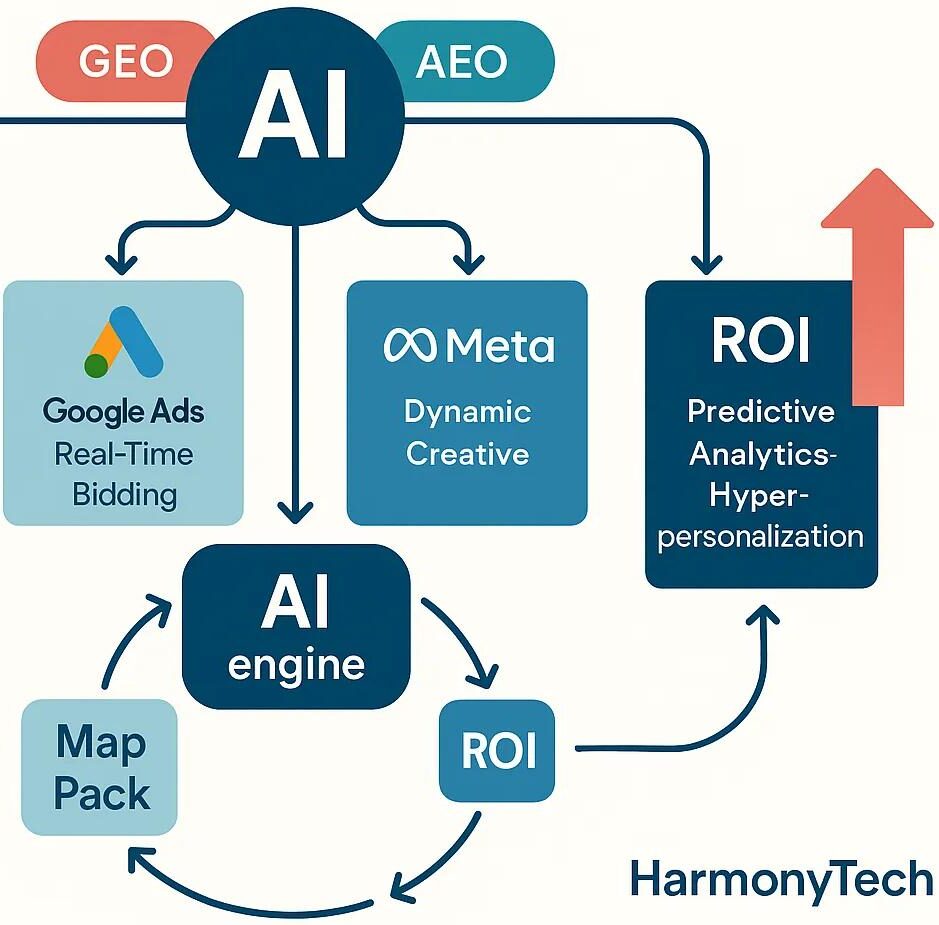
AI-powered paid media uses predictive bidding, audience scoring, and creative automation to sharpen efficiency and local relevance. Predictive bidding tweaks bids in real time based on conversion probability signals like micro-location, time of day, and device. Audience scoring segments users by predicted value so you bid more where return is higher and pull back where it’s lower. Creative automation generates many ad variants tied to local offers and rotates them using early-stopping rules to prioritize winners. The result is concentrated spend where it pays and faster creative optimization in competitive South Florida markets. Our AI-powered paid media optimization maximizes your ROI through intelligent bidding and targeting strategies.
This kind of real-time optimization is a core aim of advanced AI advertising systems — automated adjustments plus detailed performance analytics.
Here are practical paid-media levers SMBs can apply with measurable expectations.
- Real-time bid adjustments by micro-location and intent: Drives more conversions in high-value neighborhoods.
- Audience scoring for prioritized spend: Lowers CPA by focusing on high-propensity users.
- Template-driven dynamic creatives: Speeds iteration and boosts engagement with localized messaging.
These paid-media tactics turn predictive signals into optimized spend and stronger KPIs. The sections below dive deeper into bidding mechanics and creative automation.
How does AI optimize PPC bidding and audience segmentation locally?
AI optimizes PPC bidding by combining conversion-likelihood models with contextual signals — search query, micro-location, time, and device — to estimate expected value per auction. Bidding engines then apply multipliers for high-value signals and scale back when predicted returns fall, keeping budgets efficient. Audience segmentation uses clustering and propensity models to reveal micro-segments — event attendees or nearby shoppers — letting you tailor bids and messages for each group. This granular approach cuts wasted impressions and improves conversion rates when models are refreshed and fed accurate conversion data.
To set this up you need reliable conversion tracking and a feedback loop that feeds post-click behavior back into model training for continuous refinement.
What AI techniques help with real-time ad creative generation and A/B testing?
AI techniques include template-driven generation, asset recombination, and automated multi-arm testing with early stopping. Generative systems produce headline, description, and image variations based on audience signals, then test them in parallel. Multi-arm bandit algorithms allocate traffic to higher-performing variants while minimizing exposure to losers, accelerating learning and improving campaign ROI. Creative metadata (audience, placement, performance) feeds back into generation rules so future creative reflects proven elements. Operationalizing this loop streamlines production and keeps messaging relevant to hyperlocal audiences.
This iterative creative cycle ties directly into personalization and automation workflows to form a focused performance engine.
What are effective AI content strategies for localized marketing?

AI content strategies blend idea generation, entity-based SEO, and human editing to scale high-quality, localized assets — blog posts, video scripts, and social content. Start with topic ideation driven by local search signals and event calendars, then use generative models to create drafts optimized for target entities and semantic relevance. Apply NLP for entity extraction and topic modeling so each piece aligns with local intent and schema. Human editors then refine tone and factual accuracy, adding the local details that resonate in Miami, Fort Lauderdale, or Margate. This balance produces content that connects with local audiences and performs well for semantic search.
Below is a short checklist of core stages and checks for generating localized content at scale.
- Cluster ideas by local intent and events: Focus on neighborhoods and seasonal demand.
- Generate drafts with entity-aware prompts: Create structured drafts that include target entities and schema signals.
- SEO optimize and human edit: Confirm accuracy, brand voice, and local relevance before publishing.
This workflow balances scale with quality control so you maintain consistent content output that supports both SEO and paid campaigns.
How does AI generate and optimize blog, video, and social content for South Florida businesses?
AI produces content via a staged pipeline: research and ideation, draft generation, SEO and entity optimization, and human review for localization and compliance. During research, models surface trending local queries and content gaps. Drafts include entity-rich headings and schema-ready snippets to improve semantic matching. Optimization layers add internal links, structured data, and local phrases to capture neighborhood intent. Final human review adjusts tone to local context and verifies facts to avoid errors. This pipeline delivers scalable content while retaining the regional specificity that converts in South Florida markets.
When each asset has a clear discovery or conversion goal and aligns with paid and organic plans, content becomes a reliable growth driver.
What role do NLP and generative AI play in semantic content marketing?
NLP and generative AI power semantic content marketing by extracting entities, detecting intent, and producing contextually relevant drafts that align with knowledge-graph signals. NLP identifies entities and topics to map content to searcher intent, and generative models create initial copy that editors refine for accuracy and tone. This combination increases the chance content satisfies semantic queries, appears in AI summaries, and matches entity-based search signals. Human editors validate relationships and ensure local specificity and factual correctness.
Used thoughtfully, these technologies speed content production and lift semantic relevance, closing the loop from content to conversion for local businesses.
If you’re ready to apply these strategies in South Florida, Harmony Technologies offers consultative services that combine local SEO, predictive analytics, automation tooling, and content workflows tailored to Miami, Fort Lauderdale, and Margate. Our work emphasizes measurable outcomes and practical implementation so SMBs can adopt AI without heavy technical overhead.
We also publish applied learnings and advanced techniques in our A.I. Ranking Blog, with real examples and case takeaways for practitioners.
To get started, Harmony Technologies provides consultations, audits, and local case reviews to identify the highest-impact AI tactics for your market. If you want a tailored plan, request a consultation or an audit that evaluates your local SEO, predictive models, automation stack, and content workflows; the audit highlights prioritized actions, estimated KPIs, and a rollout roadmap designed for South Florida SMBs. This gives you a direct path from strategy to measurable execution without large upfront commitments.
**
No Responses