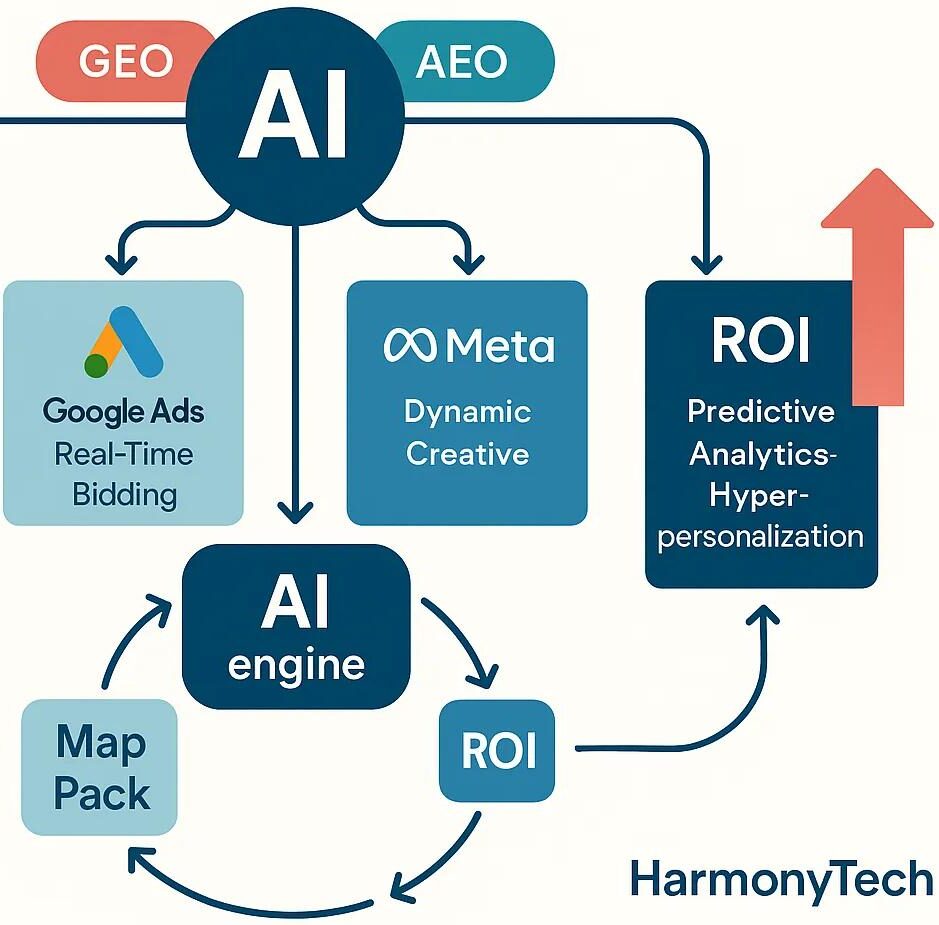
AI SEO, AEO, GEO
Artificial intelligence has moved from being an add‑on in SEO to becoming a structural force that changes how search engines interpret content and how users discover information. In 2026, AI-driven ranking systems focus far more on intent, entities, and user satisfaction than on surface-level keyword matching.
Modern search engines use machine learning and large language models to:
- Interpret queries in natural language, including ambiguities and multi-intent questions.
- Model relationships between entities (people, places, products, ideas) rather than just words.
- Predict which piece of content is most likely to satisfy a user in a given context (device, location, history).
For SEO professionals, “AI SEO” is not a single tactic. It is a way of working that integrates AI into:
- Research (keywords, questions, topics, audiences).
- Creation (drafting, outlining, editing, localizing).
- Optimization (internal linking, metadata, semantic coverage).
- Testing and measurement (predictive modeling, anomaly detection).
The key mindset shift is this: instead of asking “How do we rank for this keyword?”, the modern practitioner asks “How do we best solve the intent behind this cluster of questions and situations, at scale, with the help of AI?” Our
comprehensive local SEO services help South Florida businesses dominate local search results.
AI Content Optimization-What AI content optimization means
AI content optimization is the practice of using AI systems to plan, create, refine, and maintain content so it:
- Aligns tightly with user intent.
- Covers topics comprehensively and semantically.
- Meets quality standards for clarity, depth, and accuracy.
- Performs measurably better on organic and AI-driven surfaces.
The objective is not to outsource thinking to machines, but to:
- Offload repetitive analysis.
- Generate structured starting points.
- Surface gaps and opportunities that humans might miss.
- Maintain quality across large content libraries.
The optimization lifecycle
A robust AI content optimization workflow typically follows a repeatable lifecycle:
- Intent and audience definition
- Clarify primary and secondary intents (e.g., “how to choose”, “compare”, “troubleshoot”).
- Identify audience segments (experience level, role, geography, industry).
- Topic and query mapping
- Cluster related queries into topics.
- Map each topic to a content asset (pillar, cluster article, FAQ, guide, video script).
Outline and structure generation
- Use AI to propose outlines covering:
- Definitions and fundamentals.
- Use cases and examples.
- Process steps or frameworks.
- Pitfalls, FAQs, and advanced considerations.
- Draft creation and human editing
- Generate draft sections, not finished pages.
Edit for:
- Accuracy and source support.
- Brand voice and nuance.
- Legal, medical, or financial compliance where relevant.
- On‑page optimization
- Refine titles, headings, and subheadings.
- Improve introductions and conclusions for clarity.
- Ensure internal links connect to related resources.
- Optimize images, alt text, and media descriptions.
Semantic enrichment
- Add definitions, examples, and context where the model glossed over complexity.
- Expand sections that answer related but distinct user questions.
- Introduce entities (companies, tools, standards, locations) clearly.
- Measurement and iteration
- Track rankings, clicks, dwell time, conversions, and engagement.
- Use AI to spot underperforming sections and suggest revisions.
- Refresh content on a cadence tuned to the volatility of the topic.
Practical techniques
Some concrete techniques used by advanced teams in 2026:
- Generate multiple intros or explanations, then choose or blend the clearest.
- Ask AI to “argue against” a section to surface missing caveats.
- Use AI to produce content at different expertise levels:
- Executive summary version.
- Practitioner guide version.
- End-user “how to” version.
- Create multilingual variants and then have native editors refine tone and idioms.
- Ask for edge cases and failure scenarios to deepen troubleshooting sections.
Discover
proven strategies to boost local rankings and attract more customers in your area.
Semantic SEO With AI-From keywords to entities
Semantic SEO is the practice of optimizing content around meanings, entities, and relationships instead of isolated keywords. AI accelerates this shift by making it feasible to:
- Extract entities (brands, tools, standards, people, locations) from content.
- Map how entities relate (is a type of, competes with, located in, used for).
- Understand the multiple intents behind a single phrase (“python” as language vs animal vs tool).
Search engines rely increasingly on this entity graph to:
- Determine what a page is about.
- Decide whether a page is authoritative on a topic cluster.
- Connect content to knowledge panels, carousels, and AI-overview style answers.
Using AI to design semantic coverage
To practice semantic SEO with AI:- Identify the core entity and context
- For “AI SEO”, related entities might include: search engines, ranking algorithms, structured data types, specific tools, verticals like ecommerce or local businesses.
- Generate entity and topic maps
Use AI to produce:
- A list of closely related entities.
- Conceptual “chapters” that fully cover the subject.
- Adjacent topics (e.g., analytics, content strategy, UX, CRO) that intersect with the core theme.
- Develop pillar and cluster content
Pillar pages:
- Broad, comprehensive reference pages (like the one you are creating) that introduce all major subtopics.
- Cluster pages:
- Deep dives into narrower issues: “AI-assisted schema markup”, “AI for ecommerce SEO”, “AI prompts for content audits”.
- Design internal linking based on relationships
- Link entity mentions to their cluster pages.
- Link up from cluster pages to the pillar as the canonical overview.
- Use consistent anchor text that reflects meaning, not just a single keyword.
Semantic patterns in content
AI can help you:
- Rewrite sentences to include clear cues about relationships, such as “X is a framework for Y”, “X differs from Y in that…”, “X is commonly used in Z scenarios”.
- Add short, explicit definitions when introducing new entities.
- Highlight contrasts and comparisons, which are helpful signals for search and for readers.
The result is a content ecosystem that:
- Feels coherent to humans.
- Is easier for AI-driven systems to interpret and reuse in answers, overviews, and snippet-style features.
AI SEO Tools 2026-Categories of tools
In 2026, AI SEO tools commonly fall into several overlapping categories:
- Research and strategy tools
- Keyword and topic discovery.
- Intent classification and clustering.
- Competitive and gap analysis.
- Content creation and optimization tools
- Drafting, outlining, and rewriting.
- Readability, tone, and clarity scoring.
Semantic coverage and “topical authority” suggestions.
- Technical and on‑page tools
- Automated audits of meta tags, headings, internal links, and site architecture.
- Structured data suggestion and validation.
- Image and media optimization (e.g., alt text generation).
Monitoring, analytics, and prediction tools
- Rank tracking integrated with AI-driven anomaly detection.
- Forecasting of potential traffic impact from specific changes.
- SEO “copilots” embedded in analytics suites.
Key capabilities to look for
When evaluating AI SEO tools in 2026, professional teams often ask:
- Does it provide transparent reasoning or only scores?
- Can it integrate with our CMS, analytics, and data warehouse?
- Does it offer entity-level insights or only keyword lists?
- How customizable are prompts, templates, and scoring criteria?
- What guardrails exist against hallucinations or incorrect technical recommendations?
A high-value stack for a serious team might include:
- A research tool for clustering and intent.
- A content assistant integrated into the writing environment.
- A technical auditor that runs continuously.
- A monitoring platform with AI-based insights.
Future of SEO With AI Direction of Travel
Several long-term trends are visible:
- More AI in ranking systems
Search engines will continue to refine models that:
- Infer user intent even from vague inputs.
- Personalize results based on behavior, context, and modality (voice, text, image).
- Integrate non-web data (apps, offline sources) more holistically.
- Rise of AI-native experiences
Users will increasingly interact with:
- Conversational interfaces that summarize across many sources.
- Domain-specific assistants (for travel, health, finance, learning).
- Voice-based and multimodal search where the “page of links” is secondary.
- Higher expectations for quality
As AI makes content production cheaper, the bar for:
- Original insight.
- Empirical backing.
- Experience-based perspective will rise.
Strategic implications for professionals
To remain effective, SEO and content leaders will:
- Treat search as just one channel in a broader answer and discovery ecosystem.
- Invest more in:
- Original research and proprietary datasets.
- Expert commentary and thought leadership.
- Clean, well-structured information architectures.
Consider SEO, UX, and product content as a unified practice:
- Content must not only rank but also convert, educate, and retain users.
- AI can support this whole journey, not merely the click.
- Build skills and processes around:
- Prompt design and evaluation.
- AI governance, review workflows, and quality control.
- Cross-functional collaboration between marketing, product, legal, and data teams.
AI Search Visibility-Beyond ten blue links
“AI search visibility” refers to how often and how prominently your brand or content:
- Appears in AI-overview panels, summaries, and snapshots.
- Is cited or referenced by AI assistants and answer engines.
- Influences users’ decisions even when they never click to your site.
Traditional visibility metrics (rank, impressions, CTR) remain useful, but must be complemented by:
- Presence in featured snippets, knowledge panels, carousels, and FAQs.
- Share of voice in question-answer boxes and AI-generated overviews.
- Brand sentiment and authority signals across the broader web.
Levers for improving AI search visibility
To improve visibility in an AI-driven search environment:
- Become an authoritative source
- Create definitive, well-structured resources on focused topics.
- Publish original data, deep comparisons, frameworks, and case studies.
- Show expertise, experience, authority, and trustworthiness.
Optimize for extraction and reuse
- Use clear headings keyed to natural-language questions.
- Provide concise, direct answers near the top of the relevant section.
- Include supporting details, examples, and citations that an AI system could surface.
Maintain freshness and correctness
- Update pages when standards, laws, tools, or practices change.
- Correct inaccuracies promptly and visibly.
- Version important resources so references remain meaningful.
Visibility in AI search will increasingly reward:
- High-signal content with low ambiguity.
- Strong alignment between structured data and visible text.
- Brands that demonstrate consistent, long-term reliability.
Local AI SEO South Florida-Local search in an AI-first world
Local SEO is being reshaped by AI in several ways:
- Queries are more conversational: “Who’s the best dentist open now near Brickell who takes my insurance?”
- Results are more personalized based on:
- Micro-location (not just city).
- Past behavior and preferences.
- Real-time factors like traffic or open hours.
For South Florida businesses, this creates both complexity and opportunity. Our
Palm Beach County marketing strategies are tailored to the unique business landscape of the area. As are our
Broward County Marketing Strategies and our
Miami-Dade County Marketing Strategies.
Foundations for South Florida businesses
Key elements for local AI SEO in South Florida:
- Accurate, rich business profiles
- Ensure your business information is consistent across:
- Google Business Profile.
- Apple Maps, Yelp, and key local directories.
- Industry-specific and neighborhood sites.
- Use detailed categories and attributes (e.g., languages spoken, amenities, specialties).
- Location- and neighborhood-focused content
Create pages tailored to:
- Specific neighborhoods (Wynwood, Brickell, Coral Gables, Fort Lauderdale Beach, Boca Raton, etc.).
- Local problems and seasonality (hurricane preparedness for certain services, tourism peaks, snowbird seasons).
- Highlight real local expertise:
- Guides, itineraries, checklists, neighborhood comparisons.
- AI-assisted local keyword and review analysis
- Use AI to:
- Cluster local queries (“near me”, “open late”, “best for families”).
- Analyze review text to identify recurring praise and complaints.
- Surface “jobs to be done” that your content and operations can address.
Example: 90‑day local AI SEO plan (South Florida)
A sample 90‑day plan for a South Florida service business:
Days 1–30
- Clean and standardize NAP (name, address, phone) and categories across listings.
- Use AI tools to:
- Extract common themes from past reviews.
- Generate a prioritized list of local intent keywords.
- Create or refresh:
- A main “South Florida” hub page.
- At least two neighborhood‑specific pages.
Days 31–60
- Build out:
- FAQ content based on real customer questions.
- “Best of” or comparison content (e.g., “How to choose a [service] in Miami vs Fort Lauderdale”).
- Launch a structured review‑response process:
- AI-assisted drafts.
- Human review and personalization before publishing.
Days 61–90
- Add:
- LocalBusiness and relevant schema to core pages.
- Event or Offer schema for time-bound promotions.
- Analyze performance changes and refine:
- Target neighborhoods.
- Service descriptions.
- Local partnerships and backlinks.
Answer Engine Optimization (AEO)-What AEO is
Answer Engine Optimization focuses on making your content:
- Easy for answer engines and AI systems to consume.
- Likely to be selected as a snippet or citation.
- Structured so that it can be reused in multiple contexts (voice, chat, cars, devices).
Traditional SEO asks: “How do we rank?”AEO asks: “How do we become the most reliable answer on this topic, in reusable form?”
Answer Engine Optimization (AEO) Tactics: Structuring Answers for SEO
Key tactics for AEO include:
- Question-first structuring
- Use headings phrased as questions users actually ask.
- Follow with:
- A concise, direct answer (2–4 sentences).
- Then, supporting explanation, examples, and caveats.
Lists, tables, and steps
- Represent processes as numbered steps.
- Compare options in tables.
- Summarize pros and cons clearly.
Explicit definitions and thresholds
- Define terms in a single, clear sentence.
- Use specific numbers, dates, ranges, or conditions when describing criteria.
- Evidence and credentials
- Where appropriate, mention:
- Research basis.
- Professional experience.
- Certifications or standards followed.
By aligning your content with the way answer engines extract and present information, you not only improve your chances of visibility, you also make your resources genuinely more useful to human readers.
AI-Powered Keyword Research-From seed terms to topic universes
AI-powered keyword research in 2026 moves beyond “search volume” lists. Modern workflows emphasize:
Intent segments:
- Informational (learn about).
- Navigational (go to).
- Commercial investigation (compare, review).
- Transactional (buy, sign up, book).
Topic clusters:
- Sets of related queries that should be addressed together or in a structured set of pages.
- Opportunity analysis:
- Difficulty vs potential value.
- Competitor coverage vs content gaps.
- Emerging trends vs declining interest.
AI-accelerated process
A practical AI-based research process:
Seed collection
- Gather seed phrases from:
- Existing analytics and site search.
- Sales and support conversations.
- Competitors and industry sites.
Expansion and clustering
- Use AI to:
- Generate related queries, questions, and long-tail variants.
- Group them into clusters around shared intents or entities.
Intent labeling and prioritization
- Label each cluster by dominant intent.
- Prioritize based on:
- Relevance to business goals.
- Funnel stage coverage (top, mid, bottom).
- Resource availability (content, experts, design).
Mapping to content
- Decide:
- Which clusters become pillars.
- Which become supporting cluster articles.
- Which can be addressed within FAQs or sections of other pages.
Continuous refinement
- Re-run clustering as:
- New products launch.
- Industry vocabulary changes.
- User behavior evolves.
The result is a keyword strategy that tracks how people truly think and ask, rather than chasing isolated phrases.
Structured Data for AI SEO-Why structured data matters
Structured data is the machine-readable layer that tells AI systems what a page is about, who is involved, where things happen, and how pieces of information relate. In 2026:
- Rich, consistent structured data is a primary way to:
- Signal entities and relationships.
- Qualify for rich results and enhanced listings.
- Increase the odds that your content is used in AI summaries or answer boxes.
- Schema.org and related vocabularies remain the backbone for:
- Article, Product, Event, LocalBusiness, Organization, FAQ, HowTo, and more.
Best practices in 2026
Modern structured data strategy includes:
- Alignment with on-page content
- Ensure the structured data doesn’t contradict visible text.
- Avoid marking up content that users cannot see.
- Depth, not just presence
- Provide all relevant properties:
For Local Business, include geo-coordinates, opening hours, service area, etc.
- For Product, include price, availability, brand, and reviews if applicable.
- For Article, provide author, datePublished, dateModified, and mainEntityOfPage.
- Entity consistency across the site
Use the same:
- Organization name and identifiers (like URLs, social links).
- Logo and contact info.
- Location details and identifiers.
- Validation and monitoring
Regularly test markup using standard tools.
- Track:
- Errors and warnings.
- Changes in rich-result eligibility.
- Click and impression trends for rich-result impressions.
Structured data as AI fuel
For AI SEO, structured data is not only about rich snippets. It is also about:
- Helping answer engines understand:
- Who you are.
- What you offer.
- Where and how you operate.
- Giving AI models unambiguous hooks to:
- Connect your content to external data sources.
- Recognize your brand in different contexts.
- Attribute information correctly in multi-source answers.
Bringing It All Together
A modern AI SEO strategy in 2026 weaves together:
- AI content optimization: Using AI to draft, refine, and maintain high-quality, intent-aligned content.
- Semantic SEO: Designing content and internal linking around entities, meanings, and relationships.
- Tooling: Selecting and orchestrating AI tools for research, creation, technical optimization, and monitoring.
- Future orientation: Anticipating shifts in AI-driven search experiences and answer engines.
- Local and niche strategies: Adapting AI SEO principles to local markets like South Florida and to specific industries.
- AEO and structured data: Optimizing for extraction, reuse, and machine understanding.
Harmony Technologies knows these topics and subjects like few others in the market. We get that jumping to the absolute top of the page means increasing your LLM visibility through the tacticals we’ve so thoroughly described. Contact Us today for
A.I. SEO services that will drive revenue to your business.