
Find Reliable Paid Media Services Near Me for Quick Results

How to Select the Best AI-Driven Local Paid Media Agency
Choosing an AI-enabled local Paid Media agency means blending technical skill with real neighborhood know‑how to boost visibility, foot traffic, and qualified leads. This guide lays out what an AI-driven local Paid Media provider does, why local experience matters in South Florida, and how to evaluate, budget for, and onboard the right partner. If you’ve wondered “How do I pick a nearby Paid Media agency that actually produces measurable ROI?” this article walks you through benefits, goal setting, budgets, interview questions, credential checks, and clear next steps. You’ll find checklists, comparison tables, and practical signals to watch for when vendors mention AI or predictive analytics. By the end, you’ll know how to choose a local Paid Media agency, which KPIs to require, and how to start a measurable partnership that leverages paid media to enhance local search strategies in Miami, Fort Lauderdale, Margate, and nearby communities.
What Are the Key Benefits of Hiring a Local Paid Media Agency Near You?

A local Paid Media agency focuses on improving search visibility and conversions for geographically targeted queries by optimizing your Google Business Profile, cleaning up local citations, and creating neighborhood-level content that matches what nearby customers are searching for. They use local keyword targeting and on-page tweaks to earn map-pack placements and drive more calls, visits, or bookings. Local teams also react faster to reputation issues and can coordinate offline partnerships and events that support citation accuracy. Pairing local insight with technical execution, enhanced by targeted paid media campaigns, typically yields higher-quality leads than a one-size-fits-all national approach.
Key advantages for businesses competing locally include:
- Stronger local search visibility and better chances of appearing in the map pack, making it easier for nearby customers to find you.
- More relevant, higher-quality leads because listings and content match local intent.
- Faster updates and responsiveness on listings, reviews, and promotions compared with remote-only providers.
- Proactive reputation management that preserves conversion rates and trust.
- Smoother integration across local strategies, with paid media, social, and earned media working together to maximize local ROI.
These benefits come from specific actions — like Google Business Profile optimization and citation consistency — which in turn translate to measurable traffic and conversions in your market.
How Does Local Paid Media Improve Your Business Visibility and Traffic?
Local Paid Media strengthens visibility by aligning three core elements: accurate listings (consistent NAP), well-optimized Google Business Profile signals, and hyperlocal on‑page content that reflects nearby search intent, and strategically integrating paid media campaigns to amplify reach. Together, these factors create clearer relevance signals for search engines and improve your chances of appearing in the map pack and local organic results. Adding structured data (schema), maintaining consistent citations, and targeting neighborhood- or city-level keywords drives impressions and actions like clicks for directions and calls. Tracking search queries, views, and actions in analytics and GBP gives you measurable evidence of improved visibility.
Research consistently emphasizes the strategic value of local optimization for businesses aiming to dominate nearby search results and grow organic traffic.
Local Paid Media Optimization & Google Strategies for Retailers
This research demonstrates why local optimization matters for retailers: it increases organic traffic and offers practical recommendations for optimizing a business in Google to win placement in the Local Pack. Using a retailer example, it shows how micromarking and local-focused data can improve visibility versus competitors and drive higher conversions.
Business optimization in the digital age: Insights and recommendations, A. Natorina, 2020
Practical next steps include auditing current listings, fixing NAP inconsistencies, building localized landing pages, and deploying local business schema. These actions create clearer search signals and better user experiences — which typically lead to more foot traffic and qualified local leads.
Why Is Local Market Expertise Crucial for Paid Media Success?
Local market expertise matters because search behavior, seasonality, and competitive dynamics differ across regions. South Florida markets like Miami and Fort Lauderdale, for example, have tourism-driven seasonality and multilingual search patterns that shift intent. An agency that understands local events, partnerships, and trends can time campaigns, target the right micro-keywords, and create culturally relevant content that converts, further enhancing these local strategies with targeted paid media efforts. Local know‑how also guides which citation sources and community channels to prioritize, strengthening local trust and authority.
Signs of genuine local expertise include region-specific case studies, sample localized keyword research, and familiarity with local review platforms. That expertise reduces wasted spend, speeds time-to-impact, and helps set realistic goals and budgets — which we cover next.
How to Define Your Paid Media Goals and Budget Before Selecting an Agency

Start by translating business objectives into measurable Paid Media goals—visibility, leads, or sales—and map those goals to KPIs like local keyword rankings, Google Business Profile actions, and lead volume. Define timelines and expected time-to-ROI so you can choose between quick citation fixes or a longer content-driven strategy. Clear goals determine the scope of services and the budget tier you’ll need. Aligning objectives with a consistent measurement plan makes it easier to compare proposals objectively.
Below is a practical EAV table showing common service levels, typical monthly costs, and realistic time-to-ROI to guide budget planning.
This comparison clarifies trade-offs: lower budgets buy essential fixes and quicker small wins, while higher tiers combine content, technical work, and paid amplification for sustained growth. Next, define the KPIs that match each package.
What Are Realistic KPIs for Local Paid Media Campaigns?
Good KPIs for local Paid Media include organic traffic growth for city-level keywords, Google Business Profile metrics (search views, map views, actions), local rankings for priority keywords, and lead-focused metrics such as form submits, phone calls, or bookings. Early targets often focus on GBP actions (for example, a 10–30% increase in three months, depending on baseline). For content-led efforts, track keyword clusters and organic visits month-over-month, then layer in conversion-rate metrics to assess lead quality. Whenever possible, tie local landing pages and GBP actions to CRM or call-tracking to verify ROI.
Academic and industry work repeatedly highlights the importance of tracking local campaigns so you can measure effectiveness and optimize performance.
Measuring ROI & Effectiveness of Local Marketing Campaigns
This paper examines the importance of tracking local marketing efforts to measure effectiveness and drive optimization. It reviews relevant metrics and KPIs—reach, engagement, conversion rates, customer acquisition cost, and return on investment—to help practitioners evaluate local campaigns in data-rich environments.
TRACKING LOCAL MARKETING CAMPAIGNS: MEASURING EFFECTIVENESS AND OPTIMIZING PERFORMANCE, 2025
Use dashboards that combine Search Console, GBP insights, and analytics goals to keep a single view of progress and spot when strategy changes are needed.
How Much Should You Expect to Invest in Local Paid Media Services?
Budget depends on scope: citation cleanup and GBP optimization sit at the lower end ($1,000–$2,000/month), while integrated Paid Media with content production and paid coordination is mid-range ($2,000–$4,000/month). Full-service programs that include AI-driven predictive analytics, ongoing content, CRO, and the strategic integration of paid media to enhance all local strategies, typically start near the higher end ($4,000–$6,000+/month). Time-to-ROI generally runs 2–9 months depending on competition and site health. Contracts should clearly list monthly tasks, reporting cadence, and expected milestones so you know what you’re paying for.
Understand these budget bands to avoid underinvesting for the outcomes you want and to compare proposals with realistic expectations.
What Essential Questions Should You Ask When Vetting a Local Paid Media Agency?
Ask direct questions that reveal methodology, transparency, and local experience so you can compare vendors objectively. Request concrete examples of measurable outcomes, ask about reporting cadence and data access, and probe how they balance AI automation with human oversight. The checklist below helps uncover whether an agency uses defensible tactics or relies on vague promises.
- Can you share specific local case studies showing percentage increases in leads or GBP actions?
- Which tools and data sources do you use, and will we have dashboard access to raw metrics?
- How do you apply AI or predictive analytics in local campaigns, and how is paid media integrated to enhance these local strategies, and what level of human review accompanies automated recommendations?
- What timeline do you propose for milestones, and how do you attribute leads to Paid Media work?
- Who will be on our account team and what are their local execution responsibilities?
These questions expose transparency and operational readiness. The next table helps you evaluate AI claims in particular.
Note: the EAV table below compares agency AI claims to the evidence they should be able to provide.
How to Evaluate an Agency’s Use of AI and Data-Driven Paid Media Techniques?
Ask for concrete artifacts: sample dashboards, the names of analytics and automation tools, model outputs applied to local keyword targeting, and a clear description of human review processes. Credible agencies will show how predictive analytics informs content calendars, and how paid media is strategically deployed to enhance local bidding and seasonal forecasts. Request model validation details and how often automated recommendations are reviewed by an analyst to prevent blind automation. Harmony Technologies, for example, emphasizes AI-powered ad optimization, audience prediction, personalized ad copy, and continuous learning from campaign data, all integrated with local strategies to ensure paid media enhances overall performance — use claims like these as a template for the evidence you should request.
Scholarly and industry research further explains how AI strategies are changing digital marketing, improving visibility and personalization at scale.
AI-Powered Paid Media & Digital Marketing for Market Competitiveness
This study investigates how artificial intelligence strengthens market competitiveness through applications in Paid Media and digital marketing for e-commerce. It shows how AI improves visibility, personalization, and customer engagement in crowded, algorithm-driven markets.
Enhancing Market Competitiveness Through AI-Powered Paid Media And Digital Marketing Strategies In E-Commerce, R. Hasan, 2025
Confirm tool names, sample exports, and oversight practices to reduce risk and understand how automation contributes to measurable outcomes.
What Red Flags Indicate an Ineffective or Misleading Paid Media Agency?
Watch for red flags: blanket guarantees of top rankings, refusal to share sample reports or case studies, vague “AI” claims without supporting evidence, opaque pricing, and no clear attribution method. Promises of guaranteed rankings or reluctance to explain methods and data sources often signal risky or outdated tactics. Push for specifics: ask for case-study URLs (or anonymized raw data), model performance metrics, and precise deliverable lists. If an agency dodges these questions or offers one-size-fits-all plans with no local tailoring, treat that as a warning.
Common red-flag behaviors include:
- Guarantees of top rankings or “secret” methods without proof.
- No sample dashboards, reports, or client references.
- Vague “AI” claims with no description of human oversight.
- Undefined deliverables or refusal to sign clear SLAs.
- Lack of clarity on how paid media specifically enhances broader local strategies.
Spotting these signs early preserves your budget and helps you hire a transparent, data-driven partner.
How to Assess Local Paid Media Agency Credentials: Reviews, Case Studies, and Transparency
Assess credentials by triangulating reviews, case studies, and transparency practices—each offers different evidence of capability and reliability. Reviews reveal client experience and communication patterns but can be biased; case studies show methods and outcomes when they include baselines, timelines, and metrics. Transparency signs include shared dashboards, a clear reporting cadence, SLA documents, and openness about tools and data sources. In case studies, look for measurable evidence such as percent increases in organic leads, timeframes, and attribution approaches.
Below is an evidence table showing the measurable proof to request when evaluating claims.
Prioritize agencies that provide verifiable data and open metric access instead of vague narratives.
After you check these credential signals, consider agencies that combine AI with local expertise and clear reporting. Harmony Technologies — headquartered in Margate, Florida and serving South Florida including Miami and Fort Lauderdale — positions itself as an AI-driven local marketing partner that emphasizes precision, local market knowledge, holistic digital tactics, and the strategic use of paid media to enhance all local strategies and deliver measurable outcomes. When reviewing any agency, ask for the same transparency Harmony highlights: sample dashboards, KPI baselines, and integrated paid/social data. Requesting these artifacts during vetting lets you validate claims and compare providers on equal footing.
This focus on measurable proof helps you choose a partner who can demonstrate real impact with transparent data and reporting.
Why Are Client Reviews and Testimonials Important in Choosing an Paid Media Partner?
Client reviews and testimonials reveal service quality, communication style, and the durability of results — but only when they include specifics such as timelines, KPIs, and context. Generic praise without metrics is weak evidence; reviews that cite measurable outcomes like increased GBP actions, better local rankings, or higher conversion rates are more useful. Verify authenticity by checking multiple platforms and requesting references for similar industries or locales. Recent, relevant reviews from South Florida businesses are especially valuable for local agencies because they reflect regional competition and nuance.
Ask for references tied to case-study data and, when possible, request raw reporting exports to confirm public testimonial claims.
How to Analyze Case Studies for Measurable Local Paid Media Results?
A strong case study includes a clear baseline, defined KPIs, the methods used (including tools and any AI components), a timeline, and an attribution approach that separates Paid Media impact from paid or seasonal effects. Check whether the case study includes third-party verification or client dashboards and whether the claimed lift matches the methods described. Ask follow-ups: how were leads tracked, which pages changed, and how did the agency control for external variables? Good case studies let you reproduce similar steps for your market.
Use these questions to judge whether a case study shows replicable, measurable outcomes or just activity without clear impact.
Why Choose an AI-Driven Local Paid Media Agency Like Harmony Technologies in South Florida?
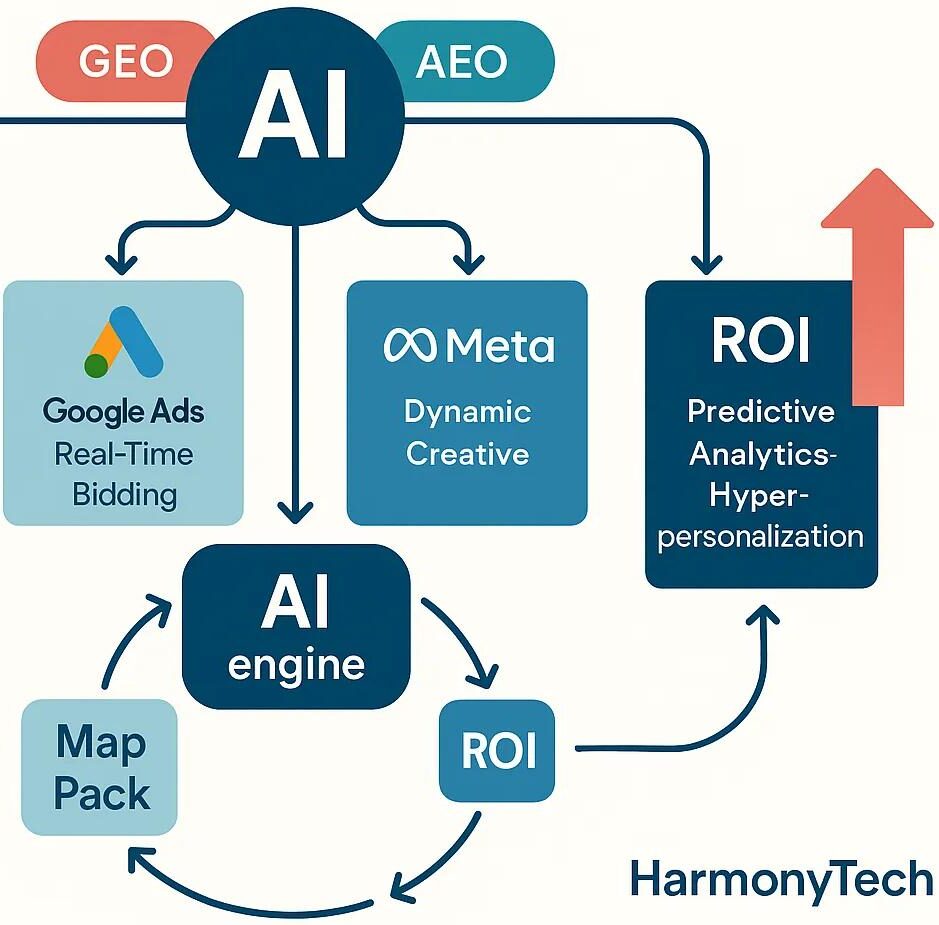
Choosing an AI-focused local Paid Media partner pairs predictive insights with local execution so you can capture shifting demand and improve ROI. Harmony Technologies — based in Margate, Florida and serving South Florida including Miami and Fort Lauderdale — emphasizes AI-driven precision to optimize ad spend, predict audience behavior, generate personalized ad copy, and continuously learn from campaign data, ensuring paid media effectively enhances all local strategies. For South Florida businesses, predictive models can anticipate seasonal surges and shift budget toward neighborhoods where demand is rising. A local presence enables faster on-the-ground adjustments that remote providers may miss.
Harmony Technologies’ Core Paid Media Services
- AI-Powered Ad Optimization: Leveraging artificial intelligence to optimize ad spend for maximum efficiency and ROI across platforms.
- Predictive Audience Targeting: Utilizing advanced analytics to identify and target high-value local audiences with precision.
- Personalized Ad Copy Generation: Crafting dynamic, personalized ad content tailored to specific local segments and user intent.
- Continuous Campaign Learning & Adaptation: Implementing systems that learn and adapt from real-time campaign data for ongoing performance improvement.
- Integrated Local Paid Media Strategies: Strategically blending paid media campaigns with local search, social, and earned media efforts for holistic digital growth.
- Hyperlocal Campaign Management: Expertly managing geographically targeted campaigns for specific South Florida markets, including Miami, Fort Lauderdale, and Margate.
Harmony’s holistic approach blends local Paid Media with paid, earned, and social strategies, where paid media is strategically added to enhance all local strategies, so search optimization and advertising reinforce each other. When evaluating partners, request sample dashboards, local case-study metrics, and a description of how AI outputs are validated by human analysts. An agency that can show model mechanics and share exportable results signals it’s ready to deliver measurable local improvements.
If you’d like to explore AI-driven local strategies, contact Harmony Technologies to discuss how predictive analytics and local expertise can be applied to your South Florida market.
What Unique Advantages Does AI-Powered Paid Media Offer for Miami and Surrounding Markets?
AI-powered Paid Media brings predictive seasonality modeling, hyperlocal personalization, and automated optimization that improve ad spend efficiency and content relevance in multilingual, tourism-driven markets like Miami and Fort Lauderdale. Predictive analytics can forecast demand shifts tied to events or travel seasons so you can proactively adjust content and bidding. Personalization can deliver dynamic content variations based on neighborhood-level intent to lift conversion rates. Automated monitoring and anomaly detection surface local reputation issues early so you can address them before they hurt conversions.
Measure AI impact with metrics such as forecast error, GBP action lift, and ROI by neighborhood. Together, these capabilities help local businesses compete more effectively against larger, national advertisers.
How Does Harmony Technologies Deliver Measurable ROI Through Local Paid Media?
Harmony Technologies focuses on measurable outcomes by combining AI forecasting with integrated reporting and clear KPI targets around traffic, leads, and conversions, strategically using paid media to enhance all local strategies and accelerate results. Agencies that truly demonstrate ROI provide baseline reports, consistent dashboards, and conversion attribution linking Paid Media work to business results. When comparing partners, ask for percent increases, timeframes, and the datasets used for attribution. Harmony’s value props — AI precision, local expertise, the strategic use of paid media to enhance all local strategies, and integrated digital marketing — should be backed by the same artifacts you request from any vendor: dashboards, exportable data, and documented timelines.
Demanding transparent evidence cuts through marketing claims and helps ensure vendor promises translate into measurable local improvements.
What Are the Next Steps After Selecting Your Local Paid Media Agency?
After you select an agency, prioritize onboarding tasks that establish access, baseline reporting, and communication protocols so work can begin quickly and progress can be measured. Onboarding should include account access (Analytics, Search Console, GBP), an initial technical and listings audit, and a baseline report with KPIs and timelines. Agree on reporting cadence and decision points for optimizations, and document responsibilities — who provides content, who approves listing changes, and escalation paths. These operational foundations reduce delays and set both parties up to iterate efficiently.
Below is a practical onboarding checklist to guide the first 60–90 days.
- Grant data access: Analytics, Search Console, and Google Business Profile with appropriate permissions.
- Complete an initial audit and baseline report capturing current rankings, traffic, and GBP metrics.
- Set agreed KPIs, reporting cadence (weekly dashboards, monthly deep-dive), and SLAs for deliverable timelines.
- Define roles and content responsibilities, approval workflows, and escalation paths.
How to Set Clear Expectations and KPIs with Your Paid Media Partner?
Set primary and secondary KPIs that map to business goals — primary might be qualified lead volume or GBP actions, while secondary could be local keyword ranking improvements and organic traffic. Agree on report formats, data access, and attribution methods to ensure transparency. We recommend weekly automated dashboards for operational metrics and monthly strategic reviews for performance and planning. Include milestone reviews at 30, 60, and 90 days to capture early wins and adapt the plan.
A simple KPI template should list objective, metric, baseline, target, and review date so responsibilities and timing are clear to both parties.
What Does a Successful Collaboration Look Like in AI-Driven Local Paid Media?
Successful partnerships combine regular, transparent reporting, joint planning sessions, iterative testing, and continuous improvement driven by data plus human insight, with paid media strategically integrated to enhance all local strategies. The agency translates AI outputs into actionable recommendations, and the client supplies timely local context to refine those recommendations. Checkpoints include monthly performance reviews, quarterly strategy recalibrations, and shared dashboards with exportable data for independent verification. Clear roles, documented responsibilities, and a culture of testing produce steady, sustainable gains rather than one-off spikes.
When these elements align, local Paid Media becomes a predictable growth channel that increases visibility, drives higher-quality leads, and helps you capture a larger share of your market.
What Does a Successful Collaboration Look Like in AI-Driven Local Paid Media?
In practice, expect iterative cycles where AI suggests optimizations, human analysts validate them, and outcomes are measured against agreed KPIs, with paid media consistently added to enhance all local strategies and accelerate impact. That loop — AI → recommendation → human review → measured outcome — creates continuous learning and sustained performance improvements essential for competitive local markets like South Florida.
Frequently Asked Questions
What should I look for in a local Paid Media agency’s portfolio?
Look for case studies with measurable results. The best portfolios include specific metrics — percentage increases in organic traffic, lead counts, and Google Business Profile actions — plus timelines and a brief explanation of methods used. Diversity of industries shows adaptability, but prioritize relevant local work. Transparency is key: agencies that can provide sample dashboards or raw data are easier to verify and trust. A strong portfolio explains both outcomes and how they were achieved.
How can I ensure my local Paid Media agency understands my specific market?
Ask for examples of past work in your industry or region and request case studies that highlight local trends, customer behavior, and competitive dynamics. Probe their local keyword research and content approach, and ask how they incorporate events, partnerships, and cultural nuances into campaigns. A competent local agency should speak confidently about regional search patterns and community channels that matter for your business.
What role does content play in local Paid Media strategies?
Content is central to local Paid Media. High-quality, localized content answers the specific questions nearby customers are asking and helps your site rank for neighborhood-level queries. That includes blog posts, city- or neighborhood-focused landing pages, and local guides that use relevant terms. Content also feeds your Google Business Profile and supports citation consistency. Regular updates and optimization keep content relevant and help attract local traffic over time.
How often should I expect to see results from local Paid Media efforts?
Timelines vary by market competitiveness and current site health. For foundational work — GBP optimization and citation cleanup — you can often see improvements in 2–4 months. Broader strategies involving content and technical Paid Media typically take 4–8 months to show noticeable lifts. Be realistic: set milestones, review progress regularly, and adjust tactics based on data.
What are the best practices for maintaining local Paid Media after initial setup?
Maintaining local Paid Media requires ongoing attention: keep your Google Business Profile current, respond to reviews, monitor citations for consistency, and publish fresh local content. Regularly review performance metrics and adapt strategies based on what’s working. Coordinate with your agency on seasonality, promotions, and local partnerships to keep momentum.
How can I measure the success of my local Paid Media campaigns?
Measure success with KPIs that map to business results: organic traffic, GBP actions (calls, directions), local keyword rankings, and lead generation (form submissions, calls, bookings). Use analytics, Search Console, and GBP insights together, and implement conversion tracking and attribution to link Paid Media activity to revenue or leads. Dashboards that combine these sources give a clear view of ROI.
Conclusion
Picking the right local Paid Media agency can materially improve visibility and lead generation in competitive neighborhoods. By combining local expertise with AI-enabled strategies, and strategically adding paid media to enhance all local strategies, along with transparent reporting, you can set measurable goals and achieve sustainable growth. Take the next step: vet agencies for local case studies, ask for dashboards and attribution, and connect with a local Paid Media expert to begin transforming your digital presence.
No Responses