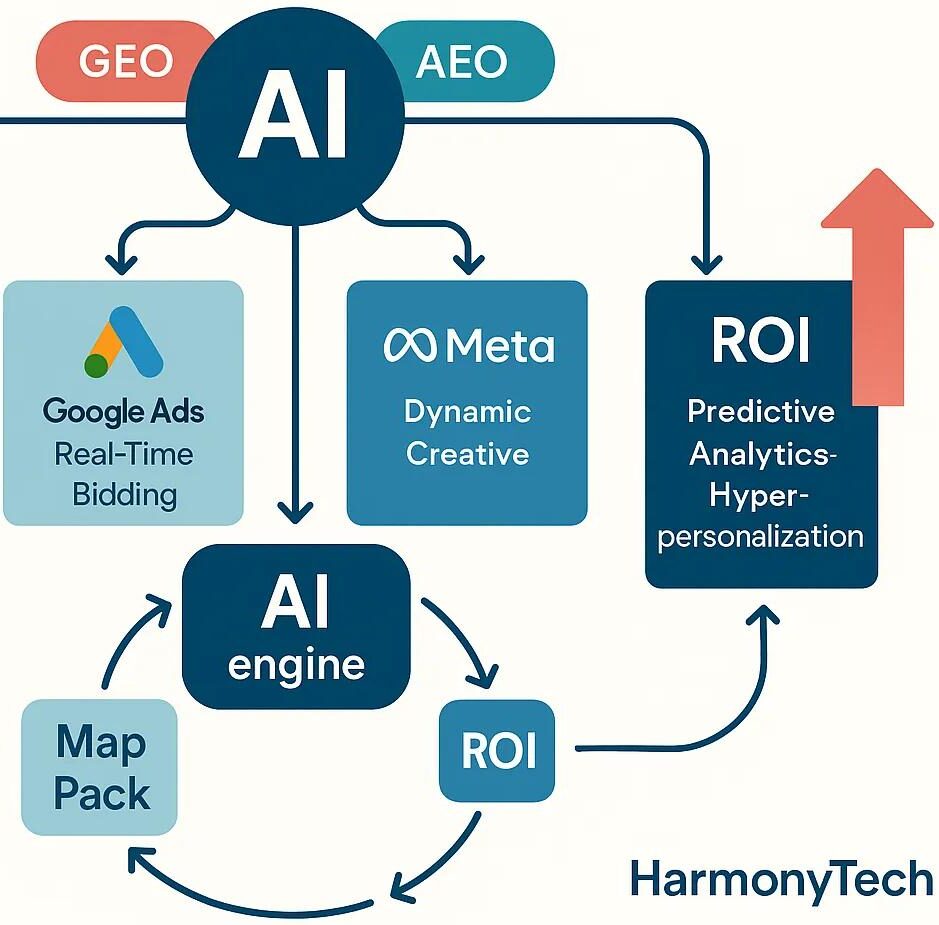
Unlock Success with Harmony Technologies Review Insights

Harmony Technologies Review: How AI-Driven Marketing Boosts ROI
HarmonyTech is an AI-driven digital marketing agency that combines generative and answer-engine optimizations with paid, earned, and social strategies to increase measurable ROI for clients. This review explains how HarmonyTech’s integrated AI approach—covering Generative Engine Optimization (GEO), Answer Engine Optimization (AEO), paid media automation, martech stack design, and local search optimization—reshapes discoverability and conversion in 2024. Readers will learn what differentiates HarmonyTech from traditional agencies, how AI augments SEO and paid channels, the practical mechanics of AI-powered social engagement, and which local tactics work best for South Florida businesses. The article first defines core capabilities and unique value propositions, then examines technical approaches (GEO/AEO), paid-media optimization loops and platform fit, scalable AI social workflows, regional advantages for Margate and South Florida, and finally the predictive analytics and personalization that drive outcomes. Throughout, the review integrates factual company details where relevant and frames evidence-based practices that marketing and procurement teams can evaluate for federal or commercial deployment.
What Makes HarmonyTech a Leader in AI-Driven Digital Marketing?
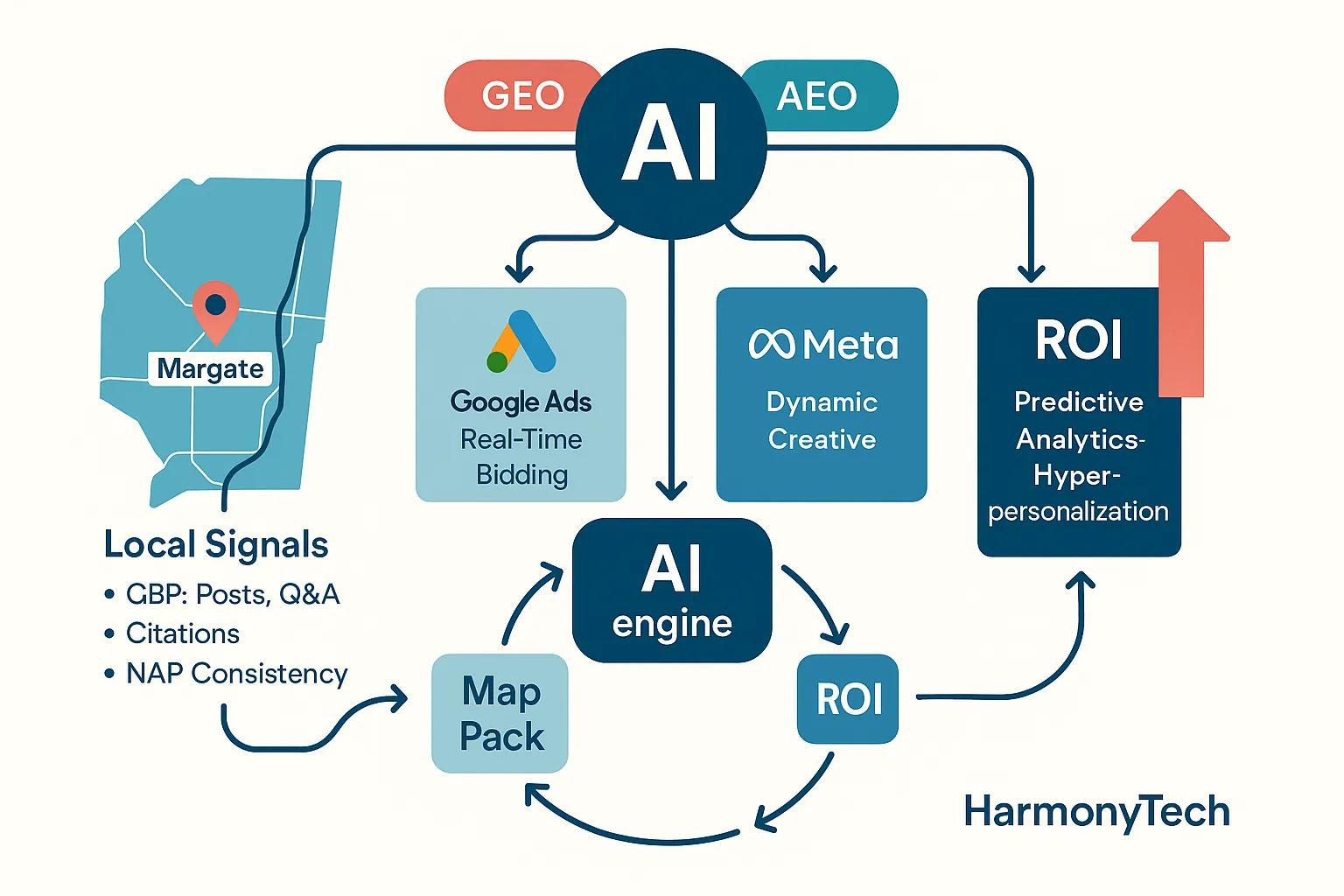
HarmonyTech positions itself as a leader by integrating AI across paid, earned, and social channels to deliver real-time optimization and predictive insights that improve both reach and ROI. The mechanism involves combining generative content capabilities with answer-engine signals and programmatic feedback loops so campaigns self-tune for engagement and conversion. The primary benefit is faster time-to-value: campaigns capture intent, adapt creatives, and reallocate spend automatically to higher-performing segments. This cross-channel AI fabric reduces manual latency in decision loops while enhancing personalization and local relevance, especially for South Florida audiences.
HarmonyTech’s leadership rests on a few distinct value propositions that separate it from one-off AI pilots and siloed marketing teams:
- Integrated AI optimization across paid, earned, and social channels, enabling unified performance gains.
- Real-time ROI maximization for paid media through predictive bidding and spend reallocation.
- Intelligent organic reach via GEO/AEO techniques that target answer engines and generative surfaces.
- Local market expertise in South Florida, allowing regionally tuned models for Margate-area businesses.
These differentiators lead naturally into how HarmonyTech adapts its solutions for different client types and mission contexts, including federal procurement and commercial enterprise scaling.
How Does HarmonyTech Serve Federal Agencies and Commercial Enterprises?
HarmonyTech applies AI-driven marketing in ways that respect the differing requirements of federal agencies and commercial enterprises, focusing on security, scale, and measurable outcomes. For federal engagements the emphasis shifts to secure data handling, compliance-aware martech stacks, and deterministic attribution models that can satisfy procurement and oversight needs. Commercial enterprises receive solutions tuned for lead generation, customer acquisition cost reduction, and scale—leveraging predictive analytics to prioritize high-value segments and maximize LTV. Both audiences benefit from the same AI backbone, but implementation details—such as data governance, platform access, and reporting cadence—are adapted to institutional priorities.
HarmonyTech’s approach to scalability and security ensures the same AI mechanisms that optimize creative and spend can be deployed within constrained environments, while the enterprise focus on attribution and conversion paths delivers actionable insights for revenue teams. This segmentation explains why federated governance and commercial agility are both achievable with a disciplined AI operations model.
What Is HarmonyTech’s Mission and Vision for AI Innovation?
HarmonyTech’s stated vision centers on enabling intelligent, scalable marketing that converts predictive signals into measurable outcomes using AI-driven martech architecture. The company emphasizes a mission of integrating Generative Engine Optimization and Answer Engine Optimization with paid and social automation to produce consistent ROI improvements and smarter organic reach. The rationale is that marketing effectiveness in 2024 depends on systems that understand intent, generate contextually relevant content, and close the loop with real-time performance signals.
Looking ahead, HarmonyTech aims to prioritize predictive analytics and hyper-personalization as core differentiators, enabling clients to anticipate demand and deliver the right message at the right moment. That vision aligns with current industry trends that favor cookieless targeting, LLM-aware SEO, and data-driven martech orchestration as essential components of modern digital strategy.
How Do HarmonyTech’s AI-Powered SEO Services Enhance Search Rankings?
HarmonyTech’s AI-powered SEO services focus on entity-first optimization and response-oriented content to capture both traditional search and emerging answer-engine traffic. The mechanism pairs Generative Engine Optimization (GEO) to scale relevant content with Answer Engine Optimization (AEO) to capture featured snippets and conversational surfaces, and the benefit is increased visibility across diverse SERP features and AI-driven discovery platforms. AI augments traditional processes by automating intent mapping, generating optimized drafts, and continuously testing content permutations against real user signals. The result is an SEO program that is both faster to scale and more tightly aligned with modern search engines and LLM-based answer layers.
This approach aligns with recent academic insights highlighting AI’s profound impact on revolutionizing traditional SEO practices.
AI’s Transformative Impact on SEO & Digital Marketing
The integration of Artificial Intelligence (AI) into Search Engine Optimization (SEO) practices has ushered in a new era of digital marketing, characterized by transformative innovations and ethical considerations. This paper delves into the profound impact of AI on SEO, elucidating its multifaceted role in revolutionizing traditional approaches to optimizing online visibility and user engagement.
Optimizing SEO with AI: Achieving Success Through Responsible Innovation, A Mitra, 2024
This table shows that GEO accelerates topical coverage while AEO targets immediate answer visibility; combining them with traditional SEO results in durable and discoverable content assets. Understanding these mechanisms sets the stage for the specific definitions of GEO and AEO.
What Are Generative Engine Optimization and Answer Engine Optimization?
Generative Engine Optimization (GEO) uses large language models and content-generation pipelines to create high-quality, context-rich pages and asset variations faster than manual authoring. GEO’s mechanism centers on semantic expansion, entity linking, and template-driven personalization, and the benefit is expanded topical authority with consistent voice and structure across content. GEO is ideal when scaling coverage for long-tail intent and dynamic informational needs.
Answer Engine Optimization (AEO) targets the extraction and presentation layers used by answer engines and conversational agents by structuring responses, using concise fact-based blocks, and optimizing for Q&A patterns. AEO’s mechanism emphasizes schema, clear entity relationships, and prioritized snippets, delivering the benefit of capturing high-visibility placements. Together, GEO and AEO complement traditional SEO by addressing both breadth and precision in modern discovery pathways.
How Does AI Improve Traditional SEO Strategies?
AI improves traditional SEO by automating labor-intensive tasks—keyword intent clustering, semantic mapping, content brief creation, and performance-driven optimization—while adding predictive capability to identify emerging opportunity windows. The mechanism is a closed-loop system where model outputs inform content creation and live performance data retrains models to prioritize the highest-impact topics. The benefit is faster iteration, reduced editorial friction, and measurable uplift in rankings and engagement.
Practical examples include automated content briefs that include entity maps and suggested schema, predictive keyword opportunities surfaced by intent trend models, and near-real-time content tuning based on user engagement metrics. These integrations reduce manual SEO backlog and make strategic prioritization data-driven, which naturally transitions into how paid media benefits from similar AI loops.
How Does HarmonyTech Maximize ROI with AI-Driven Paid Media?

HarmonyTech maximizes paid media ROI by employing real-time bid optimization, creative personalization, and cross-channel attribution to reallocate budget toward the highest-performing segments. The mechanism fuses predictive audience scoring with automated bidding engines and dynamic creative optimization, producing continuous spend efficiency improvements and the benefit of lower CPA and higher conversion velocity. This AI-driven loop shortens response times to market shifts and amplifies the impact of creative and targeting signals across platforms.
Such integrated strategies are increasingly recognized in research as crucial for enhancing customer engagement and maximizing ROI in today’s digital landscape.
Multi-Channel AI Marketing for Digital Conversion & ROI
In an increasingly digitized and data-saturated marketplace, the integration of multi-channel marketing strategies has become essential for organizations aiming to enhance customer engagement, streamline user experiences, and improve return on investment (ROI). This systematic review examines the evolution and effectiveness of integrated digital marketing approaches by synthesizing findings from 85 peer-reviewed studies published between 2005 and 2022.
MARKETING CAPSTONE INSIGHTS: LEVERAGING MULTI-CHANNEL STRATEGIES FOR MAXIMUM DIGITAL CONVERSION AND ROI, AJ Mou, 2024
To illustrate the practical tactics used for real-time optimization, consider the following list of common techniques HarmonyTech applies to paid media programs.
- Automated bid adjustments that respond to predicted conversion likelihood in real time.
- Dynamic creative personalization that swaps assets based on audience signals and intent.
- Predictive audience scoring that prioritizes high-LTV prospects for spend reallocation.
These tactics collectively create a feedback-driven optimization engine that reallocates budget and creative to where incremental ROI is highest, which is clarified further by comparing platform tactics.
This comparison highlights where HarmonyTech typically directs specific tactics: Google for intent capture, Meta for scale and creative testing, and LinkedIn for B2B and federal-targeted acquisition. Understanding platform fit supports selection of the right optimization loop.
What Real-Time Optimization Techniques Does HarmonyTech Use?
HarmonyTech employs a set of real-time techniques—automated bid engines, creative rotation tied to performance signals, and predictive bidding informed by lookalike and LTV models—to continuously improve campaign ROI. The mechanism relies on streaming performance metrics that trigger micro-adjustments in budget and creative selection, and the benefit is faster capture of high-intent traffic while limiting wasted spend. Typical outcomes include reduced cost-per-acquisition and improved conversion rates through incremental spend shift toward top-performing audiences.
Examples include:
- Automated micro-bid windows during peak intent signals.
- Creative variants that auto-deploy when engagement thresholds are met.
- Predictive reallocation across channels when cross-channel attribution shows unequal returns.
These mechanisms short-circuit manual optimization cycles and free teams to focus on strategy rather than repetitive tuning.
Which Platforms Benefit from HarmonyTech’s AI Ad Targeting and Bidding?
HarmonyTech aligns platform selection to campaign objectives: Google Ads for intent-driven acquisition, Meta for broad audience engagement and creative scale, and LinkedIn for B2B and federal outreach that requires professional targeting. The mechanism is matching each platform’s targeting primitives to the campaign’s desired conversion funnel, and the benefit is more efficient use of platform features to capture audience intent at different funnel stages. Programmatic channels are used when granular audience segmentation and third-party inventory are needed.
Choosing platforms by objective ensures predictive models and budget allocation routines are optimized for the unique data signals each channel provides, which naturally leads into how those same AI approaches apply to social media engagement at scale.
How Does HarmonyTech Engage Audiences at Scale with AI Social Media Marketing?
HarmonyTech engages audiences at scale by combining AI-driven content generation, predictive scheduling, and automated engagement workflows that mimic authentic responses while scaling interactions. The mechanism uses audience segmentation, tone-matching models, and posting-time optimization to increase relevance and timeliness, and the benefit is consistent, personalized presence across platforms without requiring proportional human resources. This method improves signal-to-noise in social feeds and supports brand-consistent messaging across large follower bases.
To clarify the social content process, here are the main workflow steps HarmonyTech uses to deliver personalized social at scale.
- Audience signal collection feeding segmentation and persona models.
- Automated content generation with tone matching and variant creation.
- Predictive scheduling and response automation to maximize engagement windows.
These steps create a continuous performance loop that refines voice and timing, which sets up the specifics of content creation and scheduling below.
How Is AI Used for Personalized Content Creation and Scheduling?
AI-driven social content pipelines begin with audience segmentation and intent signals that inform personalized content generation, followed by predictive scheduling engines that place posts when target segments are most receptive. The mechanism blends generative copy and asset variants with tone and brand safety constraints, producing content tailored to micro-segments, and the benefit is higher engagement with lower creative overhead. Scheduling predictions are based on historical engagement patterns and platform-specific peak windows, which increases the probability of organic reach.
This approach allows teams to maintain consistent brand presence at scale while the models learn optimal cadence and content types, bridging into the next discussion of engagement benefits.
What Are the Benefits of AI-Enhanced Social Media Engagement?
AI-enhanced social engagement yields faster response times, improved personalization at scale, and measurable increases in reach and conversion by prioritizing high-impact interactions. The mechanism is automated triage and response combined with sentiment-aware routing, which benefits customer experience and brand perception while enabling human agents to focus on complex issues. Typical metrics that improve include response rate, engagement per post, and conversion actions tied to social interactions.
These improvements make social channels both a performance and retention tool, and they feed back into paid and organic programs to amplify overall marketing effectiveness.
What Advantages Does HarmonyTech Offer for Local AI Marketing in South Florida?

HarmonyTech offers localized AI marketing capabilities that optimize Google Business Profile signals, localized content, and citation management to improve visibility for Margate and South Florida businesses. The mechanism uses region-specific audience modeling and automated GBP recommendations to surface the right local attributes and responses, and the benefit is increased foot traffic, calls, and local conversions for businesses competing in dense markets. AI models factor in regional language, seasonal patterns, and local intent to prioritize the most impactful local SEO actions.
Below is a concise mapping of local SEO signals to AI-driven enhancements and expected visibility outcomes.
This EAV mapping demonstrates how AI augments traditional local signals to produce clearer local discovery and stronger map-pack performance. The next subsection outlines tangible local applications and illustrative regional outcomes.
How Does AI Improve Local SEO for Margate and South Florida Businesses?
AI improves local SEO by generating locally relevant content, recommending GBP optimizations, and monitoring citation consistency to ensure signals align across the web. The mechanism includes automated suggestions for local post topics, AI-crafted Q&A responses, and priority fixes for inconsistent NAP data, and the benefit is improved performance in local pack results and higher conversion intent from searchers. Region-specific audience modeling also helps tailor offers and times to local behavioral patterns.
A simple optimization checklist for local businesses includes:
- Maintain GBP completeness with AI-suggested posts
- Ensure citation uniformity
- Create localized landing pages with AEO-friendly answers
What Success Stories Highlight HarmonyTech’s Regional Impact?
Regional impact examples typically describe measurable local visibility and conversion gains for small-to-medium businesses and enterprise regional campaigns using HarmonyTech’s AI stack. The mechanism is targeted local modeling and multi-channel orchestration that aligns GBP, local landing pages, and paid local ads, producing benefits such as higher map-pack placements and improved local conversion rates. Illustrative outcomes emphasize uplift in local calls, foot traffic, and form submissions in competitive South Florida markets.
These kinds of regional improvements reflect HarmonyTech’s focus on local market nuances and set the context for why prospective clients evaluate predictive analytics and personalization as decisive factors for 2024 engagements.
Why Choose HarmonyTech for AI-Driven Digital Marketing in 2024?
HarmonyTech is positioned as a compelling choice in 2024 because it combines predictive analytics, hyper-personalization, and cross-channel AI automation to deliver measurable improvements in acquisition and retention. The mechanism integrates martech stack components—predictive models, content personalization engines, and real-time bidding systems—into a coherent operations model, and the benefit is reduced time-to-insight and more efficient marketing spend. These capabilities support both tactical campaign wins and strategic, data-driven growth planning that aligns to modern privacy and measurement realities.
Top reasons to consider HarmonyTech for AI-driven marketing:
- Predictive analytics that forecast customer intent and prioritize high-value opportunities.
- Hyper-personalization engines that tailor experiences across channels at scale.
- Integrated AI operations across paid, earned, and social channels for continuous optimization.
These reasons culminate in how predictive analytics and personalization concretely drive results, which is explained next along with guidance on showcasing outcomes.
How Do Predictive Analytics and Hyper-Personalization Drive Results?
Predictive analytics identify signals that foreshadow conversion intent, allowing budgets and messaging to be prioritized toward prospects most likely to convert, while hyper-personalization tailors content and offers to those high-propensity segments. The mechanism combines propensity scoring with personalized creative assembly, producing benefits such as higher conversion rates and improved ROI per dollar spent. Illustrative metric improvements often include higher click-to-conversion ratios and increased average order values when offers are dynamically matched to predicted needs.
Framing these capabilities as part of an operations model clarifies how organizations can move from reactive advertising to anticipatory marketing that allocates resources where they will have the greatest financial impact.
What Client Testimonials and Case Studies Demonstrate HarmonyTech’s Effectiveness?
Representative case-study summaries emphasize outcome-focused metrics—improved ROAS, lower CPA, and local visibility gains—derived from HarmonyTech’s integrated AI interventions, and the mechanism for validation is structured measurement and attribution across channels. While individual client data varies, typical evidence showcases faster identification of converting segments, higher-quality leads, and consistent improvements in organic and paid synergy. Publishing structured reviews and using Review/AggregateRating schema is recommended to surface credibility for prospective buyers.
For teams ready to explore a pilot or discuss specific regional or federal needs, HarmonyTech can be contacted for project inquiries via their corporate contact channels; interested stakeholders frequently begin with a discovery conversation to map objectives and measurement criteria. Contact details for inquiries include the company email info@harmonytec.net and phone 754-946-8078, which allow procurement and marketing teams to request more information or schedule an initial consultation.