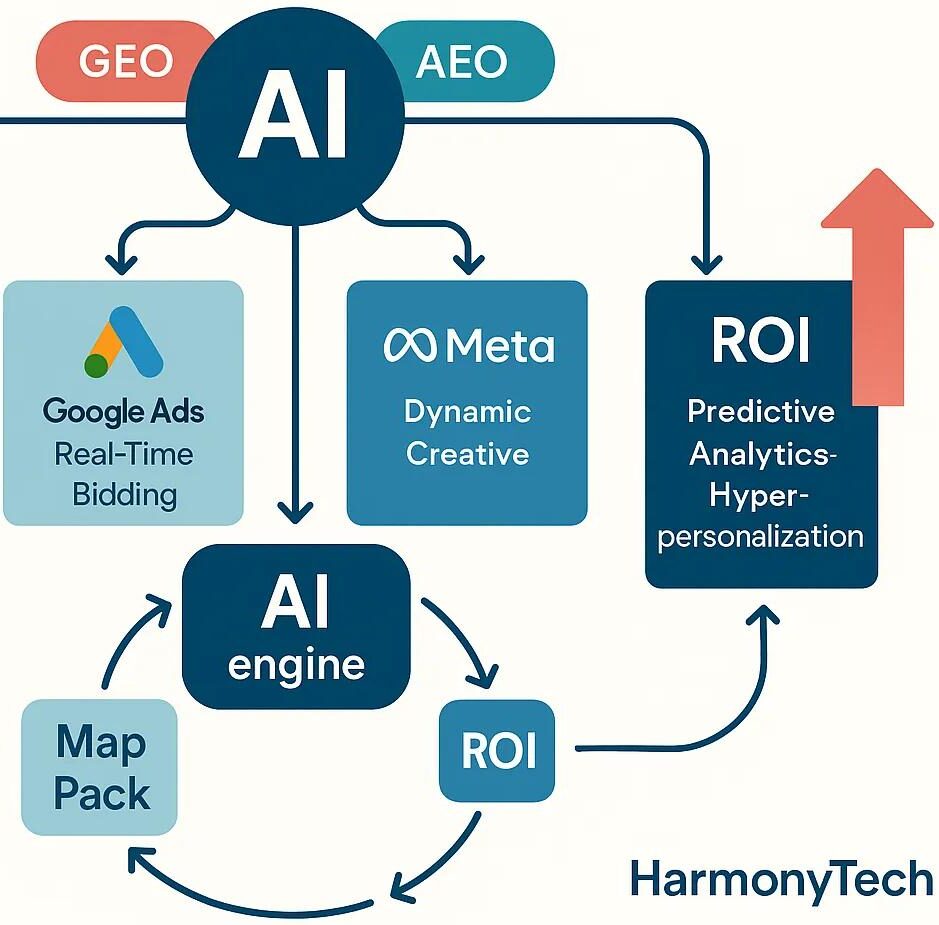
Real-time AI Optimization for Dynamic Marketing Campaigns

Drive Dynamic Campaign ROI with Real-Time AI Optimization
To maximize ROI with AI-driven marketing strategies, it is essential to ensure clean, reliable data that supports accurate targeting of neighborhoods and demographic segments. Harmony Technologies focuses on delivering AI-driven local targeting solutions by maintaining correct data pipelines from various sources, which leads to higher-quality leads, reduced wasted impressions, and improved conversion rates. By leveraging comprehensive listing data and behavioral signals, AI can create precise audience segments and tailor marketing strategies effectively. Consistency in data attributes enhances the precision of geo-targeted campaigns, ultimately boosting model confidence and campaign effectiveness.
The foundational importance of robust data pipelines for AI-driven marketing is further underscored by advanced research into automated data engineering.
AI-Driven Data Pipelines for Real-Time Analytics
In the era of big data and real-time analytics, the demand for efficient and scalable data pipeline automation has never been greater. Traditional data engineering approaches, often plagued by manual interventions, scalability limitations, and rigid architectures, struggle to keep pace with the dynamic nature of modern data ecosystems. This paper presents a groundbreaking AI-driven framework designed to revolutionize end-to-end data engineering processes by embedding intelligence at every stage—from data ingestion and transformation to quality assurance and deployment. Leveraging cutting-edge machine learning algorithms, natural language processing (NLP), and automated metadata management, our system dynamically adapts to schema changes, recommends optimal pipeline configurations, and detects anomalies with minimal human oversight. The framework uniquely integrates reinforcement learning for real-time pipeline optimization and employs graph-based models for comprehensive
AI-driven data engineering: Streamlining data pipelines for seamless automation in modern analytics, S Peddisetti, 2023
What is Real-time AI Optimization in Marketing?
Real-time AI Optimization in Marketing refers to the use of accurate and reliable data to enhance AI models for targeting specific neighborhoods and demographic segments effectively. This involves employing clean data for lookalike modeling, geofencing, and bidding strategies, which can lower cost per acquisition (CPA) and increase conversion rates. By ensuring that data pipelines provide correct attributes, businesses can achieve higher-quality leads, reduce wasted impressions, and improve campaign effectiveness through precise audience targeting.
This real-time optimization is powered by sophisticated machine learning techniques that continuously learn from diverse consumer interactions to predict conversions and refine campaign delivery.
Real-Time ML Campaign Optimization & Conversion Prediction
Machine Learning (ML) has emerged as a pivotal technology for transforming digital marketing by enabling real-time decision-making based on multimodal consumer interaction data. At a macro level, ML empowers marketers to transcend rule-based targeting by continuously learning from diverse user data streams including click behavior, social media activity, device usage, sentiment in reviews, and past purchases. This rich interaction data is fused to model customer intent, optimize campaign delivery, and forecast conversions with high precision. Techniques such as gradient boosting, recurrent neural networks, and deep learning architectures allow platforms to adaptively segment users and dynamically adjust ad content and timing for maximum impact.
Machine Learning in Digital Marketing: Real-Time Campaign Optimization and Conversion Prediction Using Multimodal Consumer Interaction Data
How does AI enable instant marketing adjustments?
AI enables instant marketing adjustments by analyzing accurate and impeccable data to provide superior audience segmentation and precise targeting. This allows businesses to quickly adapt their ad placements and messaging based on real-time customer behavior and preferences, leading to more relevant marketing efforts and improved ROI.
What distinguishes real-time AI from traditional marketing methods?
Real-time AI distinguishes itself from traditional marketing methods by leveraging clean, reliable data to enable sophisticated lookalike modeling, precise geofencing, and relevance-driven bidding strategies. This results in tighter cost-per-acquisition (CPA) and boosted conversion rates. AI systems can accurately predict neighborhoods with higher conversion potential and tailor creative and bidding strategies accordingly, while traditional methods may rely on broader, less precise targeting that can lead to wasted impressions and lower campaign effectiveness.
How Does AI-Driven Paid Media Enhance Dynamic Campaigns?

AI-driven paid media enhances dynamic campaigns by utilizing clean, reliable data to improve targeting accuracy. This enables sophisticated lookalike modeling, precise geofencing, and relevance-driven bidding strategies, which help to tighten cost per acquisition (CPA) and boost conversion rates. By ensuring that data pipelines feed correct attributes into audience models, campaigns can achieve higher-quality leads, reduce wasted impressions, and deliver measurable conversion lifts. Additionally, consistent data allows AI systems to predict neighborhoods with higher conversion potential, facilitating tailored creative and bidding strategies that enhance campaign effectiveness.
What are the benefits of AI-powered ad spend optimization?
- Precise Audience Targeting: AI-driven systems can construct accurate audience segments based on structured business data, ensuring ads reach the most relevant audiences.
- Personalized Messaging: AI can tailor messaging to better resonate with specific audience segments, enhancing engagement.
- Optimized Spend Allocation: AI helps allocate ad spend more effectively, reducing wasted expenditure on less relevant audiences.
- Improved Engagement Metrics: By leveraging amplified relevance and behavioral signals, businesses can achieve higher click-through rates (CTRs), increased calls, and more direction requests.
- Reduced Decision Friction: An optimized profile with clear information makes it easier for customers to make decisions, leading to a shorter time-to-conversion.
- Enhanced Algorithmic Standing: Tracking key metrics allows businesses to understand how profile adjustments impact their visibility and relevance in search results.
- Adaptability to Market Dynamics: AI can respond to fluctuating demand and diverse queries, ensuring that marketing efforts remain effective in a dynamic environment.
How do real-time bidding and targeting improve ROI?
Real-time bidding and targeting improve ROI by enabling precise geofencing and relevance-driven bidding strategies that tighten cost per acquisition (CPA) and boost conversion rates. Clean, reliable data allows for sophisticated lookalike modeling and accurate audience segmentation, which leads to higher-quality leads and reduced wasted impressions. This strategic targeting results in measurable conversion lifts for campaigns, ultimately enhancing the effectiveness of advertising efforts.
In What Ways Does AI Improve SEO, GEO, and AEO Strategies?
AI improves SEO, GEO, and AEO strategies by ensuring accurate metadata, service descriptors, and consistent categories, which are critical for targeting the right neighborhoods and demographic segments. Clean, reliable data enables sophisticated lookalike modeling, precise geofencing, and relevance-driven bidding strategies, leading to tighter CPA and increased conversion rates. AI systems can accurately predict neighborhoods with higher conversion potential when data is consistent, allowing for tailored creative and bidding strategies. This precision enhances the effectiveness of geo-targeted campaigns and boosts model confidence, ultimately yielding higher-quality leads and reducing wasted impressions.
How does AI boost local SEO for South Florida businesses?
AI boosts local SEO for South Florida businesses by ensuring that accurate business information is readily available and structured. This information helps customers and platforms discover, trust, and engage with the business, ultimately connecting local SEO efforts with advanced AI marketing strategies and driving tangible sales results.
What role does generative AI play in search optimization?
Generative AI plays a role in search optimization by leveraging clean, reliable data to enhance local targeting solutions. It enables sophisticated lookalike modeling, precise geofencing, and relevance-driven bidding strategies, which help tighten cost per acquisition (CPA) and boost conversion rates. By accurately predicting neighborhoods with higher conversion potential, AI can tailor creative and bidding strategies effectively. Consistent data inputs are crucial for maintaining the precision of geo-targeted campaigns, ultimately leading to higher-quality leads and reduced wasted impressions.
How Can Predictive Analytics Transform Marketing Campaigns?

Predictive analytics can transform marketing campaigns by utilizing amplified relevance signals and strengthened behavioral signals to enhance targeting and engagement. By analyzing key metrics such as click-through rates (CTRs), calls, and direction requests, businesses can optimize their profiles to better satisfy searcher intent. This optimization reduces decision friction for customers, making it more likely they will convert. Additionally, AI-driven marketing systems can use accurate business data to create precise audience segments, personalize messaging, and allocate spending effectively, ultimately improving lead quality and reducing wasted ad spend.
What is AI-driven customer behavior forecasting?
AI-driven customer behavior forecasting involves using AI-driven marketing systems to analyze structured business data, which helps in constructing precise audience segments, personalizing messaging, and optimizing spending. This process relies on accurate data to effectively target the right demographics and neighborhoods, ultimately influencing customer behavior and improving engagement metrics.
How does predictive analytics support lead scoring and market trends?
Predictive analytics supports lead scoring and market trends by enabling superior audience segmentation and precise targeting through accurate data analysis. When business information is reliable, AI models can effectively analyze customer behavior and preferences, leading to more relevant ad placements and improved messaging. This results in higher lead quality and better ROI for marketing strategies, especially in competitive markets. Additionally, monitoring engagement metrics and conversion rates provides insights into the effectiveness of data management efforts, helping businesses identify areas for strategic improvement.
How Does AI Personalize Customer Journeys and Content?
AI personalizes customer journeys and content by leveraging clean, reliable data to create sophisticated audience segments and infer intent patterns. This involves a meticulous data flow from listings to data aggregators, ad platforms, and analytics, which enables AI systems to accurately predict neighborhoods with higher conversion potential. By ensuring consistent location, category, and service attributes, AI can tailor creative and bidding strategies effectively, leading to higher-quality leads, reduced wasted impressions, and improved conversion rates.
What techniques enable dynamic content personalization?
- Accurate Service Descriptors: Ensuring that metadata and service attributes are correct and consistent.
- Lookalike Modeling: Utilizing clean, reliable data to create models that identify similar audience segments.
- Geofencing: Implementing precise geolocation strategies to target specific neighborhoods.
- Relevance-Driven Bidding Strategies: Tailoring bidding based on audience relevance to improve conversion rates.
- Behavioral Signals: Analyzing critical behavioral data to infer intent patterns and construct audience segments.
- Data Pipelines: Using comprehensive listing data and aggregator records to feed advanced audience models for precise targeting.
How does AI enhance customer engagement and conversion?
AI enhances customer engagement and conversion by enabling superior audience segmentation and precise targeting through impeccable data. Accurate business information allows AI models to analyze customer behavior and preferences, leading to more relevant ad placements and impactful messaging. This results in improved online visibility and conversion rates, fostering deeper trust and reducing marketing waste.
Indeed, the strategic application of AI models, often leveraging comprehensive customer data, is critical for evaluating engagement and optimizing marketing decisions in real-time.
AI-Driven Real-Time Marketing Optimization & Customer Engagement
In today’s dynamic business environment, marketing campaigns are pivotal in driving brand awareness, fostering customer loyalty, and boosting revenue. Customer engagement has become crucial to the success of any marketing plan as businesses intends to build stronger relationships with their target customers. Hence, a Fish School Search-driven Adaptive Long Short-Term Memory (FSS-ALSTM) model was developed to evaluate customer engagement, analyze sequential customer data and optimize marketing decisions. The dataset comprises data collected from various customers, including website visits, social media interactions, email responses, and transaction history. Preprocessing of input data includes cleaning, handling missing values, outliers, and duplicate entries.
AI-Driven system for Real-Time Optimization of Marketing Campaigns and Customer Engagement, SK Gupta, 2025
How to Measure and Maximize ROI from AI Marketing Efforts?
To measure and maximize ROI from AI marketing efforts, focus on the following strategies:
- Monitor Key Performance Indicators (KPIs): Track metrics such as conversion rates, engagement metrics (click-through rates, customer reviews), and volumes derived from platforms like Google Business Profile. Analyzing these KPIs will provide insights into the effectiveness of your marketing efforts.
- Ensure Impeccable Data: Maintain accurate and reliable business information to enable superior audience segmentation and precise targeting. Flawless data allows AI models to analyze customer behavior effectively, leading to more relevant ad placements and messaging.
- Analyze and Optimize: Conduct thorough analyses of your data management efforts to identify areas for strategic improvement. This will help in eliminating wasted ad spend and enhancing lead quality.
- Enhance Local SEO and Customer Engagement: Consistently accurate data is crucial for improving local SEO and driving customer engagement, which can significantly boost online visibility and conversion rates.
What key performance indicators track AI marketing success?
- Conversion rates derived from Google Business Profile actions.
- Engagement metrics such as click-through rates.
- Customer reviews.
How does attribution modeling improve campaign performance?
Attribution modeling improves campaign performance by ensuring accurate audience matching, which leads to a lower cost-per-acquisition (CPA) and elevated click-through rates. It enhances lead quality through precise service alignment and allows for meticulous micro-targeting, increasing relevancy for diverse audiences. This results in optimized spend allocation and a higher return on investment (ROI). Tracking quantifiable KPIs, such as reduced CPA and improved conversion rates, further validates the effectiveness of maintaining precise business information.