Choose the Best SEO Agency Near Me for Your Florida Business

Your Guide to Choosing the Best South Florida SEO Agency
Picking the right SEO agency is one of the most strategic decisions a South Florida business can make. The agency you choose affects how customers find you, how many leads you generate, and—ultimately—your revenue. This guide walks you through the evaluation process for local agencies and explains why local market knowledge plus responsible AI tools matter for cities like Miami, Fort Lauderdale, Margate, West Palm Beach, Stuart, and Port St. Lucie. You’ll get a clear explanation of local search mechanics, the top selection criteria, interview questions to ask, pricing and ROI approaches, and how modern AI changes local SEO workflows. Along the way there are comparison tables, checklists you can use immediately, and practical examples — plus a brief look at how Harmony Technologies delivers AI-enabled local SEO for South Florida clients, without the hard sell.
Why Local SEO Expertise Matters for South Florida Businesses

Local SEO matters because search engines weigh proximity, intent signals, and local relevance when deciding which businesses to show nearby customers. Effective local SEO aligns on-page content, Google Business Profile signals, and consistent citations with real user intent so your business appears in the local pack and map results. In South Florida, factors like multilingual audiences, tourism-driven demand, and fierce local competition shift keyword priorities and content choices — so local knowledge isn’t optional, it’s a multiplier for discovery and conversion.
Research reinforces the value of local optimization for retailers aiming to grow organic traffic and secure better placement in Google’s Local Pack.
Local SEO Optimization for Retailers & Google Local Pack
This study documents why optimizing a retailer’s local presence for search engines increases organic traffic. It offers practical recommendations for retailers to improve Google visibility and provides a micromarking example that helps secure an advantaged placement in the Local Pack versus competitors, ultimately boosting traffic and conversions.
Business optimization in the digital age: Insights and recommendations, A Natorina, 2020
Next, we list the practical local tactics agencies should be fluent in to win local queries.
Core local SEO tactics in South Florida include Google Business Profile optimization, targeted local content, proactive review management, and consistent citations.
Your Google Business Profile is central to these efforts; research shows careful GBP work improves local discoverability and drives actions.
Optimizing Google Business Profile for Local Visibility
This research examines how applying a structured SOSTAC approach (Situation, Objectives, Strategy, Tactics, Action, Control) to Google Business Profile can increase visibility for a beauty clinic. Despite market potential, internal constraints like limited staff and digital literacy reduced online reach; the study recommends practical steps to bridge that gap and attract new clients.
Strategi Optimalisasi Google Profile Business dalam Meningkatkan Visibilitas Online Glowmax, CS Barkah, 2025
- Google Business Profile optimization: Use accurate categories, clearly listed services, and locally targeted descriptions.
- Localized content and landing pages: Build city- and neighborhood-specific pages that match local intent in Miami, Fort Lauderdale, and Margate.
- Review and reputation management: Grow review volume, respond promptly and professionally, and use feedback to improve conversions.
- Local citations and structured data: Keep NAP consistent and implement schema so map-pack eligibility improves.
These tactics blend technical and reputation signals — the next section explains how South Florida’s market dynamics change how you prioritize them.
What Makes South Florida’s Market Unique for SEO Agencies?
South Florida needs multilingual targeting, seasonal planning, and vertical-aware keyword strategies. With large Spanish- and Portuguese-speaking populations and high tourist traffic, language-aware metadata and bilingual content often capture significant local demand. Hospitality and tourism see seasonal spikes, while clusters like real estate and healthcare require tailored buyer-journey content. Agencies unfamiliar with these demographic and seasonal patterns frequently waste content and budget — so ask for local examples when choosing a partner.
Understanding these nuances leads into how local SEO mechanics produce visible results across cities — explained next.
How Does Local SEO Impact Business Visibility in Miami, Fort Lauderdale, and Margate?
Local SEO drives visibility through three linked mechanisms: Google Business Profile signals that feed the local pack; on-site localized content that matches query intent; and citations/authority signals that confirm local relevance. In Miami, high competition and multilingual intent make city- and neighborhood-level landing pages plus GBP localization essential. In Fort Lauderdale, review velocity and proximity signals can determine map-pack placement for many service businesses, so reputation work matters. In Margate and similar suburban areas, clear service pages and precise schema often let small businesses capture high-intent queries with less competition. These signals interact — knowing how they work helps you ask the right vetting questions.
What Are the Key Criteria for Selecting the Best SEO Agency in South Florida?
Choose an agency using a checklist that emphasizes measurable outcomes, local experience, transparent processes, ethical methods, and modern capabilities like AI and GEO/AEO familiarity. Verify case studies and references that show measurable results and industry fit, confirm the reporting cadence and access to raw data, and avoid agencies that promise #1 rankings or hide link tactics. Also require a clear explanation of how AI or GEO/AEO tools are used and how humans oversee them. Use the short checklist below when comparing providers.
Top five criteria to evaluate an SEO agency:
- Demonstrable results with case-study metrics tied to business outcomes.
- Local market experience and city-specific strategies for Miami, Fort Lauderdale, or Margate.
- Transparent reporting cadence and access to raw performance data.
- White-hat methods with no promises of guaranteed rankings.
- Clear use of AI/GEO/AEO tools with documented human oversight and processes.
This checklist narrows options fast. The table below helps you compare vendors objectively by evidence, transparency, and pricing approach.
Intro: Use the table below to compare potential vendors on evidence, reporting transparency, and pricing so you can weigh trade-offs objectively.
Summary: Favor agencies that provide verifiable before/after evidence, regular transparent reporting, and clear pricing to reduce risk and improve attribution.
When you review track records, focus on baselines, timelines, and the actions that produced results — not marketing blurbs. Ask for starting metrics (organic traffic, local pack impressions, leads), the timeframe of improvements, and which tactics were used. Request references that match your industry and local market. Once you verify process transparency, move on to checking for red flags and ethical practices below.
How to Evaluate Proven Track Records and Case Studies?
Good case studies include clear baselines, timelines, and attribution of actions to outcomes so you can judge whether similar results are realistic for your business. When reviewing them, request the starting metrics (organic traffic, local-pack impressions, leads), how long results took, and which tactics (on-page, technical fixes, GBP management) were implemented. Confirm the client’s industry and market size are comparable to yours and ask for references to validate long-term performance. These steps reduce risk and set realistic expectations before contract talks.
After vetting results, you’ll want to verify transparency and ethical practice — essential for sustainable SEO.
Why Is Transparency and Ethical SEO Practice Essential?
Transparency and ethical SEO prevent short-term spikes that later cause long-term problems. A transparent agency explains methods, risks, and realistic timelines. Good responses include detail on link strategies, content workflows, and reporting access; red flags are secretive techniques, guaranteed top rankings, or unexplained traffic surges from low-quality sources. Insist on analytics access, rank-tracker exports, and a documented roadmap to track progress and scope changes. Ethical alignment also makes ROI attribution simpler and supports a true partnership — especially when AI-driven optimization is involved and requires human oversight.
How Does AI-Driven Digital Marketing Enhance SEO Results for South Florida Businesses?

AI augments SEO by automating routine work, improving intent modeling, and scaling content personalization — and it helps prioritize the highest-opportunity keywords faster.
As search and AI technologies evolve, intelligent tooling plays a growing role in modern SEO. Properly applied, AI helps identify user intent, predict opportunity, and speed up content production without sacrificing local nuance.
AI’s Role in Modern SEO Strategies for Business Success
As technology advances, Artificial Intelligence has become integral to contemporary SEO approaches. AI helps search engines—and SEO teams—understand context and user intent, enabling more effective campaigns. This piece explores AI’s role in modern SEO and how businesses can use it to improve campaign outcomes.
The role of AI in modern SEO strategies, 2023
Practically speaking, AI can cluster intent, estimate ranking difficulty, and suggest content structures that align with new search experiences and answer engines. For local businesses in South Florida, that means agencies can prioritize neighborhood-level wins, A/B test messaging faster, and scale multilingual content with human review. The following table links AI capabilities to SEO tasks and expected benefits so you can compare vendor claims more critically.
Intro: The table below shows specific AI features, the SEO tasks they enable, and the likely outcomes to help evaluate agency claims.
Summary: Use this table to press agencies for specifics about which AI tools they use, how those outputs are supervised, and what human validation looks like.
What Are the Benefits of AI in Local SEO and Digital Marketing?
AI speeds research and scales personalization in ways a human team alone can’t sustain. Faster keyword and intent analysis shortens time-to-insight for new campaigns and enables rapid iteration on localized landing pages for Miami or Fort Lauderdale audiences. Predictive analytics surface pages with the best ROI potential, while automated testing and content recommendations improve conversion-focused copy over time. These advantages only pay off when experienced strategists review AI outputs to preserve local context and quality.
With those benefits in mind, the next section explains how agencies actually apply these capabilities.
How Harmony Technologies Uses AI for Predictive and Generative SEO Optimization
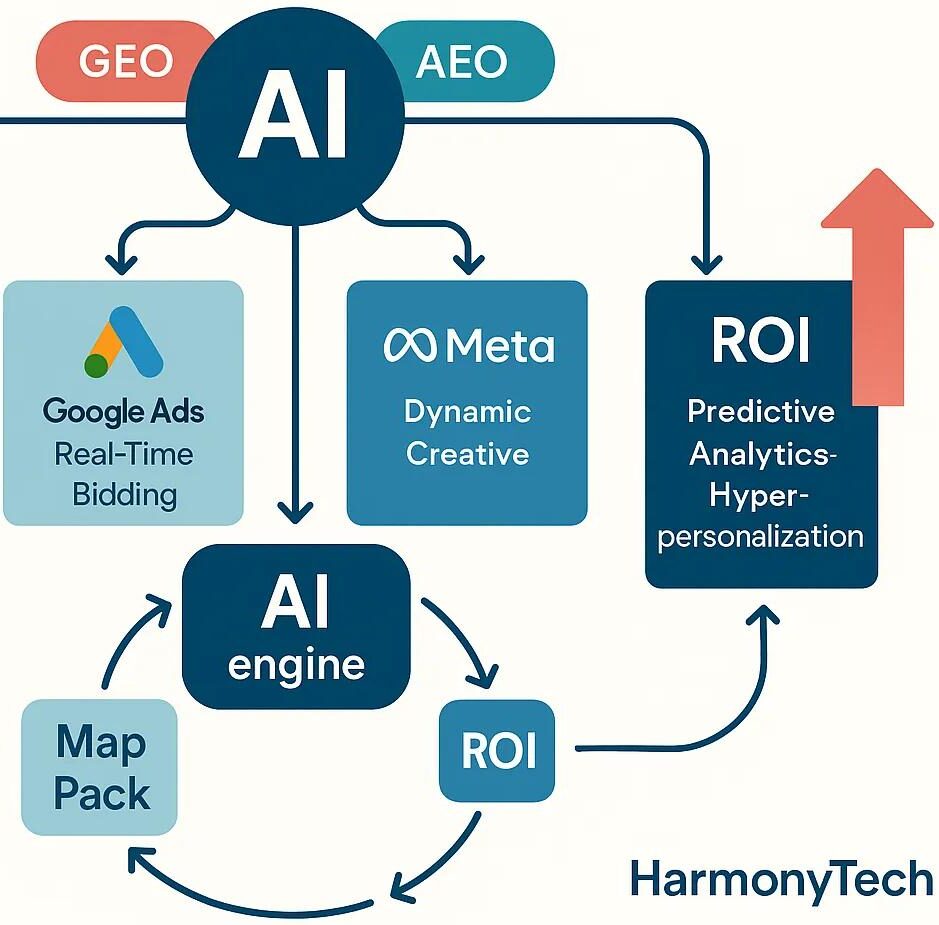
Harmony Technologies uses AI-driven workflows to highlight local opportunities through predictive analytics, create localized content variants, and coordinate optimization across paid and organic channels for South Florida clients. Their process pairs predictive marketing to identify high-impact keywords with generative tools to scale localized content, while GEO/AEO practices aim to improve AI-driven search visibility. Harmony emphasizes human review of AI outputs and integrates results into dashboards and paid-media adjustments to improve ROI for small and mid-sized businesses in Miami, Fort Lauderdale, and Margate. When evaluating providers, ask for concrete case examples of predictive prioritization and the human validation steps used.
That practical perspective leads into the interview questions you should use to vet potential partners.
What Questions Should You Ask When Hiring an SEO Agency Near You?
Interview firms with direct questions that reveal local experience, AI usage, reporting practices, and ethical standards so you can compare answers objectively. Good questions probe city-specific GBP strategies, multilingual workflows, AI model use and oversight, reporting cadence, and SLA commitments. Below is a curated list of questions with the answers you should expect and warning signs to watch for.
Intro: Use these questions in discovery calls; each item highlights the types of answers that inspire confidence and those that raise concern.
- What local SEO strategies have you used for Miami or Fort Lauderdale clients? — Expect city-specific case examples, not one-size-fits-all templates.
- How do you handle multilingual content and regional dialects? — Look for processes that include native review, local keyword research, and culturally accurate copy.
- Which AI tools do you use and how do humans validate outputs? — Good answers name the tasks AI handles and the QC steps humans perform; be wary of claims of unsupervised automation.
- Can you show reporting samples and grant temporary analytics access? — Favor teams that offer raw-data transparency and clear KPIs.
- How do you measure leads and attribute conversions to SEO? — Strong answers mention call tracking, form attribution, and CRM integration.
- What timelines are typical for measurable results in our industry? — Expect realistic ranges tied to baseline metrics; avoid agencies that promise guaranteed #1 placements.
Summary: Choose agencies that bring concrete local examples, offer reporting access, and clearly describe human oversight of AI. Avoid vague or evasive responses.
Which Questions Reveal an Agency’s Local SEO and AI Expertise?
Ask about GBP optimization for specific neighborhoods, examples of seasonal campaign adjustments, and a walkthrough of AI editorial review workflows — these requests reveal depth. Request sample neighborhood landing pages for Miami or proof of performance tied to seasonal tourism peaks; those examples test whether the agency customizes strategies. Also ask for a simple demonstration of their AI editorial review process to confirm human oversight. Agencies that share specific examples and step-by-step validation show they can manage complex local campaigns and evolving AI-driven search formats.
Knowing the right questions helps you spot red flags and avoid unethical providers. The next section lists those warning signs.
How to Identify Red Flags and Avoid Unethical SEO Agencies?
Watch for guaranteed rankings, opaque link-building claims, refusal to share reporting, and unexplained traffic surges from low-quality sources. If an agency insists its methods are “proprietary” but won’t provide references or evidence, press for third-party verification — persistent secrecy is a reason to walk away. Require contracts that specify deliverables, reporting cadence, and scope to prevent hidden fees and scope creep. Spotting these signs early helps you choose partners focused on long-term, sustainable growth instead of risky short-term gains.
How to Understand SEO Pricing Models and Measure ROI for South Florida Businesses?
Understanding common pricing models helps align expectations and sets you up to measure ROI. Typical models include monthly retainers for ongoing optimization, project-based fees for migrations or audits, and performance-based agreements tied to KPIs. Each model has trade-offs: retainers ensure steady attention, projects deliver defined outcomes, and performance arrangements shift risk but require tight attribution rules. The table below maps service types to pricing structures and expected KPI focus to help you decide.
Intro: This table compares service types, typical pricing formats, and KPI/ROI expectations so you can match vendor proposals to business needs.
Summary: Pick the model that matches your preference for predictable spend versus risk-sharing, and insist KPIs and attribution are written into the contract.
What Are Common SEO Pricing Structures in Florida?
Florida follows national pricing patterns—monthly retainers, fixed-price projects, and performance agreements—each requiring clearly stated deliverables and timelines. When comparing proposals, ask for a detailed scope, milestone schedule, and reporting cadence so you can compare offers fairly. Avoid proposals that don’t specify how reporting attributes leads or that lack escalation paths for missed milestones. After you agree on pricing, align on KPIs and the tools you’ll use to measure them.
How to Track and Evaluate SEO ROI Effectively?
Measure ROI by combining GA4 and Search Console with call-tracking, CRM attribution, and local rank tracking so you capture both online visibility and offline conversions. Assign a conservative lead value by channel, map incremental organic leads to revenue using reasonable attribution windows, and use a dashboard that pulls GA4, GSC, and call-tracking metrics for monthly review. Add periodic qualitative checks — for example, short customer-origin surveys — to validate attribution. Consistent measurement lets you evaluate an agency fairly and refine strategy around business outcomes.
Track these KPIs as a baseline:
- Organic sessions and users, broken down by landing page.
- Local pack impressions and Google Business Profile actions.
- Phone calls and form submissions attributed to organic search.
- Lead-to-customer conversion rates and revenue per lead.
Summary: A mix of analytics, call-tracking, CRM linkage, and conservative attribution produces the most reliable ROI picture for local businesses.
Why Choose Harmony Technologies as Your AI-Powered SEO Partner in South Florida?
Harmony Technologies presents itself as an AI-focused digital marketing partner for South Florida businesses, with services spanning AI-enhanced SEO, paid media, social, local search optimization, and GEO/AEO practices. Their stated strengths are predictive analytics, localized market knowledge for Miami/Fort Lauderdale/Margate, and integrated channel coordination. If you want an agency that blends predictive tools with local expertise, include Harmony on your shortlist — and when you do, ask for the case studies and reporting formats we recommended earlier.
Intro: The table below summarizes Harmony’s AI capabilities against specific SEO tasks so you can ask focused questions during a discovery call.
Summary: Use this table to probe Harmony’s claims — request predictive opportunity lists, examples of generative content that were human-reviewed, and cross-channel case studies.
What Differentiates Harmony Technologies’ AI-Driven SEO Services?
Harmony emphasizes real-time optimization powered by AI, predictive marketing to anticipate demand, and GEO/AEO practices that align with emerging AI search behaviors. They pair AI outputs with human oversight to produce localized content and synchronize paid and organic campaigns for South Florida clients. When you speak with them, ask for sample dashboards, predictive opportunity lists, and a description of their human review process so you can validate their approach against your goals.
How Have South Florida Businesses Benefited from Harmony’s SEO Solutions?
Harmony reports helping small and mid-sized South Florida businesses improve visibility and lead generation through coordinated AI and local optimization workflows in markets like Miami, Fort Lauderdale, and Margate. To judge real impact, request case studies that outline the client’s challenge, the approach taken, and measurable outcomes — and ask to see the reporting that verifies those results. Review baselines, improvement timelines, and the human-AI validation steps used; if the examples align with your needs, a discovery conversation will determine fit and next steps.
Final note and call to action: For a concise review of your local SEO needs and an assessment of AI-driven opportunities tailored to your South Florida market, contact Harmony Technologies to request case studies, reporting samples, and a discovery audit to evaluate fit and potential ROI.
Frequently Asked Questions
1. What should I look for in an SEO agency’s portfolio?
Look for case studies that show measurable results relevant to your industry: baseline metrics, the specific strategies used, and the timeframe for results. A range of projects demonstrates adaptability; client testimonials and references provide social proof that the agency delivers on its claims.
2. How can I assess the effectiveness of an SEO agency’s strategies?
Ask for reporting access and sample dashboards. Effective agencies track KPIs aligned to your goals — organic traffic, leads, and conversions — and explain what’s working and why. Ask about A/B testing practices and how they iterate based on performance data.
3. What role does content play in local SEO success?
Content builds relevance and trust in your market. Localized pages, blog posts, and FAQs that address city- or neighborhood-level intent help search engines and customers understand your offerings. Good content also improves engagement metrics that support SEO performance.
4. How important are online reviews for local SEO?
Very important. Reviews influence both consumer trust and local rankings. Positive feedback improves credibility and visibility in the Local Pack. Proactive review collection and professional responses help convert searchers into customers.
5. What are the common pitfalls to avoid when selecting an SEO agency?
Avoid agencies that promise guaranteed rankings, hide their methods, or refuse to share reporting. Steer clear of opaque link-building schemes and contracts that lack clear deliverables. Choose partners who prioritize ethical practices and transparent communication.
6. How can I ensure that an SEO agency stays updated with industry changes?
Ask about their training, certifications, and participation in industry events. Reputable agencies have formal processes to adapt strategies after algorithm updates and emerging trends, and they communicate those changes and their impact to clients regularly.
7. What is the expected timeline for seeing results from SEO efforts?
Timelines vary by industry, competition, and the website’s starting point. Expect initial signs of progress in three to six months, with more significant gains often taking longer. SEO is a long-term investment that requires steady work and realistic expectations.
Conclusion
Choosing the right SEO agency in South Florida can significantly improve your visibility and lead generation when you prioritize local expertise, transparent processes, and responsible use of AI. Understand the market dynamics, use the checklists and questions here, and require evidence and reporting before you commit. If you’d like help assessing your local SEO needs or reviewing AI opportunities for your market, start with a discovery call — informed decisions make better partnerships.