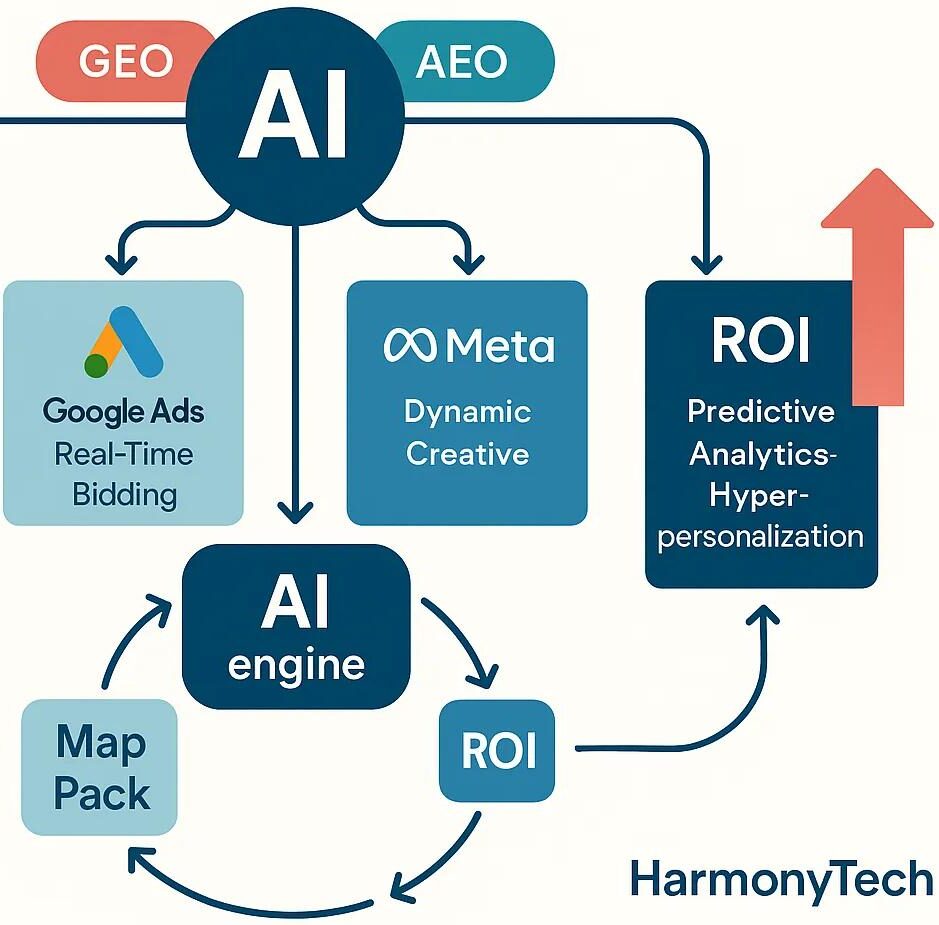
Boost Ad Spend Using AI — Practical guidance for SMBs

Small and medium-sized businesses (SMBs) must make every advertising dollar count. This guide walks through AI-driven programmatic and machine learning approaches that improve campaign outcomes, and gives hands-on steps to sharpen targeting, speed creative testing, and lift ROI — while keeping data clean and analytics actionable.
How Does AI Improve Advertising Spend Efficiency?
AI turns raw data into automated, measurable actions: smarter bids, audience adjustments, faster creative experiments, and tighter targeting. That reduces wasted impressions, raises conversion rates, and reallocates budget toward stronger performance signals through predictive models and real-time optimization.
Understanding AI Budget Allocation and Its Impact on ROI
Track AI performance with clear KPIs: ROI, conversion rate, and CPA. For e-commerce, add AOV and ROAS; for lead generation, measure lead quality and conversion-to-customer. Use these metrics for routine, evidence-based adjustments and to confirm AI decisions align with business goals — including attribution modeling and customer lifetime value analysis.
What Are the Best AI Budget Allocation Techniques?

Effective allocation depends on reliable tracking, clear objectives, and scheduled reviews. Verify conversion tracking, build first-party datasets, and run monthly or campaign-driven reviews. Prioritise spend by KPI impact, run structured tests, and move quickly on strong AI signals while folding in cross-channel attribution and audience segmentation.
Programmatic Ad Buying for Real-Time Budget Optimization
Programmatic buying works when goals are documented and data feeds are dependable. Keep conversions accurate and first-party integrations intact, test against KPIs frequently, and shift spend in real time toward higher-performing placements using dynamic creative optimization and contextual targeting.
How Does Machine Learning Enhance Automated Ad Campaign Management?

Machine learning automates routine management by analysing behaviour, segmenting audiences, and running multivariate tests. It accelerates creative iteration and hones copy and visuals for relevance. Continuous monitoring and disciplined data hygiene supply the models they need to improve outcomes and lift ROI, using NLP and image recognition for richer personalization.
Industry research shows machine learning enables scalable automation and personalized delivery when supported by quality data and governance.
Machine Learning for Ad Campaign Optimization & Personalization
Machine learning has reshaped advertising and campaign personalization, automating many aspects of campaign management.
“Optimizing Ad Campaigns with Machine Learning: Data-Driven Approaches in Modern Media”, 2024
Predictive Analytics Forecasting Ad Spend Efficiency
Predictive analytics relies on high-quality data, concrete KPIs, and continual validation. Cleaner data supports finer segmentation, lowers CPA, and improves ROI. Regular audits and integrated sources keep forecasts reliable for allocation decisions, including churn prediction and propensity modeling.
As ad volumes grow, scalable ML infrastructure — cloud compute and edge AI — is essential to preserve predictive accuracy and support intelligent allocation.
Machine Learning Infrastructure Optimization in Advertising Systems
The rapid growth of advertising data has strained traditional platforms. Optimizing ML infrastructure — from hardware upgrades to distributed processing and improved model training and deployment — helps systems handle large datasets and deliver more precise insights. Practical benefits include personalized targeting, better measurement of ad effectiveness, proactive fraud detection, and smarter resource allocation.
Application and Practice of Machine Learning Infrastructure Optimization in Advertising Systems, Y Jiang, 2025
Performance-Based Ad Spending Models Using AI Algorithms
Performance-based models use AI to nudge budgets toward top-performing campaigns with real-time metrics. Models analyse history, forecast outcomes, and reallocate spend to maximise ROI — allowing agile responses to market signals and, in some implementations, reinforcement learning to refine decisions over time.
Which Digital Marketing Budget Tools Maximize Ad Spend Efficiency?
Pick tools that automate workflows and surface near-real-time signals. Modern AI platforms combine campaign automation, structured testing, and reporting — and typically integrate with CRM and marketing automation systems so teams can act on unified insights.
| Tool | Feature | Application |
|---|---|---|
| SearchAtlas OTTO | On-page SEO automation powered by AI | Speeds SEO work for better visibility and semantic search relevance |
| LLM Visibility | Optimizes for AI-driven search | Improves content discoverability and voice-search readiness |
| AdEspresso | A/B and multivariate ad testing | Refines ad creative and placement using data-driven insights |
When matched to business needs, these platforms can significantly improve ad performance and support data-driven budget and audience decisions.
Comparing AI-Powered Software Applications for Ad Spend Optimization
Compare features, ease of use, and measurable impact. Some solutions automate placements end-to-end; others prioritise analytics and reporting. Choose tools whose capabilities align with your goals, integration needs, and growth plans.
Features of Cost-Effective Advertising Models for Small to Medium Businesses
Cost-conscious SMBs adopt practical practices:
- Embrace Experimentation: Run small, structured tests to find what works before scaling.
- Monitor and Analyze: Use dashboards and alerts to spot trends and act quickly.
- Stay Informed: Track platform updates and AI advances like generative models that affect creative and targeting.
- Adapt Quickly: Reallocate budget based on evidence, not hunches.
- Strategic Partnerships: Lean on agencies or consultants for expertise and execution at scale.
- Data Hygiene and Integration: Keep tracking accurate and data unified across systems.
- Clear Objectives and KPIs: Set measurable goals that guide optimization choices.
- Continuous Learning: Build processes to learn from wins and losses and retrain models as needed.
These steps help SMBs deploy AI responsibly, control costs, and improve measurable outcomes.
What Case Studies Demonstrate ROI Improvements from AI Strategies?
This piece does not include specific case studies, so we cannot cite concrete ROI examples here. For tailored examples relevant to your market, contact Harmony Technologies for case study summaries and references.
2023-2024 Industry Data on AI Adoption and Cost Savings
Industry reports from 2023–2024 show rising AI adoption and measurable cost efficiencies. Organisations that integrate AI thoughtfully often report improved efficiency and higher ROI, underscoring AI’s role in ad-spend optimization and broader digital transformation.
Success Stories of AI-Driven Advertising Efficiency in South Florida
Local South Florida SMBs using AI-enabled Google Ads have automated routine tasks, tightened targeting, and improved creative relevance. With human oversight and strong data practices, campaigns better reflect local market dynamics. Harmony Technologies helps teams implement hyperlocal targeting, dynamic creatives, and data governance.
Deep learning models can provide tailored strategies and automated support to improve Google Ads performance when combined with local expertise.
Deep Learning for Google Ads Campaign Optimization
We can provide organizations with tailored strategies and automated support to optimize Google Ads campaigns and help maximise their impact.
A deep learning-based optimization model for advertisement campaign, N Ramadevi, 2024
How to Implement and Monitor AI Strategies for Advertising Spend?
Follow a structured rollout: verify data quality, define measurable objectives, and set a regular review cadence so AI-driven changes remain aligned with business outcomes.
Data Hygiene and Integration: Confirm conversion tracking, collect first-party data, and unify sources to build a single customer view. Schedule audits and apply data governance to preserve model reliability.
Set Clear Objectives and KPIs: Define primary goals (leads, sales, awareness) and matching KPIs (Target CPA, Target ROAS). Allow a learning window for AI and use incremental lift tests to validate impact.
Regular Monitoring and Reviews: Run monthly reviews — or more often during promotions — to check KPIs, investigate anomalies, and adjust campaigns based on AI insights.
Embrace Continuous Learning and Adaptation: Pilot new features, measure outcomes, and retrain models when data supports changes. Use feedback loops to improve both tactics and model performance.
Consider Strategic Partnerships: Work with experienced agencies or vendors to ensure responsible, effective AI use and to stay compliant with privacy rules like GDPR and CCPA.
Concentrating on these areas helps SMBs implement AI-driven advertising with greater reliability and measurable impact.
Using Structured Data and Semantic SEO to Enhance Campaign Performance
Structured data and semantic SEO boost local search accuracy and discoverability. Consistent business data improves audience matching, creates more relevant creatives, and lowers acquisition costs — while supporting voice search and mobile experiences.
Key benefits include:
- Improved audience matching thanks to accurate business and user data.
- Higher click-through rates from better-aligned ad copy and creatives.
- Better lead quality when offers map precisely to user intent.
- More effective micro-targeting in diverse markets like South Florida.
Keep a single source of truth, perform regular audits, and track KPIs like conversion rate to sustain effectiveness and improve local SEO and campaign performance.
Key Performance Indicators and Tools for Tracking AI Ad Spend Efficiency
To measure efficiency, monitor these KPIs:
- Return on Investment (ROI): Overall profitability of ad spend.
- Conversion Rate: Percentage of visitors who complete the desired action.
- Cost per Acquisition (CPA): Cost to acquire a customer.
- Average Order Value (AOV): Revenue per e-commerce transaction.
- Return On Ad Spend (ROAS): Revenue generated per dollar spent.
- Lead Quality: Relevance and conversion potential for lead-gen campaigns.
- Click-Through Rate (CTR): How often impressions lead to clicks.
Regular platform reports (for example, Google Ads) and connected dashboards enable timely, data-driven adjustments that keep campaigns aligned with business objectives.
Frequently Asked Questions
What types of AI tools are available for optimizing ad spend?
Tools span programmatic buying platforms, A/B and multivariate testing suites, predictive analytics engines, and creative/reporting automation. Choose based on whether you need automation, deeper analytics, or creative optimisation — and look for features like natural language generation and sentiment analysis where relevant.
How can SMBs adapt their advertising strategies based on AI insights?
Turn insights into action by setting clear objectives and KPIs, running controlled experiments, and reallocating budget to higher-performing campaigns using real-time signals and dynamic bidding.
What is the importance of first-party data in AI-driven advertising?
First-party data provides accurate behavioural signals for segmentation and personalization. High-quality first-party data reduces acquisition costs and improves model outcomes, especially when combined with privacy-compliant enrichment.
How does continuous learning impact AI advertising strategies?
Continuous learning keeps campaigns effective as consumer behaviour and platform features change. Teams that prioritise rapid testing and model updates maintain a competitive edge.
What are the potential risks of relying on AI for advertising?
Risks include over-reliance on automation and poor data quality producing misleading signals. Mitigate these by pairing AI with human oversight, clear governance, and transparency around algorithmic choices.
How can SMBs ensure their AI strategies remain cost-effective?
Define measurable objectives, enforce data hygiene, run structured experiments, and use strategic partnerships to gain expertise without large internal overhead. Watch for diminishing returns and budget fatigue and pivot when evidence suggests it.
Key Takeaways: AI-Powered Ad Spend Optimization
When applied thoughtfully, AI helps SMBs sharpen targeting, speed creative testing, and improve campaign effectiveness. With clear KPIs, disciplined data practices, and human oversight, teams can increase ROI and reduce wasted spend. Explore Harmony Technologies’ AI solutions to strengthen your advertising strategy and stay competitive as technologies evolve.