
Search Marketing in Miami-Fort Lauderdale
Revolutionizing Local Digital Discovery

The Miami-Fort Lauderdale metropolitan area has emerged as a pioneering region for artificial intelligence-assisted search marketing, where cutting-edge technology meets the diverse, dynamic business landscape of South Florida.
As AI tools have matured throughout 2023 and 2024, businesses from Aventura to Coconut Creek to Boca Raton to Homestead have discovered that intelligent search optimization can dramatically improve their visibility, customer acquisition costs, and conversion rates. This transformation represents more than just a technological upgrade—it’s a fundamental shift in how businesses understand and respond to consumer intent in real-time.
The integration of artificial intelligence into search marketing has been particularly transformative in the Miami-Fort Lauderdale area due to the region’s unique characteristics: a multilingual population, seasonal business fluctuations, and intense competition across key industries like tourism, real estate, and professional services. AI-powered tools can now analyze search patterns across multiple languages, predict seasonal trends with unprecedented accuracy, and identify micro-moments when potential customers are most likely to convert. This technological sophistication has leveled the playing field, allowing smaller businesses to compete with larger corporations by leveraging data-driven insights that were previously available only to companies with substantial marketing budgets.
The AI Revolution in Local Search Behavior
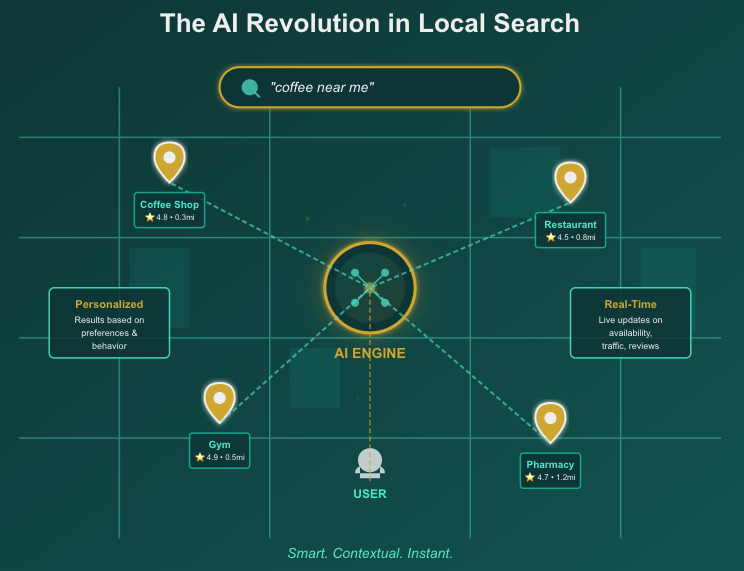
Search behavior in the Miami-Fort Lauderdale area has evolved dramatically since the widespread adoption of AI-powered search algorithms and voice assistants. The region’s residents and visitors now conduct searches that are more conversational, context-aware, and expectant of immediate, personalized results. Local businesses that have embraced AI-assisted search marketing are discovering that traditional keyword-based strategies are being superseded by sophisticated natural language processing that understands search intent, user context, and behavioral patterns.
The impact of this shift became particularly evident during the 2024 hurricane season when Hurricane Milton threatened South Florida. Businesses using AI-powered search marketing tools were able to instantly pivot their campaigns, automatically adjusting their messaging to focus on storm preparation services, emergency contacts, and safety information. AI algorithms detected the surge in weather-related searches and automatically reallocated ad spend to the most relevant keywords, while also identifying new search opportunities around terms like “hurricane shutters Miami” and “emergency generator Fort Lauderdale.”
Voice search has been particularly transformative for businesses serving the large Spanish-speaking population in the region. AI-powered natural language processing has become sophisticated enough to understand regional dialects, cultural context, and the unique way multilingual speakers construct queries. A restaurant in Hialeah might now be discovered through voice searches like “Oye Google, dónde puedo comer ropa vieja cerca de mí,” with AI systems intelligent enough to understand the cultural context and intent behind such queries.

Predictive Search Analytics & Multilingual A.I. with Cultural Context Understanding
One of the most powerful applications of AI in search marketing has been predictive analytics that help Miami-Fort Lauderdale businesses anticipate and prepare for search trends before they occur. Hotels in South Beach can now predict spring break booking patterns months in advance, not just based on historical data, but by analyzing social media sentiment, flight booking trends, and economic indicators that AI systems correlate with travel behavior.
This predictive capability has proven invaluable for businesses dealing with South Florida’s dramatic seasonal fluctuations. Air conditioning companies in Broward County use AI to predict when search volume for “AC repair” will spike based on weather forecasts, humidity levels, and historical repair patterns. This allows them to preemptively increase their search marketing budgets and adjust their messaging to capture demand before competitors recognize the opportunity.
The Miami-Fort Lauderdale area’s incredible linguistic diversity has driven some of the most sophisticated applications of AI in search marketing. Modern AI systems don’t just translate keywords—they understand cultural context, idiomatic expressions, and the subtle ways that different communities express similar needs. This has opened up entirely new opportunities for businesses that can effectively leverage AI to communicate with diverse audiences in culturally appropriate ways.
A breakthrough example occurred during the 2023 FIFA Women’s World Cup, when local sports bars and restaurants discovered that AI-powered search tools could identify and target fans of specific national teams living in South Florida. Rather than simply translating “watch soccer” into Spanish, AI systems understood that Colombian fans might search for “ver la Selección,” while Brazilian fans would look for “assistir futebol feminino,” and Argentine fans might use “mirar el Mundial femenino.” Businesses that leveraged this cultural intelligence saw dramatic increases in foot traffic during key matches.
The sophistication extends to understanding generational differences within cultural communities. AI systems can now distinguish between how recent immigrants and second-generation Americans from the same cultural background conduct searches, adjusting messaging and keyword targeting accordingly. A quinceañera planning service in Miami might target parents with Spanish-language searches while simultaneously reaching teenagers with English-language social media advertising, all orchestrated by AI systems that understand family decision-making dynamics within Hispanic communities.